Port Arthur council hears $20–25 million P3 proposal to modernize landfill; council seeks more financial and legal detail
Loading...
Summary
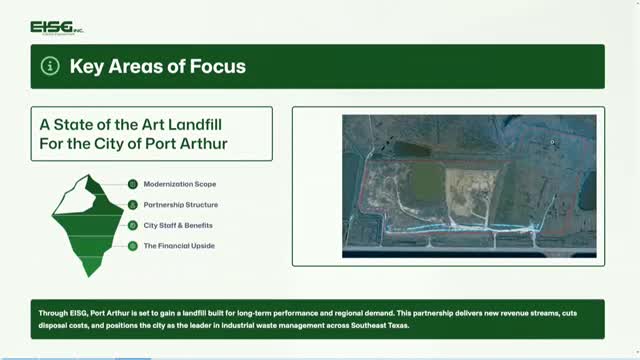
EISG, a private company, told the Port Arthur City Council at a Nov. 12 workshop it would invest $20–25 million to modernize the city landfill, expand acceptance of non‑hazardous industrial waste and pay the city a graduated royalty starting at 5% of gross revenues.
EISG, a private firm, presented a proposal at a Nov. 12 Port Arthur City Council workshop to modernize the city’s landfill and expand it to accept non‑hazardous industrial waste, promising to fund $20–25 million of capital improvements and to pay the city a royalty on gross revenues starting at 5% and rising to 10 percent over time.
At the start of the presentation, Peter, one of EISG’s presenters, said the company’s preferred model is a public‑private partnership that would leave ownership and authority with the city while requiring "0 capital" from Port Arthur and delivering revenue sharing to the city. Derek McGriff, who led the financial overview, said EISG projects first‑year full‑operation revenues of about $41 million and asserted the landfill currently captures only about 10% of the regional market, estimating roughly $60 million annually in potential market capture that Port Arthur is now losing to other sites.
The presenters described three development phases: initial roadway and permitting work and MSW (municipal solid waste) optimization in months 1–12; construction of industrial cells and solidification infrastructure in a second phase; and marketing to industrial waste generators in a third phase. Site upgrades discussed included box‑washing bays, solidification pits, roll‑offs, an equipment maintenance shop and a citizen convenience center, all intended to make the site audit‑ready for industrial clients. Harold Barber, EISG's engineer, said the work would proceed under a limited‑scope permit amendment to the landfill’s existing TCEQ permit and must meet applicable TCEQ and EPA requirements.
Council members repeatedly pressed for clarity on financial controls and contract terms. Councilmember Lewis said the city’s finance director should continue to monitor gross receipts and recommended that monitoring be paid for by the city so the city retains control. "If you pay for it, you control it," Lewis said. EISG agreed to routine financial reporting to the council and said the company would reimburse the city quarterly for payroll if city staff remain on the city payroll but are paid by EISG as part of the operational arrangement.
Councilmember Doucette and others raised long‑term concerns: how landfill cell life would be handled decades from now, whether the city has adequate adjacent land for expansion, and what remediation or post‑closure care obligations would look like. EISG said engineering can increase the landfill’s height within permit limits and that financial assurance—a surety bond or other mechanism posted with TCEQ—would be required to ensure closure and 30 years of post‑closure care as set by state rules. "That financial assurance is posted," an EISG engineer said, adding it would remain a permit requirement.
Several council members sought detail on whether the city’s RFQ/RFP covered the industrial expansion EISG described. EISG asserted the RFQ did include MSW expansion and the industrial components, and asked the council to re‑read the document. The city attorney said she preferred to discuss procurement and contract questions in executive session and staff agreed to gather and present requested documents at a later date.
Councilmembers also asked for specific financial assurances about the city’s expected annual receipts. EISG representatives described a graduated royalty that begins at 5% of gross revenues and rises to 10% once EISG has recouped capital, and presented conservative growth scenarios they say support that outcome; council members said they will need independent verification of tonnage, rates and gross receipts. EISG stated it would assume operational losses if the project runs in the red as part of the private side of a public‑private partnership.
The council directed city staff to compile follow‑up materials—including finance figures, property status, permit details, and examples of similar projects and references—and to report back. The city manager noted the council recently invested in new trucks and additional staff for solid waste operations and asked staff to factor those local investments into the analysis. The meeting concluded with a motion to adjourn, which passed, and the council adjourned at 11:42 a.m.
What happens next: staff will gather requested data for council review and the city attorney indicated procurement and contractual issues will be considered in executive session before any formal contract negotiations or decisions.