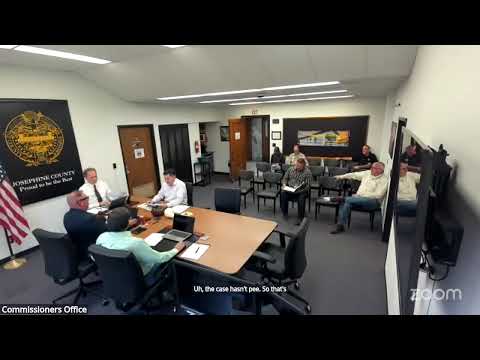
Josephine County approves several transit, airport and tech contract renewals and purchases, citing pass-through federal funding
Loading...
Summary
Commissioners approved a package of transit and airport contract renewals and purchases on Nov. 12, including a Spare software renewal, an Octobus mapping service renewal, e‑paper displays for the transit hub, and additional solar shelter lights, with votes recorded 3–0 on multiple items.
At the Nov. 12 administrative workshop the Josephine County Board of Commissioners approved a package of transit, airport and related technology items that county staff said are funded through state or federal pass-through grants rather than the county general fund.
Key approvals and votes recorded by roll call included:
- Authorization to renew the Spare demand-response/on‑demand software (staff said the renewal equates to about $48,000 a year; portion paid through federal/state transit funding). The board called the roll and approved the motion 3–0.
- Amendment No. 2 to the ODOT–MPO intergovernmental public-transportation agreement, updating contact names and reaffirming county participation; approved by roll call (3–0).
- Adoption of the updated County Transit Coordinated Plan required by state and federal rules; approved by roll call (3–0).
- Renewal of Octobus interactive mapping service (approx. $5,000/year) that provides route and real-time vehicle information; approved by roll call (3–0).
- Purchase of six e-paper informational displays for the transit hub (battery-powered tablets that show real-time arrivals), cost quoted at roughly $44,000 and to be paid from transit pass-through funds; approved 3–0.
- Purchase of an additional 10 solar‑activated bus-stop lights (bringing total deployed units to 20), described as grant-funded with an estimated local match of about $2,000; approved 3–0.
Commissioners and staff emphasized that these items are predominantly paid for from federal or state transit programs, not county general funds, and discussed operational details such as vendor responsibilities, maintenance, access to telemetry/data from fuel pods at the airport, and potential staff hours needed for implementation.
What happens next: Staff will execute the contracts consistent with procurement rules and the county's policy on contract execution; previously discussed data/access issues (for airport fuel pod telemetry) will be pursued by airport staff.