Get Full Government Meeting Transcripts, Videos, & Alerts Forever!
Get email alerts on the Zoning Ordinance Update topic
No spam. Unsubscribe anytime.
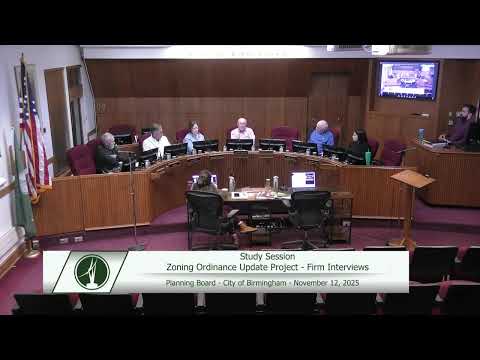
Birmingham Planning Board hears bids from four firms to rewrite zoning code; recommendation deferred to Dec. 10
Summary
The Birmingham Planning Board on Nov. 12 heard pitches from four consultant teams to lead a zoning ordinance rewrite that implements the city's recently adopted 2040 plan. Presenters emphasized online tools, visual drafting and community engagement; the board deferred making a recommendation until Dec. 10.
The Birmingham Planning Board on Nov. 12 heard hour-long interviews from four consultant teams competing to lead a rewrite of the city's zoning ordinance after adoption of the 2040 plan. Presenters emphasized easier-to-use code, web-based tools and robust community engagement; the board postponed a recommendation and said it will decide at its Dec. 10 meeting.
Why it matters: The zoning update is the technical step that implements the 2040 comprehensive plan. Board members said they want a code that's clearer for residents, predictable for developers and easier for staff to administer; they asked specifically about online tools, formats for deliverables and how community feedback will shape draft text.
What the firms proposed
Kennedy Keast Collaborative / Encode Plus: Brent Keast, CEO, framed his team's approach around place-specific drafting plus a digital platform. "We will create a zoning ordinance update that is uniquely Birmingham," Keast said, highlighting an Encode Plus product that links text, maps and development calculators so users can "type in an address" and see applicable regulations. He described a roughly 6'18 month engagement and said a public-hearing draft could emerge around month 16.
Hauseal Levine: John Hauseal emphasized visualization and national experience, and Carrie Papelbaum described a detailed scope and steering-committee model. Hauseal pointed to prior projects where 3D modeling and parcel-level GIS helped build support for changes; the team stressed early public education ("zoning 101") so nontechnical residents can engage effectively.
Giffels Webster with Public Sector Consultants: Jill Bame and colleagues pitched a locally based team with a diagnostic-first approach and a —clear zoning— deliverable organized into seven articles and two-page district "spreads" for readability. The team said it can deliver final text in multiple codification platforms (Encode, Municode or Word/PDF) and emphasized facilitation methods to surface common themes from sometimes emotional public meetings.
McKenna: John Jackson and McKenna staff highlighted local experience in Birmingham (including work that informed the 2040 plan) and proposed a three-phase process — discovery/diagnostic, design/drafting and testing/adoption — with a follow-up review 6'12 to 12 months after adoption to correct any unintended problems.
Board questions and concerns
Planning board members pressed teams on several recurring themes: the practical difference between Encode and Encode Plus (recurring hosting/maintenance fees remain but the enhanced platform offers dynamic GIS links and developer calculators); how neighborhood character would be preserved while allowing measured infill and accessory dwelling units; and how consultants would handle conflicting public input. Teams described tools for visualization, focus groups and iterative drafts to build consensus.
Next steps
Chair and staff signaled they do not expect to make a recommendation tonight. Nick (city planning staff/timekeeper) told the board: "We will make a decision if it's not tonight, on a recommendation to the city commission, at our December 10 meeting." Board members asked staff to collect reference checks and to circulate supplemental materials and internal city-department feedback ahead of the Dec. 10 meeting; several members said they would prefer the board forward a single recommended firm to the commission.
No formal procurement action was taken at the Nov. 12 meeting; the city commission will make the final retention decision based on the planning board's recommendation.
Reporting note: Quotes and attributions come from consultant presentations and planning-board discussion recorded in the Nov. 12 meeting transcript.