
Franklin reports strong 2025 building activity; Q3 brings $121 million in permitted construction
Get AI-powered insights, summaries, and transcripts
Subscribe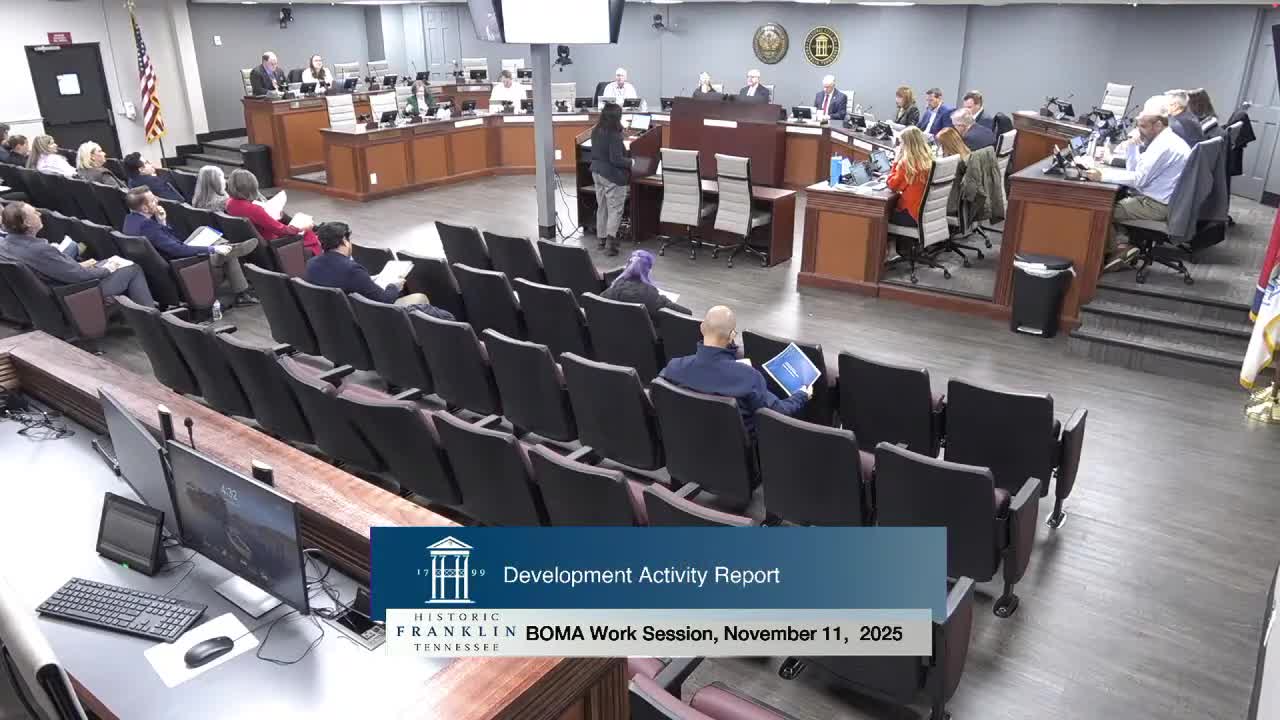
Summary
City staff told the Board of Mayor and Aldermen that Franklin’s third quarter 2025 permitting activity generated roughly $121 million in construction value and notable impact-fee receipts, while year-to-date figures show sustained development and a new customer survey process that yielded high satisfaction ratings from early respondents.
Franklin — City planning staff told the Board of Mayor and Aldermen at its Nov. 11 work session that building-permit activity remained robust through the third quarter of 2025, producing what staff described as a strong pipeline of projects moving from entitlement to vertical construction.
Catherine, development-services manager, said the city issued 246 building permits during July–September and 1,350 trade permits (plumbing, mechanical, electrical) and 112 fire permits in that quarter. "In the third quarter, we collected just under half a million dollars" in permit fees, she said, and staff recorded roughly $621,000 in road impact fees, about $40,000 in water impact fees and about $574,000 in sewer impact fees for the quarter. Q3 residential permit values were about $53 million and nonresidential about $67 million, for roughly $121 million total.
Year-to-date through September, staff reported 823 building permits, 4,075 trade permits and 320 fire permits and said cumulative construction permits totalled about $649.3 million for 2025 so far. "We're on pace to really have a strong year like we did in 2024," Catherine said.
Why it matters: impact fees and permit revenues fund many capital programs and maintenance activities. Staff noted that impact-fee totals vary with the type and location of development: Franklin does not serve the entire city for water, so water impact fees depend heavily on where new development occurs, whereas sewer service covers larger areas and so yields more consistent collections.
Questions and follow-up: Aldermen asked for more detail on the split between residential and commercial impact-fee contributions, and Catherine said staff will provide that breakdown in a future report. Board members also requested additional tracking to compare entitled projects with permits issued and construction starts so the council can better monitor projects that do not progress to completion.
Customer survey: staff described a new, short survey deployed at several touchpoints in the development process; the initial rollout drew 66 responses from an outreach of about 500 recipients and produced very positive ratings, with early responders giving five-star ratings and praising staff responsiveness. Alderman Baggett and others encouraged continued use to accumulate trend data over time.
Next steps: staff will return with more granular impact-fee detail and suggested metrics to monitor the entitlement-to-construction pipeline.