
Clayton County State Court holds marathon arraignment calendar; dozens of pleas, PTI referrals and bench warrants recorded
Get AI-powered insights, summaries, and transcripts
Subscribe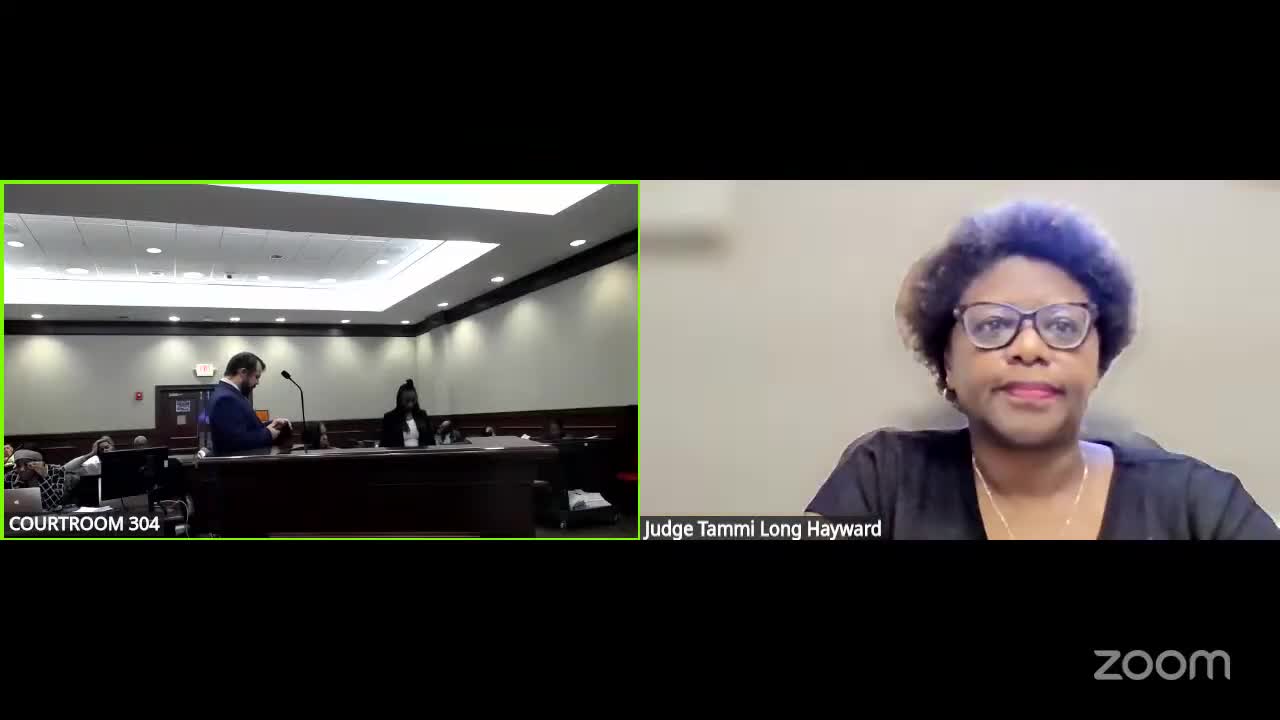
Summary
Judge Tammy Long Hayward presided over a lengthy virtual arraignment on Nov. 13, 2025, accepting multiple pleas (including DUI and family-violence cases), referring several defendants to pretrial intervention, and issuing or confirming bench warrants for absent or disruptive participants.
Judge Tammy Long Hayward convened the Clayton County State Court 10 a.m. arraignment calendar by Zoom on Nov. 13, 2025, and worked through a long list of cases, taking pleas, setting conditions, and directing numerous defendants into breakout conferences with prosecutors and defense counsel.
The court accepted negotiated pleas in a range of cases: Skyler Alexandria Carr pleaded guilty under the First Offender Act to family-violence battery and related counts and was sentenced to a 12-month term with 2 days to serve (credit for time served), the balance probated, a $300 fine (about $444 with surcharges), 40 hours of community service and enrollment in a 24-week family violence intervention program; the court imposed a no-violent-contact directive with the victim, Larry Russell. Jamie Jermaine Morgan pleaded guilty to a DUI-per-se (reported BAC 0.181) and received 12 months (1 day to serve credit), 40 hours community service, a $500 fine (about $800 with surcharges), substance-evaluation and random testing on probation. Other pleas included negotiated dispositions for defendants such as Justin Marquis Green, Judah Olds, Gregory Stevens and Jose Chavez, with probation, fines, or community service ordered as recommended by the state.
The court repeatedly warned defendants about bond conditions and the consequences of violating them — including arrest, bond revocation and possible felony aggravated-stalking charges — and encouraged people to obtain copies of their bond conditions from the Clayton County State Court clerk's office. Judge Hayward also reviewed plea options (not guilty, guilty and nolo contendere), appellate rights and the practical risk of proceeding to trial without counsel.
Operationally, the court used Zoom breakout rooms and asked remote attendees to send their first and last names, phone numbers and email addresses via the chat directed to “Courtroom 304,” so counsel and court staff could follow up. Numerous defendants were placed into breakout rooms for conferences with counsel and probation intake; several co-defendants in an affray-style case were offered pretrial intervention (PTI) and were reset for 30-day PTI status hearings to confirm enrollment.
Not all calendar entries were resolved: the court noted bench warrants and bond forfeitures for absent defendants (for example, Joshua Devion Arnold) and left in place a bench warrant and bond forfeiture for Jermaine (Draper) Gross after he appeared late, used expletives and was judged by the court to be under the influence; the judge ordered future appearances by that defendant to be in person.
Most participants the court addressed were directed to register with probation, complete course work or community service, pay fines through the traffic-court window on the 2nd floor, or report for status hearings. The court repeatedly reminded drivers to consult the Georgia Department of Driver Services for correct driver-improvement certificates and stressed that failure to pay fines could result in an arrest warrant.
The calendar continued with the court directing cases to status settings or intake conferences; many defendants were released from the virtual session after completing intake steps or given deadlines (commonly 60 days) to satisfy payment or program requirements.
The arraignment session illustrates the case-management role of the state court: handling initial pleas, confirming negotiated dispositions, referring eligible defendants to PTI and probation programming, and enforcing attendance and conduct rules for remote appearances. The court left outstanding bench-warrant matters and scheduling adjustments for staff and the jail calendar to resolve.