Get Full Government Meeting Transcripts, Videos, & Alerts Forever!
Get email alerts on the Water Infrastructure topic
No spam. Unsubscribe anytime.
Volusia County says $70 million expansion is doubling reclaimed-water capacity at Southwest Regional plant
Summary
Volusia County Water Resources and Utilities is midway through an expansion of the Southwest Regional Water Reclamation Facility that county staff said will nearly double reclaimed-water capacity to serve parts of DeBary, Orange City and Deltona.
Volusia County Water Resources and Utilities is midway through an expansion of the Southwest Regional Water Reclamation Facility that county staff said will nearly double reclaimed-water capacity to serve parts of DeBary, Orange City and Deltona.
A plant representative said the project costs "just on the other side of $70,000,000" and is financed through partnerships with the Florida Department of Environmental Protection, the St. Johns River Water Management District and county support. "We're very excited to have it underway," the representative said, adding the new ground storage tank has been placed into operation.
Why it matters: County and plant staff said the upgrade is an "alternative water supply" project intended to treat wastewater for irrigation and industrial uses and to reduce nutrient loads to regional springs such as Blue Spring and Gemini Springs. The work is also intended to accommodate development and to allow septic systems to be taken offline and connected to central treatment.
Scope and technical details: A plant presenter said the construction includes eight new structures and expansions to existing ones to increase capacity from 2.7 million gallons per day to 4,500,000 gallons per day (about 4.5 MGD). Staff described the plant as a five-stage biological nutrient removal (BNR) facility: wastewater arrives from lift stations, passes bar screens and an equalization basin, moves through anaerobic/anoxic/aeration "trains" that remove ammonia and nitrates, then proceeds to clarifiers, filters and a chlorine contact chamber for disinfection.
On reuse and safety: Staff noted reclaimed-water pipes and equipment are marked with a purple stripe to distinguish them from potable systems. Plant operators emphasized that treated effluent is disinfected, not sterilized, before it is routed to storage tanks for public reuse if it meets applicable standards. A plant staff member commented, "When I say theoretically you could drink this, some people wouldn't, but some people would," while earlier explanations made clear the plant disinfects but does not sterilize finished effluent.
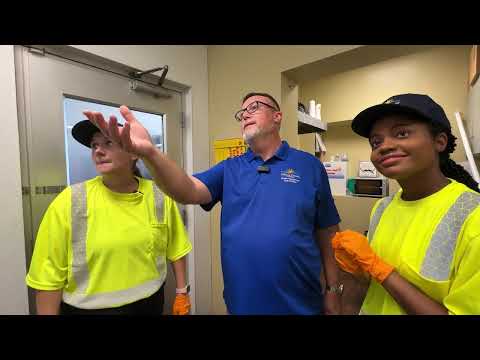
Monitoring and operations: Staff demonstrated sampling and described lab checks and process controls, including how aeration and microorganisms (ciliates, rotifers and others) break down waste. They said the project is about halfway complete and will enable more reclaimed water distribution in the southwest region of Volusia County.
What remains unclear: County staff named state and regional funding partners but did not provide a breakdown of how project costs are apportioned among those partners. Officials also did not provide a firm completion date in the on-site briefing.
Next steps: Staff said work will continue on remaining construction elements; the hosts closed the visit and invited viewers to a subsequent segment with further demonstrations.