Boston committee hears plan for citywide merchandise-licensing pilot tied to Boston 250
Loading...
Summary
City staff told the Boston City Council Committee on Small Business and Professional Licensure on Nov. 13 that a $100,000 pilot tied to the Boston 250 commemoration will test production models, intellectual-property protections and market demand; staff emphasized research with Boston University and compliance with Chapter 30B procurement rules.
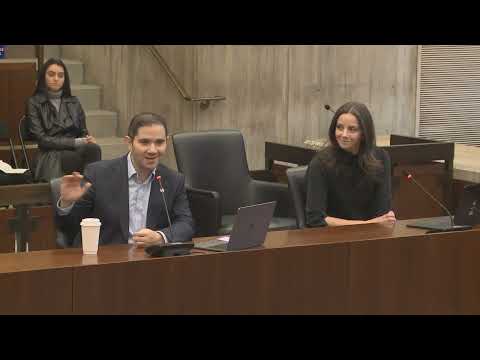
Boston City Councilors on the Committee on Small Business and Professional Licensure on Nov. 13 heard a presentation on a proposed citywide merchandise-licensing pilot tied to the Boston 250 commemoration intended to protect the city’s brand and create opportunities for local designers and small businesses.
Councilor Sharon Durkin, who sponsored the hearing, said the pilot is meant to ensure ‘‘when people take home a piece of Boston . . . it should reflect our values and support our local economy.’’ She told the committee she secured $100,000 in the current budget to fund an initial pilot and emphasized centering local artists and returning revenue to neighborhoods.
City staff from the Department of Innovation & Technology and the partnerships team described a two-track pilot that pairs an on-the-ground Boston 250 merchandising program with a research track led by a partnership with Boston University’s Questrom School. "Right now, the city doesn't own any copyright or trademark protection for our brand," Santiago Garces of DoIT said, and staff outlined a range of options from owning selected marks to leaving much of the marketplace unchallenged.
Staff presented a proposed allocation of the $100,000 pilot budget: $15,000 for program facilitation, $9,950 for the research track, $35,000 for initial design and production, with remaining funds for hard costs and neighborhood events to showcase local partners. "We want to be able to move quickly and adopt an agile startup mentality to be able to get something on the ground so that we could gather real time data," a city presenter identified as Alan said during the slide presentation.
The presentation emphasized testing several production and distribution models, including production-on-demand and competitive partnerships, and noted procurement would be run in compliance with Chapter 30B. Staff said contracting production to an external partner would reduce City exposure to inventory and operational risk while allowing the City to capture a portion of sales.
Councilors pressed staff on intellectual-property and enforcement implications after Councilor Durkin noted that items bearing city department marks are already sold online. "You can already represent our city departments — you just have to go on Amazon," Durkin said; staff responded that owning and enforcing IP would carry legal and staffing costs and that the pilot will explore design solutions and selective protection of critical marks such as the city seal.
Committee members also asked about success measures. Staff said the research partnership with BU will develop KPIs that include brand awareness, purchase intent and click-through rates; however, concrete revenue estimates were not available. "We won't be able to exactly quantify" existing market revenue or what Boston could generate, staff said.
Councilor Ed Flynn asked whether production would use union labor or U.S.-made materials; staff said those are among the stipulations being investigated and that production-on-demand partners that can meet labor and sourcing preferences are part of the evaluation.
At public comment, Miread Pittcock, operator of Beantown brand apparel, urged a vetting process that preserves product quality and ethical production. "When you place a brand . . . on a product, its quality and craftsmanship must mirror the care and the pride the city is known for," she said.
Staff said the pilot will run through Boston 250 events and will be evaluated at the end of that initiative in July 2026, when the team expects to present recommendations to the Council about next steps.
The committee took no vote at the hearing; staff will continue market research, a competitive procurement process, and pilot testing in the coming months, with follow-up expected during the next budget cycle.