
Findlay committee reviews draft no‑loitering ordinance, schedules further review
Get AI-powered insights, summaries, and transcripts
Subscribe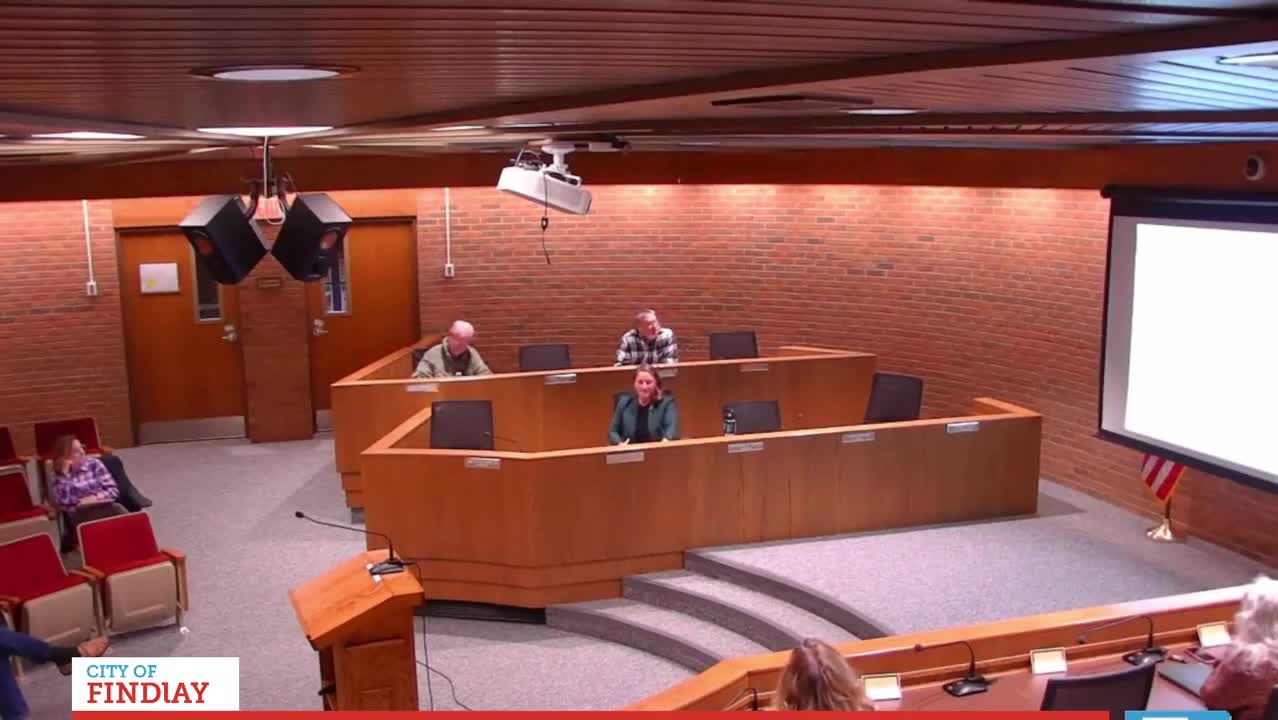
Summary
Findlay City council’s committee of the whole discussed a proposed no‑loitering ordinance aimed at curbing obstructive congregations near businesses; the council asked staff to publish a revised draft for public review and did not take a final vote.
Findlay — The Findlay City committee of the whole on Nov. 12 reviewed a proposed no‑loitering ordinance the mayor’s office and law department say would give officers a tool to address groups obstructing businesses or pedestrian traffic without criminal activity.
The mayor said the proposal grew out of complaints about “a group of individuals that was congregating towards a business that was primarily focused on children,” and that officers could ask people to move but lacked a specific ordinance to cite. The draft aims to “promote public safety and order by prohibiting conduct that obstructs public ways or facilitates criminal activity while preserving the constitutional rights of individuals to move freely, assemble, and engage in lawful activity,” according to the presentation.
Law Director Wagner, who walked council through the draft, said the language is intended to create objective criteria for enforcement. “This language is an attempt to to try to clear up and and show a clear objective and criteria for what the city desires to do, making things more objective versus subjective,” Wagner said. He acknowledged some of the ordinance’s procedural directions for officers — such as identifying themselves, explaining specific conduct observed, giving a reasonable opportunity to comply, and documenting the circumstances — may duplicate existing police policy: “a lot the the law our police department has its own policies and procedures. We’re basically putting those in there for them.”
The draft defines loitering as remaining in a public place without an apparent lawful purpose after a lawful request by an officer to move when such conduct obstructs pedestrian or vehicular traffic or interferes with business on the premises. It also includes a protection that a person may not be ordered to move “solely for standing, walking, talking, or otherwise engaging in lawful behavior in a public place.” Violating the draft ordinance would be a minor misdemeanor, with repeated violations within 12 months potentially charged as a fourth‑degree misdemeanor.
Council members pressed staff on process and on how the ordinance would apply to specific situations. Council Member Frishew asked whether the new language would have changed responses to earlier incidents outside a music business where some people were engaged in illegal activity and others were not; Wagner and the mayor said illegal acts were already prosecutable under existing law but that the loitering provision would address noncriminal conduct that nonetheless obstructs businesses. Frishew also asked whether the draft would address panhandling; Wagner said panhandling is covered by a separate ordinance and that prosecutors would select the code section that best fits the facts.
Several council members urged staff to publish a revised draft in the meeting packet before any third‑reading vote so the public could review changes. Council Member Russell asked that the amended draft be included in the packet; Wagner said staff could submit a draft ordinance as a letter for inclusion but any amended ordinance would still need to be formally accepted at the start of the meeting. Options discussed included amending and postponing consideration to the first December meeting or introducing new legislation allowing three readings so the public had time to respond.
No adoption vote on the loitering ordinance was taken at the Nov. 12 session. The committee adjourned after a motion by Council Member Niemeyer, seconded by Council Member Palmer, and a voice vote in favor.
Next steps: staff indicated they would submit the revised draft for inclusion in the packet ahead of the council’s next meeting, and council members said they expected to decide whether to amend, postpone, or introduce new legislation at that time.