Get AI Briefings, Transcripts & Alerts on Local & National Government Meetings — Forever.
City Schools of Decatur lays out 2026 legislative priorities: safety, mental health, funding and local authority
Loading...
Summary
City Schools of Decatur officials and their new lobbyists outlined four proposed 2026 legislative priorities — school safety, student mental health, school funding (QBE/capital outlay/early learning) and preserving local authority — and flagged concrete steps the district will pursue, including an anonymous tip line and an Early Learning Center.
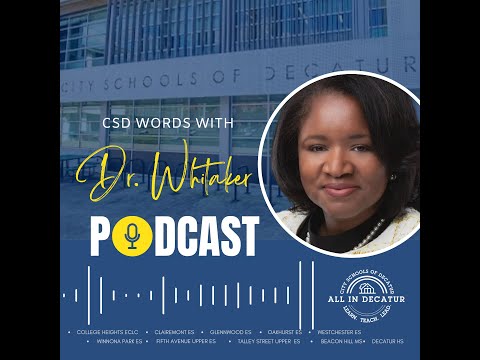
City Schools of Decatur host Doctor Whitaker announced the district—s proposed 2026 legislative priorities on the district podcast, saying the Board of Education will formally adopt the priorities in November and that the district will press its delegation at the Georgia General Assembly on safety, mental health, funding and local control.
Doctor Whitaker, host of the podcast and representative for City Schools of Decatur, said the district—s strategic plan (All In Decatur) frames the four accelerators that will guide advocacy next year and stressed local needs such as student safety at dismissal and early‑learning facilities. "We are the first school system in Georgia to have a student sitting on our board," she said, describing the district—s model of an elected, non‑voting student representative that the district would like to encourage statewide.
Rob Fortson, partner at Gilbert Herald and one of the district—s newly engaged state lobbyists, described the role of lobbyists at the Gold Dome and outlined likely legislative pressures in the 2026 election year. "We're really excited to get to work with Decatur to make sure that your interests are protected," Fortson said, adding that the Georgia General Assembly meets on a 40‑legislative‑day schedule and that budgets and education bills will drive much of the session.
On safety, Fortson pointed to recent legislation intended to improve transfer and student‑record tracing after the Apalachee tragedy and to ongoing school safety grants for monitoring and first‑alert capabilities. Doctor Whitaker recounted local advocacy on a House bill related to school‑zone cameras (speaker referenced the bill as House Bill 225) and said speed‑zone enforcement is vital for Decatur where many students walk to and from school. She also announced that the district will "bring online our anonymous tip line through Sandy Hook Promise" to provide another reporting channel.
Panelists linked mental health closely to safety and said the legislature has begun modest investments in school social workers. Fortson and Danica Thompson, vice president of state relations at Maguire Woods Consulting, urged more wraparound services and additional counselors: the American School Counselor Association recommendation of a 250:1 student‑to‑counselor ratio was cited, and Doctor Whitaker said Decatur locally prioritizes that ratio though state allocations do not always fund it.
Funding and the QBE (Quality Basic Education) formula were central to the conversation. Fortson said the QBE formula has recently been fully funded after several years of partial funding and called for modernization of the formula, which was written in the 1980s. The panel discussed capital outlay rules, recent allowance to include pre‑K counts for capital calculations, and the district—s plan to spotlight its Early Learning Center. Doctor Whitaker said the Early Learning Center is scheduled to break ground in January 2026 with doors opening in 2027.
The episode also addressed literacy and dyslexia efforts: Fortson described the literacy council—s ongoing work and the first year of implementing a mandated literacy screener; he said the council—s reports will guide resource and policy choices. On numeracy, the panelists suggested state interest may grow and that funding initiatives similar to literacy could emerge.
Panelists flagged several items they are watching at the committee level for 2026, including chronic absenteeism and proposals to improve tracking beyond the standard FTE counts, poverty‑weight adjustments and targeted funds for economically disadvantaged students (panelists noted a roughly $12,000,000 targeted allocation last year against a roughly $14,000,000,000 QBE budget). They predicted that broad voucher expansion or Promise Scholarship movement is unlikely in the 2026 election cycle, with attention instead shifting to regulatory definitions of enrollment and failing schools.
The district and its lobbyists said they will pursue both statutory and non‑statutory avenues: sponsoring local urging resolutions to promote policies such as a student board representative; working with associations like the Georgia School Boards Association and COSBA to scale local innovations; and advocating for legislative tweaks to QBE that would reduce counselor ratios and expand capital outlay flexibility.
The Board of Education will consider and vote on the final legislative priorities in November; the podcast guests said the district intends to take those priorities to the delegation and to continue monitoring committee work and funding proposals in the 2026 session.