Wausau council adopts 2026 budget after narrow amendment votes, declines to strip utilities item
Loading...
Summary
After hours of debate about developer payments, TID projects and lead‑service line funding, the Wausau Common Council adopted the 2026 budget 10–1 on Nov. 11; an amendment to remove a $40,000 study on a city administrator passed 8–3 while a proposal to cut a $1.2 million utilities relocation in TID 3 failed 4–7.
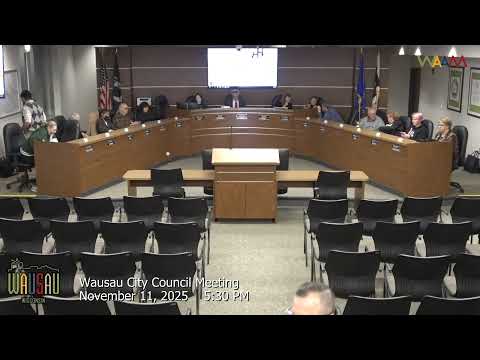
The Wausau Common Council voted 10–1 on Nov. 11 to adopt the city’s 2026 budget, concluding a long meeting marked by amendments and sharp discussion over tax increment financing, utility projects and upcoming referendum planning.
Alder Pete Rasmussen opened deliberations on the finance committee’s recommendation for the 2026 budget, file 25‑1109. Public commenter Cooper Johnson had urged the council earlier to balance development borrowing with “equal support for long‑time and lower‑income residents.”
Alder Lukens successfully moved an early amendment to remove $40,000 earmarked from the Economic Development fund for professional services related to a study of creating a city administrator or city manager. "I would like to amend it...to remove $40,000 on the administrator study," Lukens said; the amendment passed 8–3.
Debate then focused on several capital items carried in tax increment districts (TIDs). Alder Killian questioned a $1.2 million utilities‑relocation line in TID 3 tied to the Graybel Building area; Director Eric Lindman told the council the work would move utilities off private property and prepare the site for future development. Lindman said: "We have utilities that run underneath that site...it’s really to remove those from that site and redirect that sanitary sewer in preparation for any future development."
Alder Tierney moved to remove the $1.2 million utilities relocation from the budget, arguing the council should review the project before it was included. Proponents warned removing the allocation could jeopardize use of TID funds and the ability to contract for the work before the TID’s expenditure period expires; opponents noted the project is TID‑funded and would not affect the levy. The amendment failed 4–7.
Council members also discussed lead service line replacement funding and grants. Lindman said delaying the program would risk losing principal‑forgiveness grants: "We’re getting over 50% of the costs are grants...Delaying the project will put more burden on residents in the future because we won’t have the grant or the principal forgiveness dollars to help offset those costs." Finance staff added that DNR loan terms require taking a low‑rate loan to receive certain grant dollars.
After additional debate and smaller floor changes, the main motion to adopt the 2026 budget carried 10–1.
Next steps: staff and council members said they would continue work between November and January on options to reduce future levy impacts and on the framing of a possible 2027 referendum.
Votes and formal actions recorded in the meeting included (as taken from the clerk’s roll and vote calls): the Lukens amendment to remove $40,000 (passed 8–3); the Tierney amendment to remove the $1.2 million Graybel utilities relocation (failed 4–7); and final adoption of Resolution 25‑1109 (budget adoption) (passed 10–1).