
City staff warns sewer-capacity limits as council reviews Salem Highway development densities
Get AI-powered insights, summaries, and transcripts
Subscribe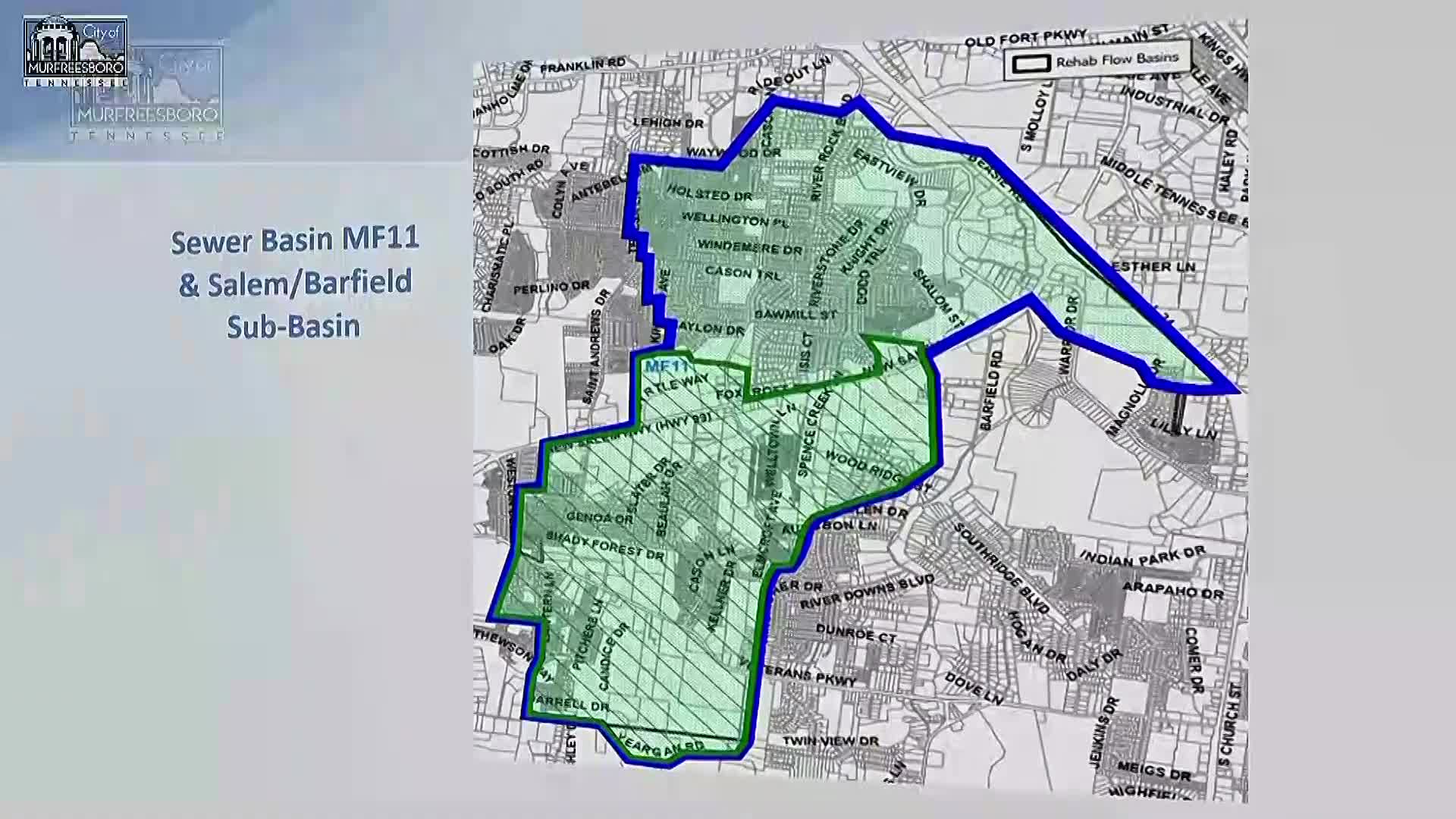
Summary
Planning and utilities staff told council that sewer capacity constraints in the Salem/Barfield subbasin limit how much new development can connect; staff presented scenarios and recommended limiting variances and reconciling zoning rules with sewer-allocation rules.
City planning and utilities staff gave a detailed briefing on the Salem/Barfield sewer subbasin and how sewer allocation limits affect development along Salem Highway.
Staff said the city previously extended about 8,900 linear feet of gravity sewer at a cost of roughly $12 million, adding the basin the capacity equivalent of 3,473 single-family unit (SFU) connections. As of the staff update, approved site plans account for about 774 SFU equivalents and Still Waters has reserved about 457 SFUs; that leaves a roughly 2,242 SFU-equivalent remainder under current assumptions. Staff presented alternate scenarios (using existing zoning, a 5-SFU/acre average inside the city, and varying assumptions outside the city) to illustrate how quickly capacity could be consumed and to explain recommendations for retaining current interior-city zoning with limited variances and managing outside-city development at lower average densities.
Council members raised concerns about long-dormant planned developments (Boxwood, Glenbrook) that retain zoning entitlements but have not proceeded to construction for 15–20 years, and noted state and local vesting/rezoning provisions. Planning staff and utilities staff discussed reservation rules for sewer capacity (a 30-month reservation period tied to down payments and a possible 10‑year extension through staged payments) and suggested strengthened operational checks so approved but inactive plans do not consume perceived available capacity.
What’s next: staff recommended council consider policy changes to reconcile zoning and sewer-allocation rules and to flag high-density rezoning requests for additional scrutiny; council asked staff to bring further analysis to future workshops and meetings.