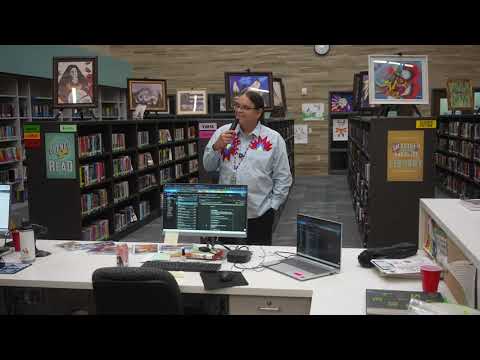
Artist who gave Dakota name 'Seas Within' explains Indigenous ceremonies and symbols behind his paintings
Loading...
Summary
An artist who identified his Dakota name as 'Seas Within' told a local audience that his paintings draw on vision-quest ceremonies, buffalo imagery and stories such as the White Buffalo Calf Woman; one piece addresses murdered and missing Indigenous women and a version of his Dakota Starry Night hangs in the South Dakota Governor’s Mansion.
The presenter, who introduced himself by his Dakota name as "Seas Within," spent the session explaining how Dakota ceremonies and personal history inform his paintings and a recently published book of his art. "My Dakota name is, Seas Within," he said, opening with the vision that gave him his name after a ceremony at Bear Butte.
Seas Within described how a hanbleceya (vision quest) on a mountain shaped the themes in his work and how art became a form of healing after childhood trauma. He recounted growing up in Central Housing in Fort Thompson, being sent to an Indian boarding school where he said he was abused, and later turning to alcohol before finding solace in painting. "I turned to my art, for healing," he said, and credited an older brother for encouraging his early work.
He discussed several pieces and the cultural meanings behind them: Dakota Starry Night, which adapts Van Gogh’s Starry Night to reflect resilience and was later purchased for the South Dakota Governor’s Mansion; a painting titled We the People connected to a 250th-anniversary contest; a powwow fancy-dancer image rendered in bright colors; and 'Provider,' a work tied to the Heyoka society that uses contrarian imagery and dual face paint to explore balance and boundary-crossing.
A central work he described was a painting about murdered and missing Indigenous women (MMIW). He said the piece depicts three young women "looking the other way" to convey searching and that a red hand motif signals distress. "This piece... represents murdered and missing indigenous women," he said, and explained the buffalo skull in the composition as symbolizing hardship for families seeking relatives.
Seas Within also retold the story of the White Buffalo Calf Woman bringing the chanupa (sacred pipe), explaining its spiritual role and how those beliefs inform his iconography. He described the Sundance tree painting as a top-down view representing prayers and fertility symbols and pointed to other works honoring veterans and animal spirits, including an "Eagle’s Telling." He explained that certain motifs—dragonflies, parfleche designs, buffalo—connect daily life, ceremony and ancestral memory in his panels.
He invited listeners to an upcoming group show at the Hilton Garden Inn where he said about 30 artists would exhibit, and noted that the original Dakota Starry Night hangs in the Governor’s Mansion. He also referenced a social-media response to one image that he said received about 2,000 shares. The presentation closed with ceremonial phrasing equivalent to a prayer and a thank-you to the audience.
Why this matters: Seas Within framed the talk as cultural education—using visual art to convey ceremony, resilience and community concerns (including MMIW)—and positioned his work as both personal testimony and public storytelling. He tied artistic choices to specific ceremonial and cultural references, underscoring the role of art in preserving and explaining Lakota traditions.
The presenter identified himself primarily by his Dakota name and did not give a separate full English name during the talk. He said he moved to Sioux Falls to live with family and has shown work in institutional and commercial venues, but did not provide formal organizational affiliation. The artist described several approximate figures ("about 30" artists in the show, "about 2,000" social-media shares) and a contest tied to the 250th anniversary of the U.S. Constitution.
The presentation was descriptive and educational rather than deliberative; there were no motions, votes or formal actions reported.