
Sweetwater SD #2 board directs RFQ process for possible 6,400‑square‑foot CTE expansion
Get AI-powered insights, summaries, and transcripts
Subscribe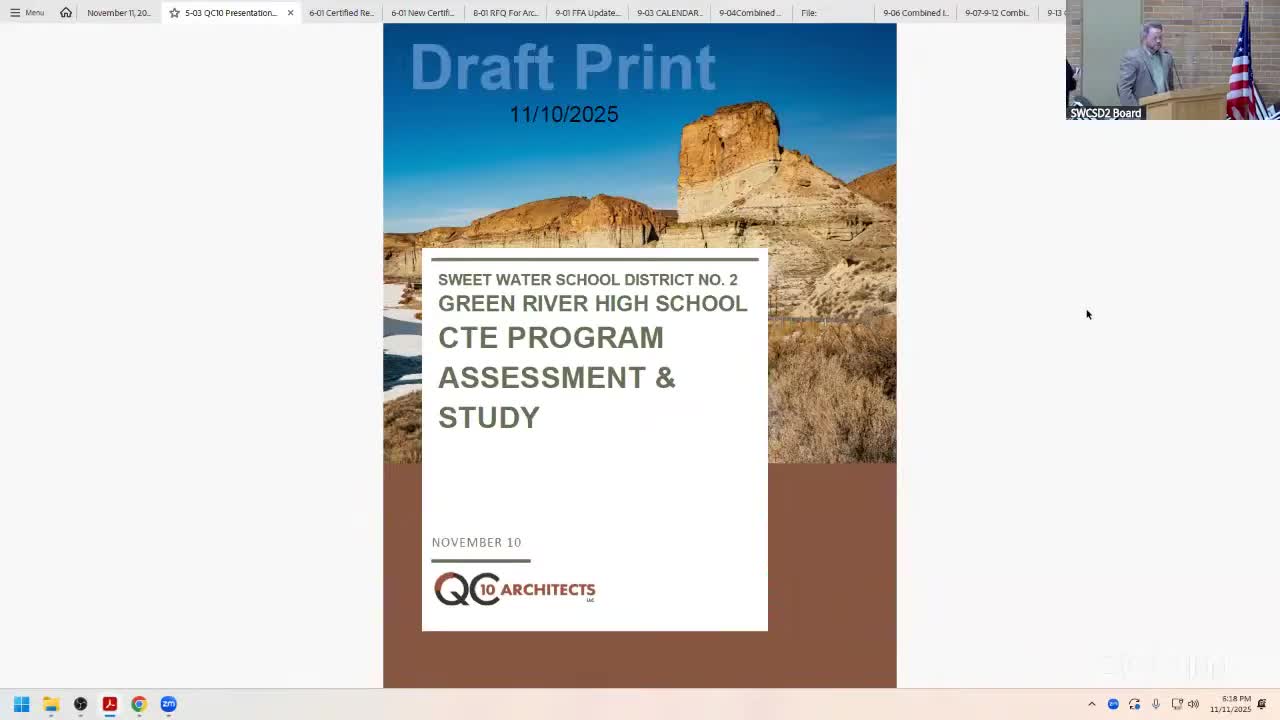
Summary
Trustees voted to issue a request for qualifications (RFQ) to pursue architectural services for a proposed roughly 6,400 sq. ft. expansion to Green River High School’s career and technical education facilities, after reviewing cost ranges and safety upgrades presented by QC10 Architects.
The Sweetwater County School District #2 Board of Trustees voted Wednesday to ask staff to publicly solicit qualifications from architects for a possible addition to Green River High School’s career and technical education (CTE) facilities.
Board member Tom Wilson moved to direct staff to issue an RFQ for an approximately 6,400‑square‑foot expansion; Trustee Tate Davis seconded the motion and the board voted in favor. The RFQ will be for qualifications (not bids) and staff said it could include both the expansion drawings and a remodel option so firms can propose evidence of experience and be invited to interviews.
Superintendent Dr. Cooper told trustees the district had three funding buckets to consider: carryover major maintenance funds, roughly $2.3 million in ‘pre‑1997’ capital funds that state guidance suggests using soon, and district reserves. Dr. Cooper said mandatory infrastructure upgrades (HVAC, electrical, ventilation and welding gas manifolds) would be funded by major maintenance dollars regardless of whether the board chose to add square footage.
QC10 Architects (principal architect Thane Migelke and project manager Jenna Brown) presented options developed after a three‑month concept study. They described three price ranges: about $3.5–4.0 million to address code, ventilation and safety upgrades within the building footprint; roughly $6–7 million for a targeted addition and renovations; and an approximately $10 million “full option” for a larger build‑out. QC10 recommended options that balance added functional square footage with cost control, and confirmed the RFQ’s purpose is to find qualified firms for a larger design contract.
Trustees asked about escalation assumptions; QC10 said the estimates use a 3% short‑term escalation and would be adjusted if the timeline extends. Board members also raised safety and fire‑code concerns in shop spaces, the difficulty of moving heavy shop equipment between rooms, and the need to plan decades ahead for modern CTE programming.
Dr. Cooper said a congressional direct‑spending application to support workforce development is being prepared (application due Feb. 1), but he called that a long shot; the district will pursue letters of support and industry partners as part of broader funding work. He said the board will revisit financial decisions in December and that no final construction contract will be awarded without further board direction.
Next steps: staff will prepare RFQ materials (including the expansion and remodel options), post the RFQ publicly, and bring qualified respondents to the board for interview and selection in December or January.