
Metro Transit readies E Line BRT for Dec. 6 launch; arterial BRT plan names top corridors for next lines
Get AI-powered insights, summaries, and transcripts
Subscribe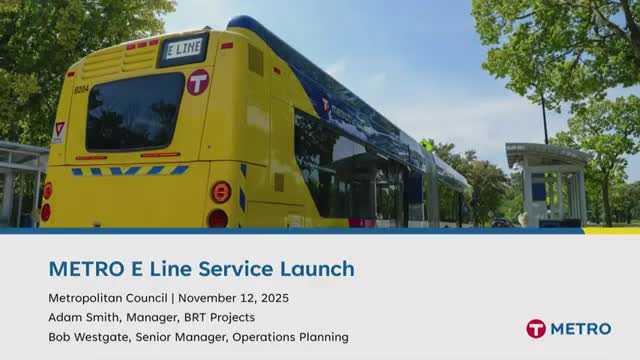
Summary
Metro Transit told the Metropolitan Council the E Line arterial BRT will begin revenue service Dec. 6, 2025, on a 34-stop corridor, and staff outlined operational readiness, outreach and a nearby arterial BRT plan update that ranked corridors for future J/K/L lines.
Metro Transit staff told the Metropolitan Council on Nov. 12 that the E Line arterial bus rapid transit (BRT) is on track to begin revenue service on Dec. 6, 2025, and presented outreach, operational readiness and construction updates. Council staff and Metro Transit also presented the arterial BRT plan update technical evaluation, identifying priority corridors for future lines.
Deputy general manager Brian Fung and project leaders said the E Line will operate on the France, Hennepin, University and 4th Street corridor with 34 stops between Southdale Transit Center and Westgate Station, upgrading Route 6. The project carries an authorized budget of about $64,000,000, with roughly half from state sources and additional federal, local and regional funds; Metro Transit said an $11,000,000 scope addition funded by Hennepin County and the City of Minneapolis funded pedestrian and accessibility improvements.
Adam (Metro Transit) said travel-time improvements could allow trips from Uptown to Downtown Minneapolis in as little as 10 minutes, and that the E Line will operate with 60-foot articulated buses. Operations manager Bob Westgate said teams have been training operators in articulated buses since Nov. 3 and have identified tight turns and signal phasing to monitor, with plans to adjust if necessary.
Metro Transit described launch activities for Dec. 6: an indoor celebration at Minneapolis College, sponsored rides, a corridor passport program and targeted outreach to employers and campuses. Staff emphasized pre-board fare payment and onboard outreach to ensure riders understand service and local route changes that will accompany the launch.
Separately, Kyle O’Donnell Burrows presented the arterial BRT plan update technical evaluation (step 3 of 4). Staff screened 17 candidate corridors down to 11 for detailed evaluation and ranked them on four goals—ridership, equity, costs and land use—finding Nicollet Avenue, Franklin/Grand/3rd Street and West 7th as the highest-scoring corridors. Staff said a prioritization step will follow to assess readiness, partner coordination and community feedback to select J, K and L lines by early 2026.
Council members asked about service pattern changes on neighborhood streets (e.g., Sheridan/39th turns), detours during events and outreach to employers; staff said they will monitor operations after launch, coordinate detours with street operations, and continue employer and campus outreach.
Sources: Metro Transit presentations by Brian Fung, Adam, Bob Westgate and Kyle O’Donnell Burrows to the Metropolitan Council, Nov. 12, 2025.