
Survey finds strong engagement but flags bullying, fatigue and counseling gaps
Get AI-powered insights, summaries, and transcripts
Subscribe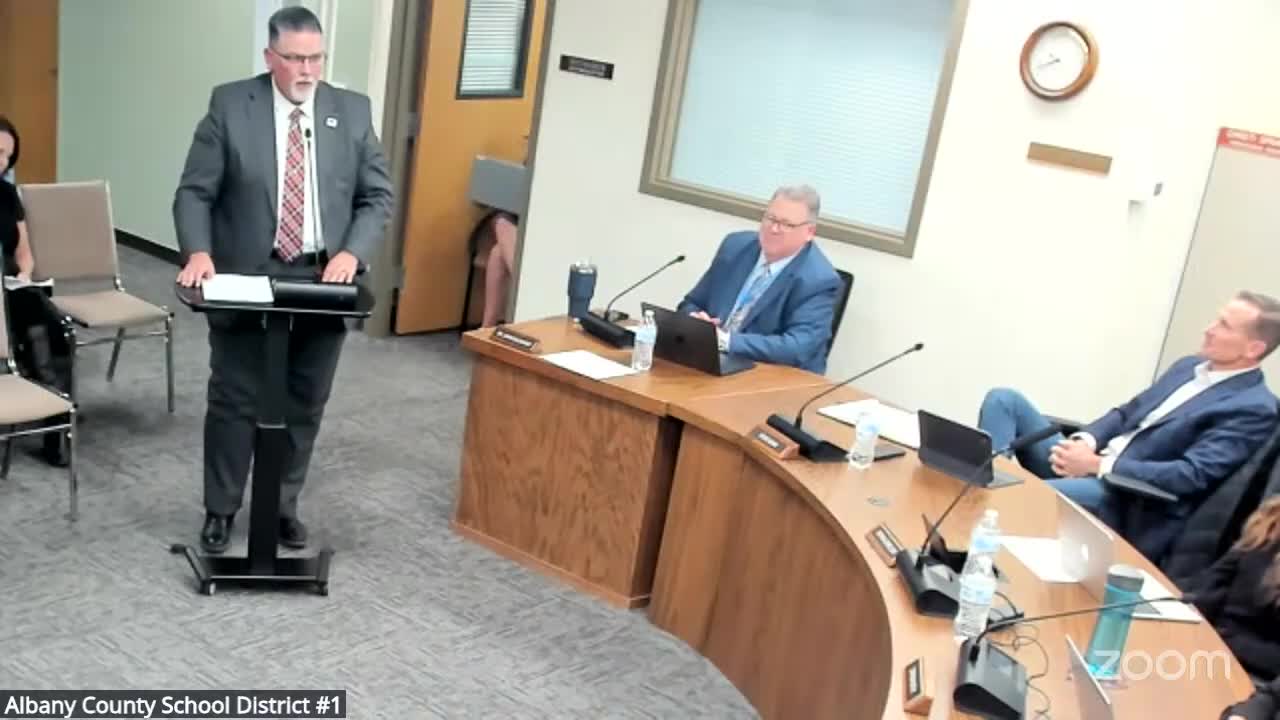
Summary
WSBA presented a custom district climate survey showing high participation but flagging bullying, student fatigue and inconsistent counseling access as priority issues.
The Albany County School District #1 board received a detailed climate-and-culture survey presentation on Nov. 10 from the Wyoming School Boards Association (WSBA) that combined responses from students, staff and community members.
Lede: WSBA reported 1,374 survey responses including 976 students (an unusually high student response rate). Presenters said the instrument was customized for the district and included student, staff, certified and community modules.
Key findings: Presenters Brian Farmer and Dr. Julie Kasorik said most measures showed favorable perceptions (blue/green on their heat maps) but highlighted specific areas for attention: relative lower agreement that students treat each other with respect (near ~40% agreement on that item in the all-schools view), open-ended comments citing bullying (often in bathrooms or unsupervised spaces), evidence of fatigue and burnout among students tied to time-management and heavy workloads, and lower student agreement with statements about meeting with counselors to plan their future.
Demographics and methodology: The survey ran for two weeks, was co-designed with district staff, and included over 200 community members, nearly 1,000 students (majority from Laramie Middle School) and broad representation among certified and classified staff. The presenters noted some items were reverse-scored for interpretation and that items with small n were suppressed or combined to protect anonymity.
Trustee questions and next steps: Trustees asked for school-by-school raw data (presenters said raw data would be provided to the superintendent but not published) and recommended follow-up focus groups and targeted board professional development (PD) to move from data to action. Presenters suggested focus groups with students and deeper analysis to inform interventions, especially around counseling access, bullying prevention, and consistent grading practices.
Why it matters: Trustees and district leaders linked the survey findings to retention, student well-being and instructional consistency. Several trustees urged the board to treat the survey as a starting point for targeted interventions rather than a final diagnosis.
Ending: Presenters will provide raw data to the superintendent; trustees signaled intent to schedule follow-up sessions (PD and possible public forums) to translate the survey findings into actionable strategies.