
Draft UDC consolidates use tables, removes 25% home‑occupation interior cap and adds limited administrative variance
Get AI-powered insights, summaries, and transcripts
Sign Up Free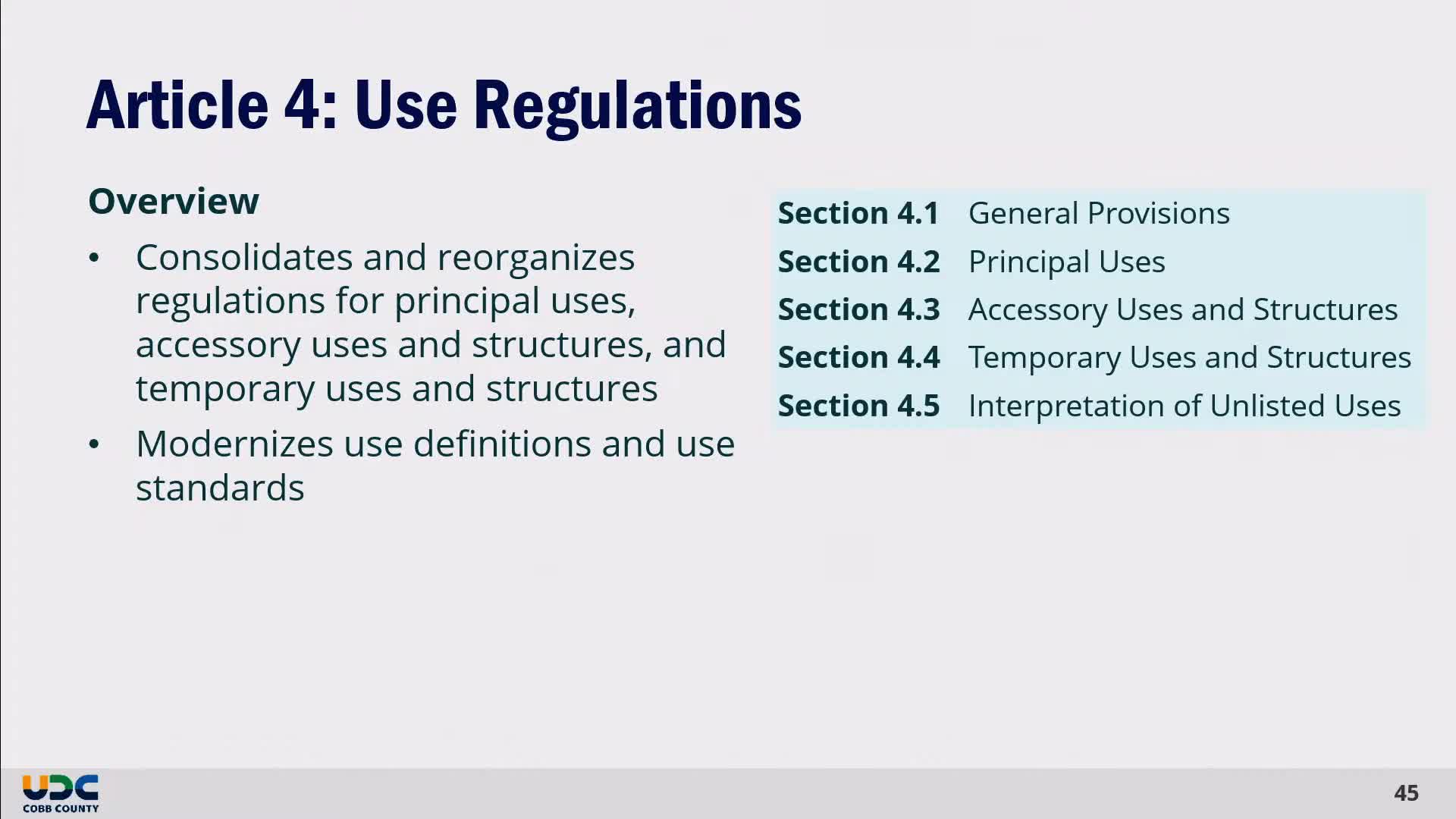
Summary
Installment 2 centralizes use regulations in Article 4, consolidates accessory and temporary use standards, removes the current 25% interior‑area limit on home occupations, and creates a limited administrative variance under Article 2 for modest staff‑level adjustments.
Jeff Green walked through Article 4 of the draft UDC, which consolidates principal uses, accessory uses, and temporary uses into a linked use table and organizes use‑specific standards in one location to reduce repetition.
Green said each use will have a clear permission code (P for permitted, S for special exception, L for special land use permit, and A for allowed in a planned development), with direct links to use‑specific standards. He highlighted that commonly repeated accessory standards — such as the customary home occupation rules — have been consolidated; the draft places the definition in Article 9 and lists standards once in Article 4.
The consultants removed a current ordinance restriction that limited home occupations to using no more than 25% of a dwelling’s floor area because enforcement was impractical. "That is very hard to enforce," Green said, noting the zoning office cannot reliably inspect private interior use.
On administration, Article 2 retains most current procedures but adds a new administrative variance allowing staff to authorize limited adjustments (for example, up to 10% to some dimensional standards) in appropriate site circumstances, reducing the need for a Board of Zoning Appeals variance in small cases. Green said development standards such as parking will be provided in Installment 3 and that staff‑level flexibility for parking requirements is being considered.