
Fort Lauderdale code board grants extensions in bulk, debates higher fines and packet changes
Get AI-powered insights, summaries, and transcripts
Sign Up Free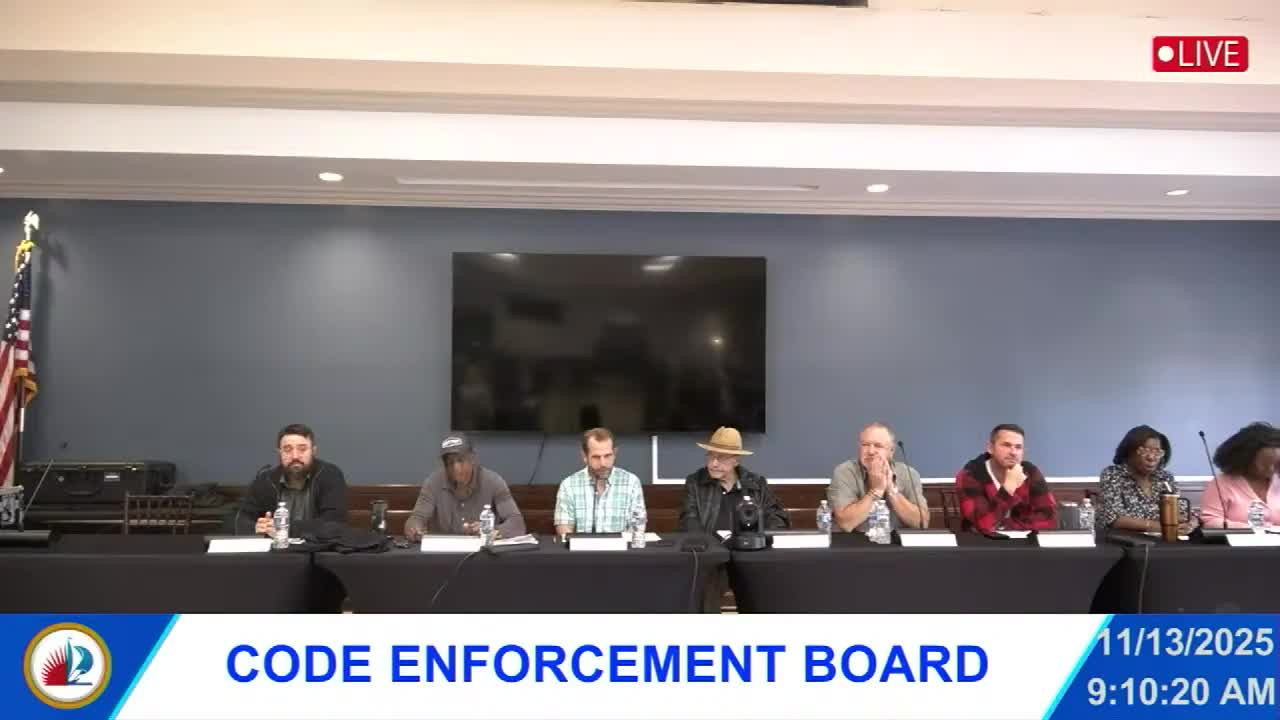
Summary
The Fort Lauderdale Code Enforcement Board on Nov. 13, 2025, heard dozens of property cases, granting routine compliance extensions while voting to increase fines for repeat or nonresponsive owners, and removing a new 'commissioner district' field from staff packets pending review.
The Fort Lauderdale Code Enforcement Board convened Nov. 13, 2025, to hear civil enforcement cases alleging unpermitted construction across the city. Chair Terry Nolan and inspectors presented a long docket; most contested owners admitted violations or asked for time to obtain permits, and the board granted staggered compliance windows — commonly 75, 103 or 131 days — with a standard $50-per-day penalty set to begin if deadlines are missed.
Why it matters: The hearing illustrates the board’s two-track approach: help property owners come into compliance when staff verifies active permitting, but move more quickly to heavier penalties or a referral to a Massey (special magistrate) hearing when owners do not engage. Inspectors repeatedly told the board that many violations were inherited by new owners; board members said they wanted the process to push people who do not cooperate toward faster resolution.
Most of the docket followed a pattern: the city’s building inspectors summarized code-authority findings and recommended either an extension to permit review or scheduling for Massey to impose fines. For example, an after‑the‑fact AC installation at 2352 NE 9th St. prompted a 75‑day extension to allow a contractor to complete retroactive permitting; inspector Andrew Gebbia summarized the difficulty in securing contractors for small retrofits and the board granted the time requested. Sebastian Koprowski, speaking for the owner, said the family “fully admit[s] that a violation exists” and asked for time to finish the paperwork.
The board did take tougher action in several cases. It imposed and then adjusted a major commercial penalty in one matter and voted to raise daily fines for select nonresponsive properties (motions to raise the daily rate to $250 and $350 were carried for individual hearings to create stronger leverage for compliance). Board members also repeatedly used mandatory reappearance orders to require owners to return in January or February to report progress.
On administrative business the board voted to remove a ‘commissioner district’ column from staff packets pending clarification from the city administration; members said the district label could unintentionally create bias or the perception of bias in enforcement decisions. “By having the commissioner’s name, someone’s relationships with the commissioner could influence a decision,” a member said during the discussion.
The board closed the meeting after approving minutes from Sept. 23 and entering several items as closed or withdrawn. Many cases were continued with instructions to stay in active contact with inspectors; a handful were scheduled for Massey to consider fines.