Get Full Government Meeting Transcripts, Videos, & Alerts Forever!
Get email alerts on the Budget topic
No spam. Unsubscribe anytime.
Staff recommends 2% levy increase and utility-tax changes as College Place prepares 2026 budget
Summary
City finance staff proposed a 2% property-tax levy increase for 2026 and utility-tax adjustments to shore up current-expense reserves, presented capital projects and rate options, and closed public hearings with a final budget adoption scheduled for Dec. 9, 2025.
Mayor Norma L. Hernandez and the College Place City Council heard a two-part presentation Nov. 12 on the city's 2026 revenue forecast and preliminary budget in which staff recommended a mix of modest tax increases and cost control to shore up declining reserves.
Finance Director Brian Carlton told the council the city is limited to a 1% statutory increase per entity but recommended the city take a 2% levy increase for 2026 (on top of a 3% carryover), which staff estimated would generate about $65,000—6,000 in additional revenue for current expense. Carlton said staff also proposes raising the utility tax applied to water, wastewater and stormwater to bring total utility-tax collections on those services to 13% and adding a new stormwater utility tax expected to produce about $90,000 for the general fund.
"We are recommending a 2% increase in property tax for 2026 that will generate an additional $65,000 in revenue for the city," Carlton said during the presentation. He stressed that assessed-value growth means City revenue does not automatically rise with home values and that modest levy and utility-tax increases are part of a balanced approach with expense controls.
Why it matters: Carlton said the city's current-expense fund has seen a multi-year drawdown. Without additional revenue or expense reductions, the city's reserve balance could fall below policy targets; using a combination of the emergency reserve and the proposed revenue measures, staff projected ending reserves near the bond-rating target of $2 million.
Council members pressed staff on mechanics and household impact. The presentation included an example showing the 2% levy would add roughly $8.50 a year to an average $403,000 home's tax bill; measuring combined effects of the proposed utility-tax and levy changes, staff estimated about a $79 annual increase for an average household.
Carlton also reviewed capital projects that depend on identified funding streams: $2 million budgeted next year for Lions Park Community Center pending final funding, a $9.6 million Mjolnir Road reconstruction project, and water projects including the Well 89 development ($4 million) and an $8 million Reservoir 4 storage tank. Funding sources cited include tax-increment financing proceeds, Public Works Trust Fund loans, Department of Ecology grants and a WSDOT grant for SafeWalk/streets work.
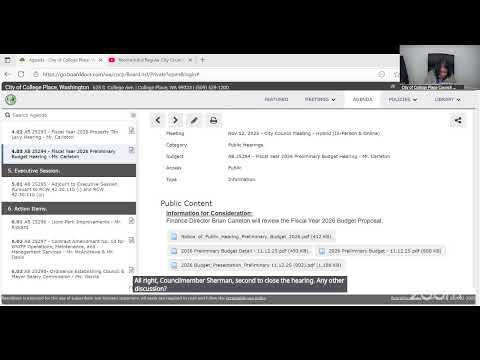
Procedural status: The council opened and then closed the required public hearings on the levy and the preliminary budget after no members of the public spoke and no written comments were filed. Carlton said the proposed budget will be posted to the city website in the next few days and that the final hearing and adoption are scheduled for Dec. 9, 2025.
What remains open: staff acknowledged a narrow window of reserves (two to three years of cushion if conditions worsen), the need to confirm final year-end reconciliations before final adoption, and continuing uncertainty around some grant and development-driven revenues.
The council did not adopt the budget or levy Nov. 12; they conducted the public hearings and requested the materials be posted for further review prior to the Dec. 9 adoption meeting.