Get Full Government Meeting Transcripts, Videos, & Alerts Forever!
Get email alerts on the Water Policy topic
No spam. Unsubscribe anytime.
South Ogden reviews state-required water-use preservation element and updated conservation plan
Summary
City staff told the council the state-required water-use and preservation element aims to align Ogden’s future land-use map with water supply and conservation, highlighting goals for indoor/outdoor reduction, metering by 2030 and capital priorities such as leak detection and pressure management.
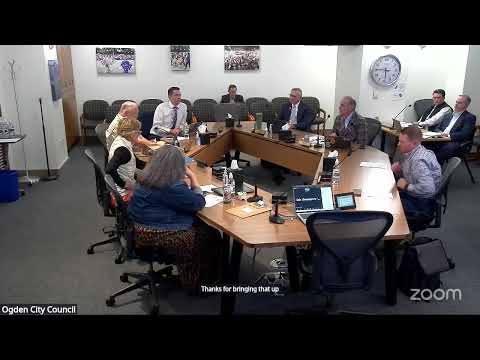
Delaney Sillman and Logan Simpson, city planning staff, opened the work-session presentation by saying the water use and preservation element is mandated by the state and must be adopted before the end of the year. "This is the water use preservation element that's required by the state," a presenter said, explaining the element ties the future land-use map to expected water demand and service-provider plans.
The presentation summarized the element’s structure: an inventory of current supplies, a water budget weighing supply against projected demand, conservation strategies for existing development, and policies to align future growth with water availability. Staff noted Ogden’s "true" gallons-per-capita-per-day is about 184 (excluding wholesale areas) and that a planning projection tied to the future land-use map yields roughly 190 gpcd under the current assumptions. They estimated a future city-wide demand of about 21,700,000 gallons per day by 2050 under the adopted land-use scenarios, and said that would represent roughly half of Ogden's supply under current assumptions.
Council members asked for clarity on data sources and the role of multi-family housing in per-capita calculations. Planning staff said the water-use figures derive from the Division of Water Rights and provider-supplied data, and that the element includes separate goals and policy levers for indoor versus outdoor conservation. "We have goals for indoor water conservation, and then we also have goals for outdoor water conservation," staff said, adding the two are addressed through different tools such as appliance rebates and landscape-ordinance changes.
Utility staff recommended technical and programmatic measures in the conservation plan. Brady (utility staff) told the council the region is targeting outdoor use as the largest source of waste and that the state’s regional target is roughly 175 gpcd by 2065; the local conservation plan targets progress toward that mark. He summarized capital priorities (infrastructure renewal, leak detection, pressure management, expanded smart-meter analytics), operational measures (remote reading and SCADA analytics), and external programs (park-strip turf conversion rebates, rain-barrel distribution, and resident water audits led by city conservationist Matt Hack).
Staff described conservation incentives already in use: a park-strip rebate funded jointly (reported as $1.25 from Weber Basin and $1.25 from the city, up to $2.50 per square foot), an average park-strip size of about 1,500 square feet, and free conservation kits and rain barrels distributed through city programs. On secondary and wholesale water, staff said roughly 34% of residents have pressurized irrigation access with another ~3% on nonpressurized secondary systems (about 37% total), with the rest relying on culinary water for irrigation; full secondary-metering data is expected to improve as meters are installed regionally through 2030.
Council members raised broader regional concerns, noting presentations they had attended that cited severe Great Salt Lake declines. One council member summarized a recent public panel citing a BYU model that predicted the lake could collapse within about five years if trends continue; staff said the city had delivered roughly 1,500 acre-feet to the lake this year where appropriate and that regional coordination is ongoing.
The work session was informational; staff said both the water element and the updated conservation plan will proceed to the December general session for formal consideration and adoption before the state deadline. The staff presentation closed with recommended next steps: annual review of the conservation plan, coordination with Weber Basin and other regional providers, and further work on ordinance updates and public outreach.