Orange County presents Vision Zero action plan, targets zero fatalities by 2040
Summary
Humberto Castellaro, a county transportation official, told the Transportation Mobility Advisory Commission that Orange County’s newly adopted Vision Zero action plan aims to eliminate roadway fatalities and severe injuries by 2040 and lays out 50 countermeasures and 24 high‑injury corridors prioritized for short‑, mid‑ and long‑term intervention.
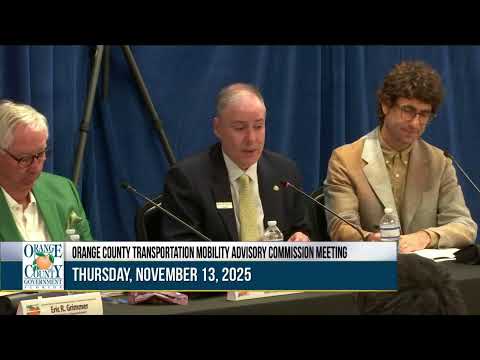
Humberto Castellaro, a county transportation staffer, presented Orange County’s Vision Zero action plan to the Transportation Mobility Advisory Commission on Nov. 13, saying the county’s formal target is to eliminate roadway fatalities and severe injuries by 2040. "We will not accept anything but zero," Castellaro said, describing the goal as an aggressive but necessary commitment.
The plan draws on five years of crash data (2018–2022) from the Florida Department of Transportation and identifies 24 high‑injury corridors countywide. Castellaro said a regional Safe Streets for All grant provided $3.7 million to the region, with $400,000 allocated to Orange County to develop the Vision Zero action plan. The plan includes a public‑facing toolkit of roughly 50 safety countermeasures — from signal, signing and striping changes to sidewalks, lighting and modular roundabouts — each summarized on a “safety card” showing expected crash‑reduction effectiveness, implementation time and approximate cost.
Castellaro described a tiered implementation approach: short‑term, lower‑cost countermeasures to deploy quickly; mid‑term measures requiring moderate design work; and long‑term corridor reconstructions that need larger budgets and right‑of‑way work. He said staff plan to integrate Vision Zero priorities into the county’s annual CIP process so the highest‑injury locations can be advanced when funding is available.
The presentation listed several quantitative context points cited by staff: Orange County serves about 1.4 million residents and hosts about 75 million annual visitors; vulnerable road users (pedestrians, bicyclists, motorcycles) accounted for about 46% of local fatalities in the period analyzed. Castellaro highlighted that a full build‑out of the complete‑streets recommendations across all corridors could cost on the order of a few hundred million dollars, and noted the county is pursuing federal grants (including a Round 3 Safe Streets for All application that requested up to $25 million with a 20% local match) and local funding to close the gap.
Commission members pressed staff on enforcement and whether Vision Zero projects are already in the five‑year CIP. Brian Sanders, transportation planning manager, said the plan is newly adopted and staff are “turning the ship” to prioritize Vision Zero corridors; some corridor studies (e.g., Hiawassee Road) are already in progress and will be coordinated with CIP and grant opportunities. Castellaro said enforcement partners — notably the sheriff’s office — are integral to the strategy and that school‑zone automated speed enforcement was authorized by a county ordinance earlier this year and will be rolled out with an initial warning period followed by citations.
Members raised trade‑offs: retrofitting older, high‑speed arterial roads is more expensive than building complete streets in new developments, and projects frequently require public engagement to secure community buy‑in. Castellaro emphasized data‑driven before‑and‑after evaluation, performance dashboards, and a five‑year reporting cadence to the board of county commissioners to show progress.
The commission heard public testimony from a LYNX operator who urged deeper traffic enforcement on high‑risk corridors. Several members suggested exploring community‑based enforcement or code‑enforcement approaches where state law or staffing constraints limit traditional police enforcement.
What happens next: staff said they will work to fold Vision Zero priorities into short‑term CIP decisions, pursue grant funding for corridor improvements, and present progress updates to the commission and the board on roughly five‑year intervals.
AI generated
The text on this page is AI generated. Summaries, highlights, analysis, and video transcripts are all produced from the original source material.
AI can make mistakes, so if you spot one, and we will fix it for everyone.
Note: the source content is unaltered by us. Any content source we link to, be it a video, an audio recording, or a document, is presented exactly as its publisher released it. That publisher is usually a government body, sometimes an individual official or another organisation.