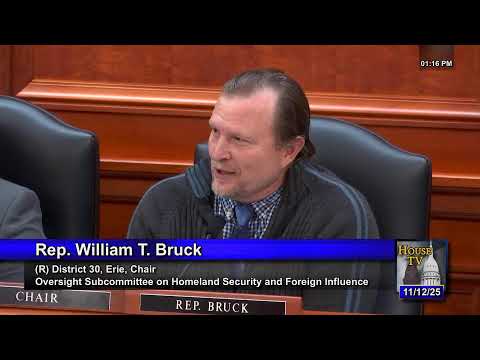
Witness tells Michigan committee Chinese influence poses risks to critical minerals, biotech, universities and digital platforms
Loading...
Summary
Michael Sobolek, a senior fellow at the Hudson Institute, told Michigan—s House Committee on Homeland Security and Foreign Influence on Nov. 5 that China—s control of processing for critical minerals, biotechnology capacity and ties inside higher education and digital platforms creates security and economic risks for Michigan and the United States.
LANSING — Michael Sobolek, a senior fellow at the Hudson Institute testifying for the Vandenberg Coalition, warned Michigan—s House Committee on Homeland Security and Foreign Influence on Nov. 5 that the People—s Republic of China poses a multi‑vector risk to U.S. supply chains, biotechnology, universities and digital platforms.
"The Chinese Communist Party is not a normal government," Sobolek said in his prepared remarks, arguing Beijing seeks "to reshape the world to its advantage" and can damage the United States "from within" through supply‑chain ties, university relationships and digital access. He told committee members the CCP has multiple levers of influence, including control of rare‑earth processing, components used in robotics and access to genetic databases.
Sobolek identified four priority vulnerabilities: critical minerals, robotics (and related AI components), biotechnology and higher education. On critical minerals he said China—s export controls earlier this year were "a serious warning shot," adding the country controls a large share of global rare‑earth processing and that many U.S. defense systems and clean‑energy technologies depend on those supply chains. He cited the Mountain Pass mine reopening and a long‑term purchasing arrangement with MP Materials as a partial protective measure but said "mining alone isn—t enough" without domestic refining and manufacturing.
On robotics and AI, Sobolek warned that embedded Chinese‑made sensors and components can enable data exfiltration or introduce false inputs to industrial AI systems. "Embedding PRC made components into American robots presents real risks," he said, describing scenarios in which compromised sensors could "feed false information into AI systems, compromising maintenance schedules and disrupting supply chains."
Turning to biotechnology, Sobolek cited a 2021 National Counterintelligence and Security Center warning that DNA is uniquely valuable and raised concerns about foreign companies collecting genetic data. He named BGI Group and described how some testing kits and sequencing capacity abroad can create datasets that, he said, give an adversary options ranging from blackmail to weaponized biology. He recounted reporting that U.S. equipment was sold to Chinese authorities for use in Xinjiang and said those sales later stopped after public pressure.
On higher education, Sobolek pointed to several law‑enforcement actions and prosecutions connected to university access and foreign nationals and said U.S. universities— financial reliance on tuition from PRC nationals—"roughly 1 in 4 international students," in his testimony—creates risks of espionage and research theft that merit scrutiny.
Committee members used the remainder of the hearing to question Sobolek on specific points. When asked whether consumer DNA services and pandemic testing kits could send genetic data to China, he replied that several COVID‑era tests were Chinese‑produced and said partnerships with firms such as BGI make it reasonable to "assume that the DNA of Americans are going into a database inside of China."
Members pressed Sobolek about policy responses. He recommended a two‑track approach: "downstream" actions to accelerate alternative supplies and domestic refining of critical minerals, and "upstream" measures to strengthen disclosure and policing of foreign influence—including modernizing foreign‑influence disclosure laws at the state level. He told the committee state governments could act where Washington is slow to update the Foreign Agents Registration Act.
Sobolek also expressed skepticism about a high‑profile private deal to separate TikTok US from ByteDance. He said the federal law intended to require separation was effective Jan. 19 and that, based on public descriptions, he did not believe the administration—s approach fully complied. "I do not believe that this deal, complies with the law that Congress passed bipartisanly last year and that the supreme court unanimously upheld," he said, adding concerns about continued contractual or board ties to ByteDance and the licensing of the algorithm.
On infrastructure and technology concerns raised by members, Sobolek named companies and technologies under scrutiny, including DJI drones and TP‑Link routers, and said the Pentagon is tracking display and component risks in military platforms. He also told members that data centers being proposed in Michigan are strategically important for AI and that permitting and energy supply are the main near‑term hurdles to construction and operation.
The committee approved the minutes from the previous meeting at the start of the session and later granted a motion to excuse absent members before adjourning. The hearing did not produce formal legislative action or votes on bills; testimony and committee discussion focused on policy options and possible state actions to deter or detect foreign influence.
Sobolek—s written testimony was shared with committee staff and he said he was available for further follow‑up.
What happens next: committee members left the hearing with several follow‑up options to consider, including whether to convene further hearings, request written materials from universities and companies named in testimony, or draft state‑level disclosure or procurement provisions to reduce reliance on foreign‑controlled components.
(Reporting includes direct quotes from Michael Sobolek—s testimony before the Michigan House Committee on Homeland Security and Foreign Influence on Nov. 5, 2025.)