
House committee adopts substitute to regulate concentrated 7‑hydroxy kratom products; moves bill forward
Get AI-powered insights, summaries, and transcripts
Sign Up Free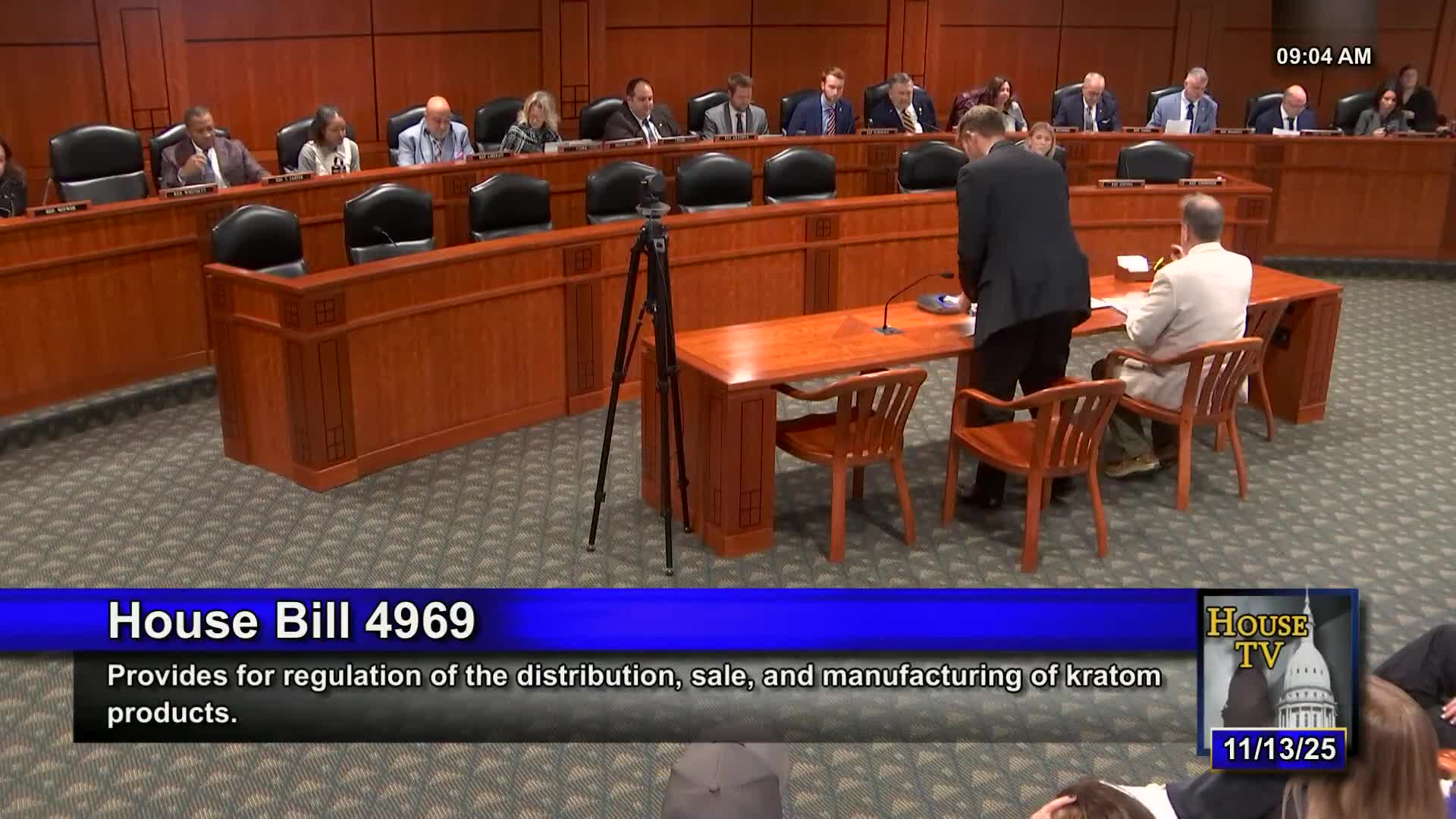
Summary
Representative Cabot said his H‑2 substitute doubles fines, clarifies kratom leaf is not a food and shifts enforcement locally; the committee adopted the substitute and reported HB 4969 with recommendation.
Representative Cabot, sponsor of the substitute for House Bill 4969, told the House Regulatory Reform Committee the H‑2 language doubles fines, clarifies that kratom leaf is not a food, and places enforcement with local law enforcement and third‑party testing labs while directing fine revenue to local governments.
"First, you asked that penalties be increased, so I doubled the fines and strengthened the punishment," Cabot said as he summarized the substitute. He also said the substitute makes clear that concentrated 7‑hydroxy derivatives should be regulated as drugs rather than food products.
Dr. Edward Boyer, a toxicologist, told the committee that 7‑hydroxymitragynine (7‑OH) binds the mu opioid receptor and can act as a partial agonist but said available data do not show deaths cleanly attributable only to 7‑OH. "There are no deaths that I can find up to this point that have been cleanly attributable to 7‑hydroxy," he said, while noting that sublingual formulations—products designed to bypass the liver—pose greater risk and that oral 7‑OH has a reported elimination half‑life of about 45 minutes.
Bruce Wade, a Clinton Township trustee, said local residents urged action and that parents reported youth misuse. "The citizens have been asking for it," Wade said, endorsing the state standard rather than isolated local ordinances.
Mac Haddow of the American Kratom Association argued for a regulatory distinction between natural kratom leaf and chemically manipulated, concentrated 7‑OH derivatives, saying federal and scientific reviews support treating them differently and warning that many 7‑OH products on the market are sublingual formulations or gummies that deliver rapid absorption.
Committee members asked whether post‑mortem toxicology reliably detects 7‑OH. Haddow and Dr. Boyer said detection can be limited by testing methods and by the compound's rapid clearance; witnesses pointed to CDC recommendations for standardized post‑mortem procedures to improve data quality.
Representative Fairbairn moved to adopt substitute H‑2 to HB 4969; the clerk took roll call and the chair announced the substitute was adopted. The committee then voted to report House Bill 4969 as substituted (H‑2) with recommendation. The committee record shows the bill was reported with the committee recommendation.
Michaela Hefferman, legislative liaison for the Michigan Department of Agriculture and Rural Development (MDARD), provided a card to the committee and the department is now registered as neutral on HB 4969.
Next steps: the committee reported HB 4969 as substituted with a recommendation to move forward; the bill will proceed in the House process according to the committee's referral and scheduling rules.