Get Full Government Meeting Transcripts, Videos, & Alerts Forever!
Get email alerts on the Local Governance topic
No spam. Unsubscribe anytime.
Danvers review committee proposes smaller town meeting, clearer manager reporting and other updates
Summary
The Town of Danvers Finance Committee hosted the town-moderator-appointed review committee, which proposed redlined changes to the Town Meeting Act and Town Manager Act including reducing town meeting membership, new nomination requirements, changes to town manager appointment and reporting, and an indexed investigatory spending cap.
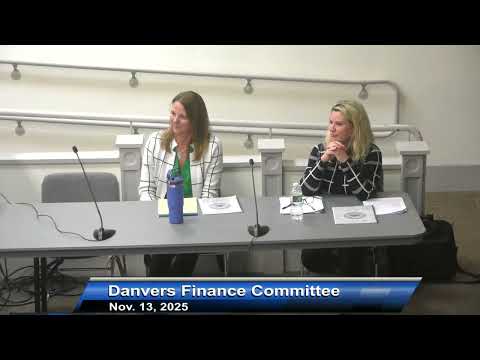
The Town of Danvers Finance Committee hosted the town-moderator-appointed Town Meeting/Town Manager Acts Review Committee to present a set of redlined changes intended to modernize and clarify two long-standing local acts.
Sally Calhoun, chair of the review committee, told the finance committee the panel met 19 times from July 2024 to May 2025 and prepared a written report dated May 13, 2025, following the town meeting vote that created the committee on May 20, 2024. “We recommend changing town meeting from 18 members per precinct to 15 members per precinct,” Calhoun said, citing repeated contests in which precincts lacked enough candidates and a May 6, 2025 election in which six of eight precincts did not have enough people running to fill their allotted slots.
The proposal would reduce the body from the current total reported by the committee (149 members) to a new configuration yielding 120 elected precinct members plus the five at-large select board members for a total of 125 voting town meeting members. Calhoun framed the change as pragmatic: smaller membership, the committee argued, may encourage better-prepared participants and reduce the frequency of under-filled precincts.
The committee also proposed requiring all town meeting candidates — including incumbents — to file nomination papers and secure 10 signatures, a step the committee said would reinvigorate the electoral process. Committee members acknowledged the recommendation could raise legal questions and said they expect Town Counsel and the Select Board to weigh in; the panel repeatedly referenced Massachusetts General Laws, chapter 43A, section 4, during the discussion.
On the Town Manager Act, the committee offered three major changes: adding a recall-election framework (the committee said the separate recall petition originated with a citizen petition), shifting the appointment of the town accountant to the town manager to align statute with current practice, and eliminating the requirement that a town manager live in Danvers during the term. Calhoun said the recall language is intended to allow voters to decide substantive grounds for a recall while excluding recall solely for the way an official voted: “Provided, however, that the vote of an elected official on a matter … shall not constitute valid grounds,” she said.
The review committee also recommended adding clearer communication requirements for the town manager, including a provision that the town manager "shall notify the select board of such change" when consolidating offices or transferring duties, and a requirement for routine operational reporting (the redline suggests at least monthly reports). During the meeting, Select Board and committee members pressed for clearer timing (for example, a clause that would require notification "within 30 days of making such change"), and the committee agreed to clarify the language to reflect intent that notification be after the fact rather than prior approval.
Committee members recommended updating a rarely used select-board investigatory spending provision that currently limits expenditures to $10,000. The committee's suggested replacement ties the cap to 0.02% of that year’s annual town budget — an approach intended to keep the allowance indexed for inflation; the committee estimated that percentage would equal roughly $28,000 in the current fiscal year.
The committee attached redlined statutory text to its report and presented the materials to the Select Board on Sept. 23. Staff informed the finance committee that proposed warrant articles would be submitted to the Select Board by Dec. 2, with a public hearing set for Dec. 16 and Select Board/finance committee review in early-to-mid January ahead of the February town meeting.
No votes were taken at the finance committee workshop; members asked for additional legal review on matters that implicate state law or long-standing statutory drafting conventions — specifically the feasibility of reducing per-precinct membership under the cited Massachusetts statute and whether language encouraging participation belongs in statute or in nonbinding guidance. The committee said it will continue to work with Town Counsel and the Select Board to refine the draft language before warrant articles go forward.
The finance committee said it will hold a formal public hearing and consider specific warrant articles in January prior to the February town meeting.