
San Miguel County offers one-time ‘reversion’ option for many deed‑restricted owners under new resolution
Get AI-powered insights, summaries, and transcripts
Sign Up Free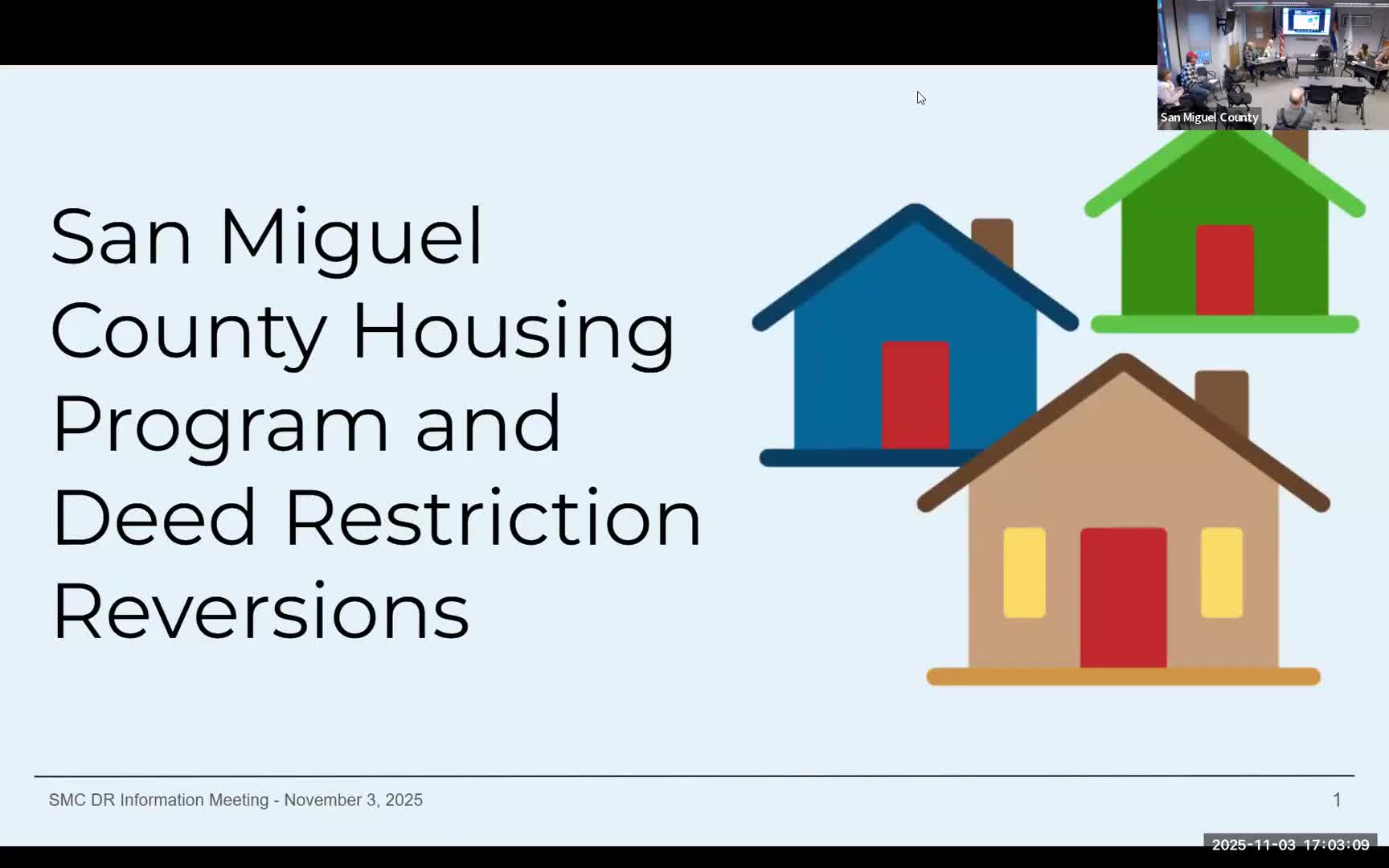
Summary
County staff and commissioners outlined Resolution 2025-23 and a one-time process allowing many deed-restricted property owners to keep their current restriction, revert to a prior covenant, or — for a limited group — adopt a prior 2016 covenant; notices were mailed Oct. 24 and owners have 90 days to respond.
San Miguel County officials on Wednesday laid out a new, one-time pathway for many owners of deed‑restricted homes to change the restrictions that govern who may live in or buy those properties. Deputy County Manager Jared Biggs said the board adopted Resolution 2025-23 in September to provide an “option to revert” after legal review of how deed restrictions apply.
The program affects properties in the unincorporated county that are subject either to land‑use‑code deed restrictions, contractual covenants, or project‑specific special covenants. "They run with the land," Biggs said of deed restrictions, describing the legal conclusion that the version of the land‑use code in effect when a property was first restricted typically governs that parcel unless the owner consents to a change.
Why it matters: county staff say deed restrictions exist to preserve a supply of housing for workers in the Telluride R‑1 school district, while allowing market forces where appropriate. Commissioners said they adopted the reversion option to address legal and fairness concerns arising from a series of covenant amendments since 2010 and more restrictive changes in 2023 — including an increase in required local work hours from 1,032 to 1,200 and longer minimum rental terms.
Who gets options: staff described three groups. Group 1 covers the most recent owners within a roughly three‑year window and receives three choices: keep the current restriction; revert to the previous owner’s recorded restriction (which may in some cases be a land‑use‑code restriction); or choose a one‑time move to a general 2016 covenant template the county is offering. Group 2 includes owners on covenant restrictions whose transfers predate the three‑year window; they may keep their current covenant or revert to a prior covenant version but, per the county, may not revert to a land‑use‑code restriction. Group 3 covers owners currently on a land‑use‑code restriction; they may keep their restriction or adopt the 2016 covenant if they wish. Owners under special covenants (project‑specific agreements with state or federal funding) are not eligible to revert.
The county provided inventory figures during the presentation: 349 deed‑restricted properties in the unincorporated county, of which staff said about 110 are land‑use‑code restrictions, roughly 117 are covenant restrictions and 122 are special covenants (the total includes some unbuilt lots).
Deadlines and process: the county sent letters and emails to primary owners on file with the San Miguel Regional Housing Authority on Oct. 24, which triggers a 90‑day period for owners to notify the county if they want to revert. Those who elect to revert will receive two notarized documents — one terminating the current restriction and one reinstating the selected restriction — and must return signed, notarized copies within 30 days of receipt. Staff said SMRHA and county offices can assist with notarization.
Resources: officials demonstrated a web page and an SMRHA owner portal where owners can view recorded deed‑restriction documents, the reception numbers needed to verify records at the clerk & recorder, and the library of land‑use‑code and covenant versions (1991–2001 land‑use code reconstructions and 2010–2023 covenant versions). Biggs said staff compiled summary tables of amendments so owners can compare language across years.
Board rationale and disputes: commissioners said limiting certain reversions — notably, preventing many older covenant owners from returning to a looser land‑use‑code standard — was a difficult but necessary choice to preserve the program’s purpose. Commissioner Brown (first name used in the session) said the board sought a middle ground to avoid opening a substantial number of houses to buyers whose primary income could come from remote work. At one point a commissioner said reverting all eligible properties back to a looser land‑use code would risk letting in what the speaker called “Tech Bros coming in,” a comment the board used to illustrate market‑pressure concerns.
Questions from owners focused on which version governs a property (the county said it is the version in effect when the lot was first deed‑restricted unless an owner signed a later document), how future compliance checks will treat land‑use‑code owners versus covenant owners, and whether lenders should be notified if owners change restrictions. County staff and SMRHA said they will tailor compliance checks to the recorded restriction for each property and encouraged owners to consult lenders before changing restrictions if the property has a mortgage.
Next steps: owners who did not receive the email should receive a mailed letter; anyone who wants to revert must notify the county within the 90‑day window identified in their letter and then return executed notarized documents within 30 days of receiving them. County staff said they will continue to field individual questions, provide the documentation in the SMRHA portal, and accept owner elections by email to Housing@SanMiguelCountyCO.gov. "We want to make this right and be respectful," Biggs said in closing.
Authorities and documents cited during the session include the county land‑use code deed‑restriction sections (cited in the presentation), the generalized 2016 covenant template (Exhibit A to Resolution 2025‑23) and Resolution 2025‑23 itself.
Ending: the session closed with staff thanking SMRHA and county employees for compiling documents and building the owner portal; the county said it will post the recording and meeting materials online and expects to continue outreach as owners make choices.