
Madera County GSA committee recommends domestic‑well mitigation rules, funds and program management contract
Get AI-powered insights, summaries, and transcripts
Subscribe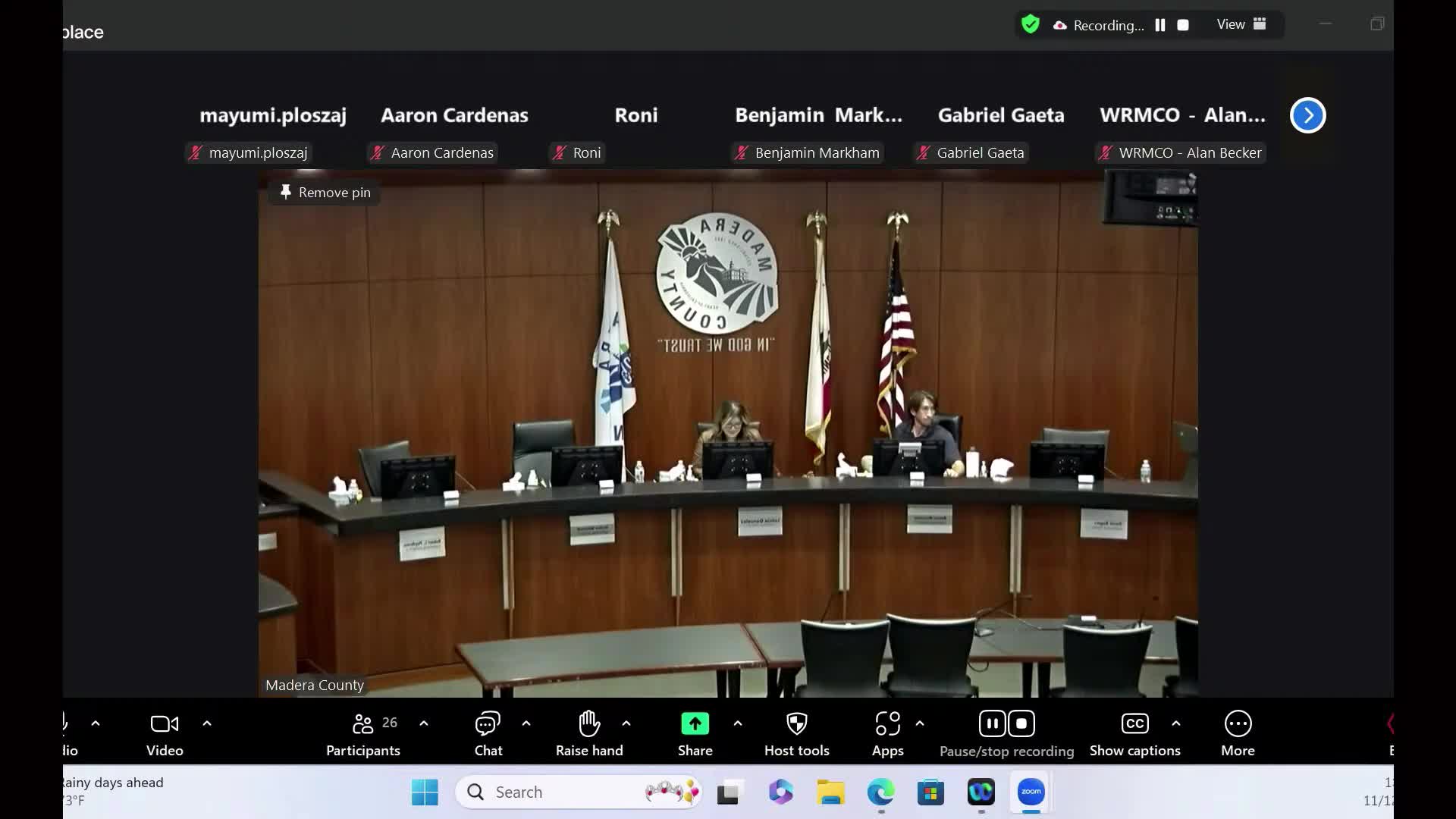
Summary
The Madera County GSA committee recommended a letter to the state and draft rules creating a domestic well mitigation program that would reimburse homeowners up to $35,000 for replacement wells or connection to community water. Staff recommended contracting Davis Engineering to run the program (not-to-exceed ~$514,000).
The Madera County Groundwater Sustainability Agency committee on Nov. 12 recommended next steps to implement a domestic well mitigation program for the Madera Subbasin, approving staff’s approach to a formal letter to the California Department of Water Resources and backing draft program rules that outline eligibility, limits and outreach.
Staff presented rules that would make landowners inside the Madera Subbasin and Madera County GSA boundaries eligible if a domestic well has gone dry or been damaged by subsidence attributable to declining groundwater. Assistance would be a one-time mitigation payment recorded on the property deed to avoid duplicate funding. The draft program offers up to $35,000 per property for drilling a replacement well or to connect a household to a community water system; staff said that eligibility may also include well deepening in some cases.
Jared Weeks of Madera County Water and Natural Resources said the draft application will be available online and on paper and is modeled on a subbasin program that has been operating. Weeks described outreach with Chowchilla Water District, nitrate management programs and Self‑Help Enterprises to shape outreach and simplify the application process.
Public comment centered on program scope and equity. Vicky Ortiz, a Fairmead resident and Fairmead Community and Friends board member, said $35,000 will not cover typical current quotes for a fully operational replacement well (she cited recent local quotes in the $55,000 range) and asked whether the $35,000 covers only drilling the hole or installation and pumps as well. Staff clarified the $35,000 amount covers the well itself (drilling) and that additional electrical or pump work generally is not covered, while acknowledging residents’ concerns about rising costs.
Growers and farm groups offered conditional support for the $35,000 cap but urged staff to set a clear eligibility date (several speakers recommended 2020) and requested more grower input on program design. Ralph Pistoresi and others asked that committees determining eligibility include knowledgeable farmers to safeguard fairness and program longevity.
Because the state has previously urged the subbasin to have a mitigation program, staff asked the committee to recommend the draft letter and rules to the full board; the committee acted in favor of that recommendation.
Program management: staff recommended contracting Davis Engineering (the consultant that developed the subbasin GSP) to manage the mitigation program in 2026, citing Davis’s familiarity with subbasin data and tools and the potential to avoid start‑up delays. The proposed agreement was described as “not to exceed approximately $514,000,” with most tasks billed on an hourly basis. Several public commenters questioned whether local farmer committees or county staff could provide oversight to reduce consulting costs. Committee members said the contract is billed by hour and is not-to-exceed and moved to approve the contract; the committee voted in favor and will reflect the tally in the formal minutes.
What’s next: the committee forwarded recommendations and the management contract to the GSA board for final action and directed staff to continue outreach, finalize well‑driller agreements (to be presented at a December or January board meeting) and prepare materials for program launch in 2026.