
Committee reviews multiple bridge projects and Boyesville salt-shed construction
Get AI-powered insights, summaries, and transcripts
Sign Up Free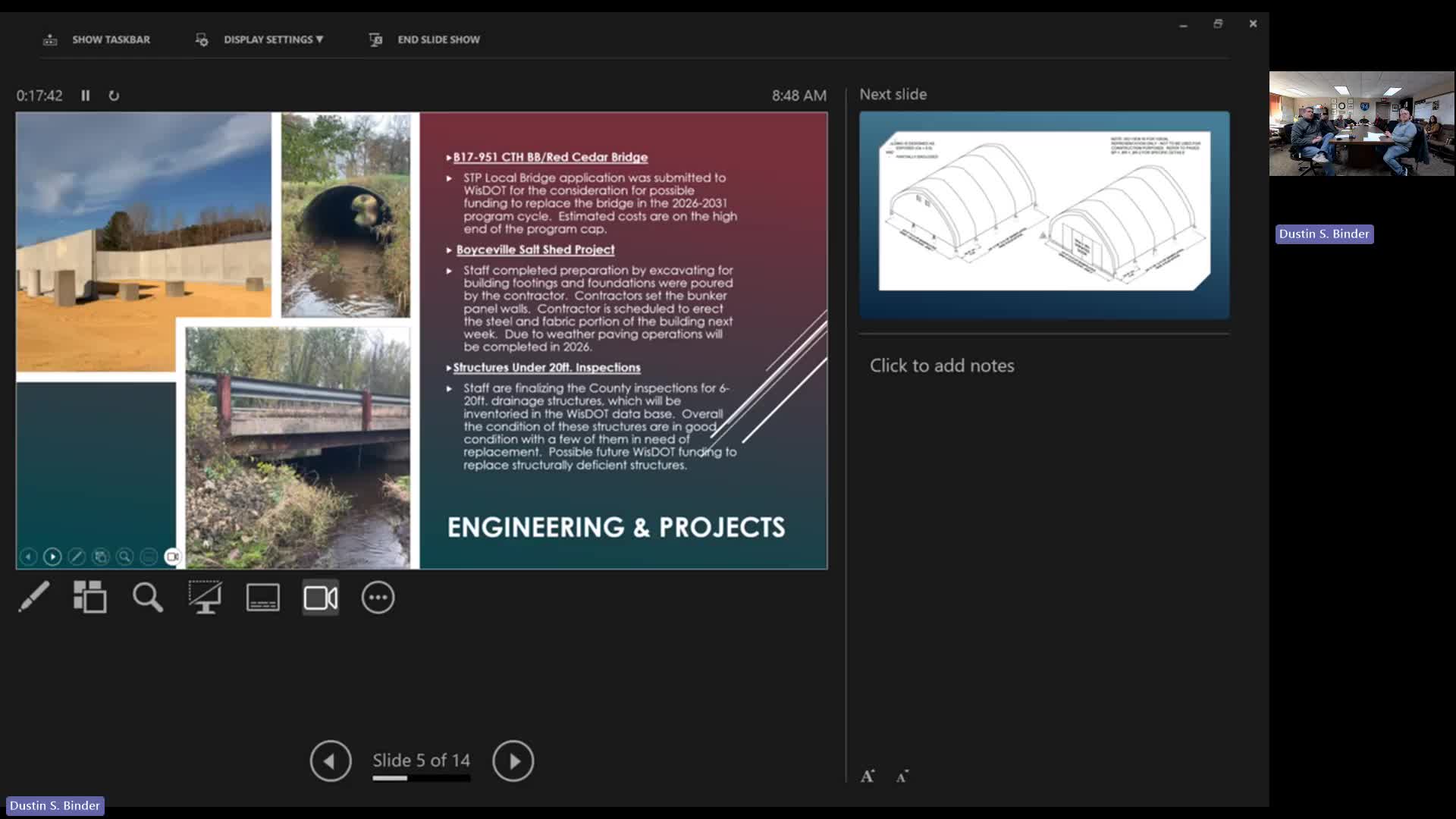
Summary
Staff reported an application for the Cedar Falls Bridge replacement with an estimated cost near $10 million, scheduled bridge replacements including one in 2027, and progress on a DOT-funded 53x64-foot salt shed in Boyesville. Public meetings and detour impacts were discussed.
The Vanders Qualls Highway Committee received project updates that included large bridge replacement planning and construction of a county salt shed.
Speaker 1 told the committee that the Cedar Falls Bridge application has been submitted to DOT’s 2026–2031 program and that the project estimate in the package is “right around that $10,000,000” to replace the bridge; staff added roughly 20–25% contingency to the application to allow for inflation and unknowns. The design discussion identified an upstream dam and privately held property crossing the project footprint; staff said the county may need to acquire that property, which will increase cost and schedule complexity.
On the County Road v Sand Creek Bridge, staff announced a 2027 replacement window and said the public information meeting on Nov. 5 drew roughly a dozen people. The replacement is expected to close the bridge for about two months with a long detour; staff noted that local roads likely will be used and that towns can post bridges/roads to restrict heavy traffic during detours.
The Hay River (High) Bridge public meeting was rescheduled to Dec. 1 after staff reported the notice was not posted in the paper as required; the postponement was attributed to miscommunication among engineers, WisDOT and county staff.
On facility construction, staff reported that Greystone Construction has set concrete bunker panels for the Boyesville salt shed. The structure is described in the packet as a 53-by-64-foot facility with capacity for approximately 1,000 tons of salt and is funded by DOT; staff said paving inside the bunker will be deferred until next year because of weather and that they are evaluating whether to pour concrete inside rather than asphalt because salt accelerates asphalt deterioration and the interior space has tight maneuvering.
Staff emphasized that county bridge-structure inspections and inventory remain ongoing: structures under 20 feet must be finalized and submitted to the state before year-end and about a dozen county structures remain to be inspected. The DOT indicated possible supplemental LRIP funding to help replace some county structures.
Staff said more design and funding work is required and that project schedules and costs will be refined as engineering and property issues are resolved. The committee took no formal vote on these projects at this meeting.