Get Full Government Meeting Transcripts, Videos, & Alerts Forever!
Get email alerts on the Mature Tree Ordinance topic
No spam. Unsubscribe anytime.
Encinitas committees debate "mature tree" ordinance: who it would cover and how to replace removed trees
Summary
City staff presented a draft "mature tree" ordinance and members of the Environmental Commission and Urban Forest Advisory Committee debated who would be covered and how removed trees should be replaced or funded.
City staff presented a draft "mature tree" ordinance and members of the Environmental Commission and Urban Forest Advisory Committee spent the meeting debating how broadly it should apply and how to ensure removed trees are meaningfully replaced or preserved.
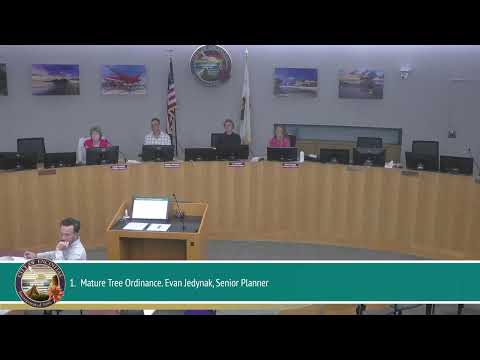
Senior Planner Evan Jednak told the joint meeting the effort began after city council direction in December 2021 and the draft would formally define a "mature tree," set objective preservation standards and a mitigation hierarchy, and create a funding mechanism for tree preservation. "This effort was initiated by the city council in December 2021," Evan said during his presentation.
The draft defines a mature tree as any tree with an 11-inch or greater trunk diameter at 4.5 feet above the base, with a lower 9-inch threshold for native species and a 4-inch threshold for native scrub oak. The ordinance would exempt certain species categories (city-listed invasive trees, monocots, fruit trees and heritage trees, the latter subject to separate rules). It would apply to public property and to private properties in new development and to redevelopment that affects landscaping; in addition the staff version would cover multifamily, commercial and mixed-use properties regardless of whether development is proposed.
Under the draft mitigation hierarchy, preservation is the first priority; if preservation is infeasible, replacement is required and only if replacement is infeasible may an applicant pay an in-lieu fee. Replacement ratios in the staff draft include 1-to-1 when an arborist documents a tree is dead, hazardous or interfering with life/safety or utilities; otherwise the proposal uses 3-to-1 for on-site replacement (reduced to 2-to-1 if replacing with native trees) and 4-to-1 for off-site replacement (reduced to 3-to-1 for natives). The ordinance includes a two-year lookback window to capture recent removals tied to later development applications and requires a three-year arborist check to confirm replacements survived to maturity.
The committee discussion highlighted four core disputes. First, whether single-family properties should be exempt. UFAC members said most California cities that adopt tree preservation rules do not carve out single-family residences; staff said the UFAC version would limit single-family coverage to removals tied to development permits (the two-year lookback). Commissioners raised concerns about enforcement and political feasibility if private yards were subject to penalties.
Second, several committee members pushed to strengthen the penalty structure and move quickly to an in-lieu fee when on-site replacement is not feasible. Evan said the draft incorporates treble fees (three times an appraised value) and directed those proceeds to a new city tree preservation and planting fund. "We took the idea from the UFAC of treble fees, which is 3 times the appraised value," Evan said.
Third, the group debated exempting properties located in CAL FIRE high or very-high fire hazard severity zones. UFAC members urged a case-by-case approach, arguing "a healthy, well irrigated, well maintained, large tree can actually be of some significant benefit," while staff clarified an exemption would allow property owners to remove trees without the ordinance review process and that any future state regulation would supersede the local ordinance.
Fourth, members questioned whether fruit trees should be exempt. UFAC members noted that protecting fruit trees at the 11-inch DBH threshold would cover only a small share of homegrown fruit trees and that preserving some commercial or historic groves could be desirable. Staff and members agreed that if fruit trees remain exempt the ordinance should define "fruit tree" precisely.
Members also pressed staff on practical matters: how many viable public sites the city actually has for off-site planting (staff cited roughly 4,300 candidate locations but acknowledged many are not plantable due to utilities or other constraints), how replacement obligations would be implemented by city crews or contractors, and how the municipal code’s existing requirement (30 trees per acre for qualifying developments) interacts with replacement ratios.
The committees converged around a few practical positions: (1) prioritize on-site replacement and require the city arborist to review developer arborist findings; (2) move to stronger in-lieu fees and place proceeds in a dedicated fund for tree preservation and maintenance if an on-site option is truly unavailable; and (3) build an evaluation mechanism using canopy metrics (LiDAR, ISA guidance) to test whether the ordinance meets canopy goals.
UFAC Chair Levkowitz and other members asked staff to bring clarified language back to the planning commission (tentatively scheduled for December) and ultimately to city council after the new year. The UFAC also asked staff to document the four specific discrepancies between the UFAC and staff drafts — applicability to single-family homes, replacement requirements vs. in-lieu fees, fire-hazard exemptions, and fruit-tree exemptions — and to collect additional examples and fee guardrails so property owners understand potential penalties.
The meeting ended without a formal vote. Chair Kramer/Cramer thanked staff for the briefing and encouraged UFAC representatives to present the committee’s recommendations at subsequent hearings.