Get email alerts on the Comprehensive Plan topic
No spam. Unsubscribe anytime.
Planning staff reviews comprehensive-plan draft, flags water reliance and notification rules
Summary
Planning staff reviewed a draft update to the Cochise County comprehensive plan, emphasizing land-use mapping, near-total reliance on groundwater and a 60-day public review process.
Planning staff presented a draft update to the Cochise County comprehensive plan and walked commissioners through key chapters — including land use and growth, water resources, energy, public services, housing and economic development — and explained next steps for public review.
Planning staff described the draft as "data driven," noting it is intended to guide growth, protect natural resources and identify infrastructure priorities. On water resources staff said county water supply depends overwhelmingly on groundwater: "it's 99.7% groundwater," and the draft emphasizes conservation, recharge and planning for drought and population changes. Staff told the commission that the county's legal authority over water allocation is limited: "We can't directly restrict or prioritize water... that authority does fall under ADWR," and recommended the county pursue incentives and education to support local agriculture where feasible.
In the energy chapter staff described goals that encourage renewable energy, resilience and planning for energy storage and emerging technologies. The presentation mentioned potential study of "small-batch nuclear adjacent initiatives" as an option to research for long-term resilience; commissioners discussed tradeoffs between renewable projects and land-use impacts, and some raised concerns about maintenance and longevity of solar and wind infrastructure.
On housing the draft highlights a need for diverse housing options, support for renters and first-time buyers and a county-affiliated affordable housing study expected to conclude later this year. The economic-development chapter emphasizes Fort Huachuca and county government as major employers and sets priorities around ports of entry, broadband expansion and workforce development.
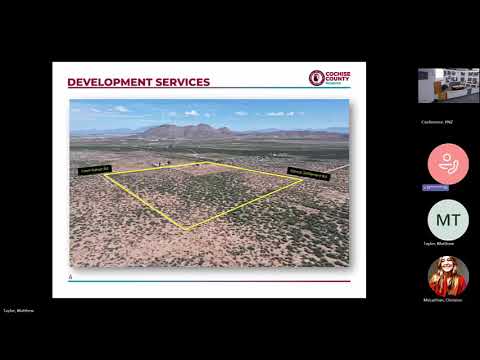
Mr. Taylor then reviewed citizen-notification requirements for zoning and plan actions: Arizona law and county rules typically require mailing notices for rezones and special uses within a minimum 300-foot radius; comprehensive plan amendments have a minimum notification radius of 1,500 feet. Mr. Taylor told the commission that staff exercises discretion to expand notices (to 500 feet, 1,000 feet or more) based on parcel size and development pattern to better reach affected owners, and noted required timing: mailed notices, property posting and legal advertisements must occur at least 15 days before a hearing. He illustrated the tradeoffs in notice counts for different radii and encouraged use of web outreach and e-mail subscriptions to boost participation.
Next steps: staff plans to finalize edits and transmit the draft for a 60-day review by agencies and the public; it will post the document online and place physical copies in county libraries for public inspection. Staff will compile submitted comments and return a responses spreadsheet to the commission before a public hearing and a subsequent recommendation to the Board of Supervisors. If adopted by the Board, the comprehensive plan is effective for 10 years.
What to watch: the county's stated dependence on groundwater, and how the draft balances water and growth goals; staff expects to receive agency and public comments during the 60-day transmittal period and return a consolidated comment report to the commission.
AI generated
The text on this page is AI generated. Summaries, highlights, analysis, and video transcripts are all produced from the original source material.
AI can make mistakes, so if you spot one, and we will fix it for everyone.
Note: the source content is unaltered by us. Any content source we link to, be it a video, an audio recording, or a document, is presented exactly as its publisher released it. That publisher is usually a government body, sometimes an individual official or another organisation.