
Bettendorf board hears DCAP update as district tops state in work-based learning score
Get AI-powered insights, summaries, and transcripts
Sign Up Free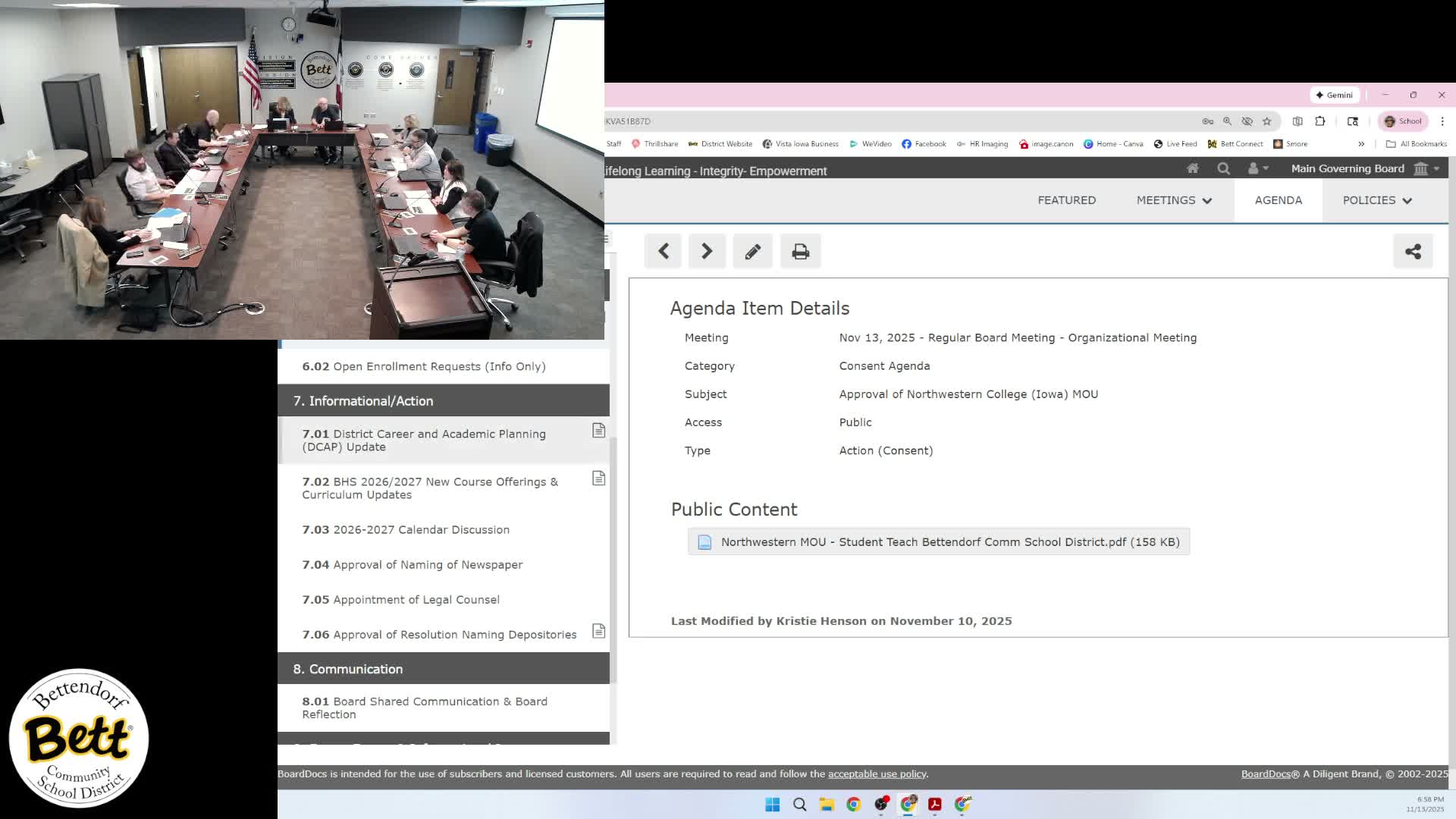
Summary
Career readiness coordinator Haley Hoyt told the board the district adopted Cougar Navigator, reported 2,100+ student assessments and that Bettendorf’s work‑based learning score rose to 76.89 — the highest among comparable districts. The presentation covered FAFSA outreach and next-year DCAP goals.
Haley Hoyt, career readiness coordinator for the Bettendorf Community School District, told the board Wednesday that the district’s District Career and Academic Plan (DCAP) is now serving younger students, producing new data and guiding curriculum and counseling work across grades.
The presentation—required annually by state rules—covered eight DCAP components, including career exploration, career information, a four‑year plan and work‑based learning. "Starting this year, House File 316 said that this work . . . needed to go down to fifth grade," Hoyt said, describing changes to the state requirement and the district’s preparations for younger students.
Hoyt said the district switched career‑information systems after the previous vendor’s summer update failed. A task force selected Cougar Navigator (Kuder), which Hoyt said now shows more than 2,100 students in Bettendorf Middle and Bettendorf High have completed interest assessments. "Within a couple clicks, I can look and see what students have completed interest assessments," she said, describing the ability to view student‑level and grade‑level trends.
The presentation also highlighted recent performance scores. Hoyt said the district’s college‑credit measure declined from 70.14 (2024) to 68.95 (2025), explaining that course changes — including reducing a ninth‑grade college credit offering — affected that metric. At the same time, she said Bettendorf’s work‑based learning score rose from a transitional 17.63 to 76.89 in 2025. "This is the highest score, for the schools of our district size," Hoyt said, noting statewide interest in the district’s practices.
Hoyt detailed a targeted FAFSA campaign aimed at increasing senior completion of the Free Application for Federal Student Aid. She said staff pursued individualized outreach, partnered with Iowa College Aid (ICAN) and local colleges for appointments and opened her calendar to families; the senior class exceeded the district’s goal, reaching 60% completion by the district deadline. The district has set a 55% goal for the next year.
Looking ahead, Hoyt said the district will integrate DCAP work into advisory and classroom planning so career learning is not “one more thing” for staff. Goals for 2025–26 include using Kuder data to support Tier 2 students not on track for their postsecondary plans, expanding elementary representation on the DCAP team and refining four‑year plan implementation.
The presentation was informational; no formal action was taken on DCAP at the meeting. The board asked clarifying questions about parent sign‑offs, credential reporting and how state scoring changes map to local practice. Hoyt said she will return with further updates after the next scoring window.