Get Full Government Meeting Transcripts, Videos, & Alerts Forever!
Get email alerts on the Whitehorse Road topic
No spam. Unsubscribe anytime.
Broadwater commissioners acknowledge 2018 memo on White Horse Road; no formal legal change, urge BLM engagement and local maintenance agreement
Summary
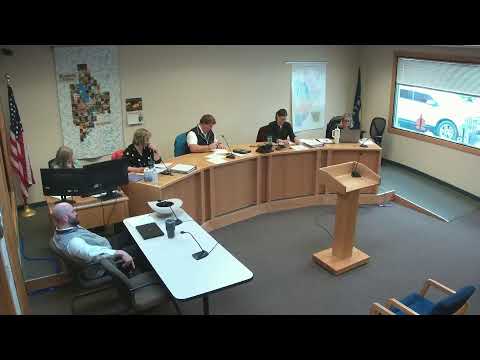
Madam Chair opened a lengthy public discussion on White Horse Road and read a 2018 memo by former county attorney Corey Swanson concluding the route is not a county road and is composed of multiple private easements.
Madam Chair opened a lengthy public discussion on White Horse Road and read a 2018 memo by former county attorney Corey Swanson concluding the route is not a county road and is composed of multiple private easements.
Commissioners and staff described the road as composed of multiple easement strips across private parcels, with the southern boundary of several properties formed by those easements. County officials noted the board has a moratorium on accepting new county roads and that no record was found showing the road was formally adopted as a county-maintained route in the historical record.
County Community Development Director Nicole Brown and County Attorney Kevin Bratcher summarized staff findings: the recorded easements allow use by heirs, assignees and invitees of the servient properties; the practical effect is broad public access because the Bureau of Land Management (BLM) owns property at the road’s terminus; and, under current law, maintenance responsibility rests with the private landowners unless a county adoption or court order says otherwise.
Residents described decades of mixed practice and continuing disputes. Tim Ravindahl, representing the White Horse Road residents’ group, asked the commission to put a county statement on the record supporting the residents’ position and to send a letter inviting BLM (and other agencies and commercial users) to participate in talks on maintenance and access. He said in public comment: “We came in here to try to make sure that we bring BLM … to the table and participate.”
Several residents, including Terry Lewis and John Vandenaker, described practical impacts they say result from the legal uncertainty, including past county maintenance petitions and what they described as fuel-tax receipts historically applied to the route. Vandenaker said the uncertainty restricts his ability to sell or subdivide property that the road crosses: “I cannot sell a teaspoonful of ground,” he said.
Commissioners discussed options and expressed reluctance to issue a formal county declaration that would attempt to bind title or an adversary to a legal conclusion. County Attorney Bratcher and others advised that a declaratory legal action or a final judicial determination would be required to change legal status beyond the 2018 opinion; the county itself said it lacks standing to seek such a declaratory judgment on a private road in the absence of a county-adopted road.
Commissioners and staff signaled support for three near-term steps: (1) put on the public record that the commission recognizes the 2018 Swanson memo and that the road is presently treated as private easement-based road with wide public access, (2) ask county staff to contact BLM and provide BLM with residents’ contact information and the record so BLM can decide whether it will negotiate an MOU or similar maintenance agreement, and (3) encourage residents to organize a formal owners’ group or road-maintenance entity that could contract or MOU with BLM or another agency. No formal motion to declare the road private or to change legal status was adopted during the meeting.
Madam Chair and Public Works Director TJ Gravely said the county has seen maintenance MOUs where federal landowners maintain sections of a route (the board cited the recent Copper City example) and noted that BLM will generally require an organization or entity to contract with rather than pay private individuals directly.
The discussion closed with commissioners agreeing to pursue outreach to BLM for guidance and to provide a letter of support to the residents if staff can identify an appropriate recipient at BLM; commissioners asked residents to form or identify an entity that would be the counterparty for any MOU or funding.
Ending: The county recorded the discussion and asked staff to contact BLM and return to the board with any response; residents were encouraged to organize a road-maintenance agreement or HOA-equivalent to enable a practical MOU.