Get Full Government Meeting Transcripts, Videos, & Alerts Forever!
Get email alerts on the Electric Utility Policy topic
No spam. Unsubscribe anytime.
Utility seeks higher application fees and new charges for very large customers to cover engineering and legal costs
Summary
Electric Utility staff proposed amendments to the Line Extension and Meter Connect Policy to recover engineering costs in application fees, add fees for very large customers (102850 MW) to cover legal and project-management expenses, adopt an adjusted plant investment fee for dedicated backbone cases, and clarify refunds for inactive projects.
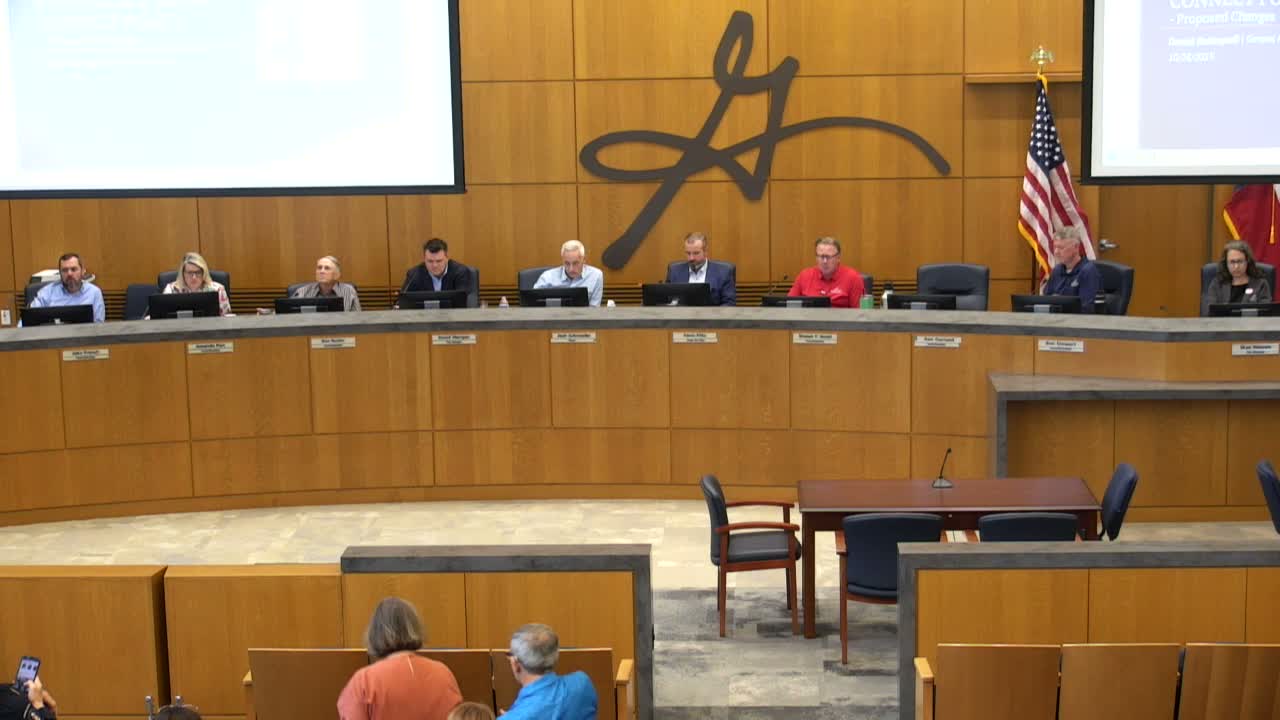
Daniel, representing the Electric Utility, presented proposed amendments to the Electric Line Extension and Meter Connect Policy and asked council to accept changes that would increase application fees and clarify how the utility recovers costs for large and inactive projects.
Daniel said the policy was rewritten in March 2020 to help growth pay for growth, and the new amendments address four principal areas: (1) increasing the application fee to recover engineering review costs so those costs are not left as operating expenses when applicants later withdraw; (2) charging additional fees for very large customers (10 MW to 50 MW) to cover complex legal work and project-management time, particularly when energy service agreements are required; (3) adopting an adjusted plant investment fee in special cases where a customer already funds dedicated backbone infrastructure so the customer does not pay twice for the same capacity; and (4) clarifying inactive-project refunds by treating any project inactive after 12 months as eligible for a refund net of costs incurred.
Daniel walked through example calculations for the plant investment fee and said the fee is charged per kilowatt of diversified load; he offered an illustrative figure that a 300 kW commercial load (a typical small restaurant example) would pay roughly $9,500 under the current structure. The application-fee increases were described as modest for single-family services (roughly $150) and larger for commercial or multiunit projects (roughly $1,800 for many categories), with tiered increases for projects between 1 MW and 10 MW and higher handling fees for projects over 10 MW.
Staff noted the Electric Board reviewed the amendments and supported them as a mechanism to recover direct costs associated with large, complex extensions. Council asked staff to return with the ordinance language for formal adoption in a forthcoming meeting cycle.
Ending: Staff will present ordinance language and recommended fee schedule for council consideration in the regular policy update cycle.