Get Full Government Meeting Transcripts, Videos, & Alerts Forever!
Get email alerts on the Pre K topic
No spam. Unsubscribe anytime.
Hearing finds Philadelphia's beverage-tax revenue declining; city pre-K and related programs increasingly rely on general fund
Summary
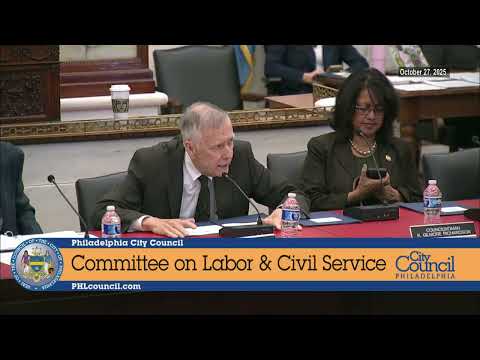
PHILADELPHIA ' City finance officials told the Council's Committee on Labor and Civil Service on Oct. 31 that Philadelphia's sweetened beverage tax can no longer fully cover the programs it was created to fund, and that the city's five-year plan anticipates increasing general-fund supplementation.
PHILADELPHIA ' City finance officials told the Council's Committee on Labor and Civil Service on Oct. 31 that Philadelphia's sweetened beverage tax can no longer fully cover the programs it was created to fund, and that the city's five-year plan anticipates increasing general-fund supplementation.
Rob Dubow, the city's finance director, told the committee that the tax, enacted in 2017 at 1.5 cents per ounce, generated about $77 million in its first full year but has trended downward in most years since. "In the September since the beverage tax began, it's generated about $620,000,000 in total revenues," Dubow said. He told members that FY25 collections were estimated around $68 million and projected FY26 receipts about $64.6 million.
The gap emerges when those receipts are compared with program costs. Dubow said city estimates for FY26 put the cost of serving the roughly 5,200 children currently in PHL Pre-K at about $73 million; adding community-schools expenditures raises that to roughly $83 million, and including Rebuild-related costs pushes the total toward $110 million. "So you can see the cost of the programs are more than what the tax is generating," he said.
Chair Councilmember Anthony Harrity pressed why beverage-tax proceeds flow through the general fund and whether that routing reduces transparency for intended beneficiaries. Dubow replied that the original financial model anticipated that the city would scale programmatic costs and that the general fund would eventually contribute: "When the program was first put in place, what we always said was that the programs were going to scale up ... FY24 was the year it flipped, so we actually spend more on these programs than is generated by the beverage tax."
Several council members asked for more detailed budget schedules and for reconciliation with the controller's numbers. The committee requested a project-by-project listing of Rebuild projects and costs since the tax began, and asked city staff to provide more detailed five-year-plan calculations showing how program costs will be funded over time.
Why it matters: PHL Pre-K, community schools and Rebuild are high-profile city initiatives that city and community leaders say expand early learning, support working parents, and fund parks and recreation improvements. If the beverage-tax trend continues, the city will need to identify a longer-term funding strategy'whether deeper general-fund commitments, broader revenue sources, philanthropic partnerships or a different tax design. The committee signaled interest in convening a working group to evaluate options.
Sources: Rob Dubow, City Finance Director (testimony); committee questioning and staff responses. The committee did not take any formal vote during this hearing.