Get Full Government Meeting Transcripts, Videos, & Alerts Forever!
Get email alerts on the Public Land Referendum topic
No spam. Unsubscribe anytime.
Boca Raton council refers two citizen measures on sale/lease of public land to Jan. 13 ballot
Summary
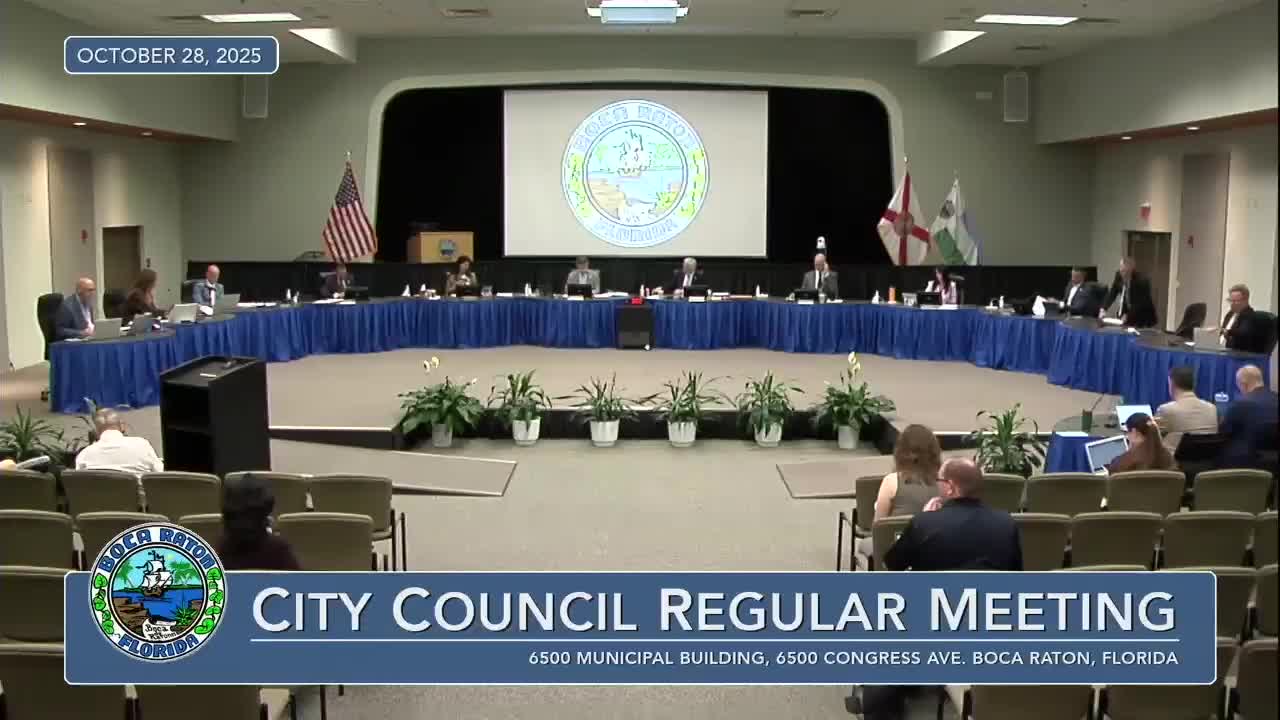
The Boca Raton City Council voted 5–0 Oct. 28 to place two identical citizen‑initiated measures — an ordinance and a charter amendment — that would prohibit the lease, sale or other alienation of city‑owned land greater than one‑half acre without voter approval on the Jan. 13, 2026 special election ballot.
The Boca Raton City Council voted 5–0 on Oct. 28 to place two identical citizen‑initiated measures on the Jan. 13, 2026 special election ballot: one measure would add an ordinance prohibiting the lease, sale or other alienation of city‑owned land greater than one‑half acre without voter approval; the other would add the same restriction to the city charter.
Why it matters: Both measures were filed by citizens and certified as sufficient by the city clerk under the charter signature requirements. If approved by voters, the measures would limit the council’s authority to transfer or lease sizable parcels of city land without a public referendum, potentially affecting future proposals that would use or repurpose public property.
The two petitions are identical in substance but differ in legal effect: a successful charter amendment would change the city’s charter directly, while an ordinance would create a municipal law requirement. City staff and the city attorney explained that the charter requires the council to consider and act on a certified initiative; because the petitions were certified and one of them is explicitly a charter amendment, the council moved to place both measures on the ballot.
Council discussion touched on timing and scope. Councilmember Michael Thompson said he wanted the council to take an up‑or‑down vote on the petitioned ordinance before referring it to voters; his procedural motion to have the council vote directly did not get a second earlier in the meeting. Council members discussed potential unintended consequences, including whether long‑standing leases, easements or agreements with nonprofits could be affected. Several councilmembers asked staff to prepare an inventory of existing leases and concessions so that the city could identify any operational impacts the measure might create.
Public comment was robust: proponents of the petitions said they were protecting parkland and public trust after months of controversy over a proposed downtown redevelopment. Opponents warned that the measure’s language — in particular the terms “alienation” and “any part thereof” — could trigger legal challenges or force referenda for routine transactions, easements, or utility agreements.
What passed: The council adopted Resolution 159‑2025 (referring the citizen ordinance) and Resolution 160‑2025 (referring the citizen charter amendment), each amended on the dais to set Jan. 13, 2026 as the election date; both measures passed 5–0. The clerk will perform the remaining administrative steps to place the questions on the special election ballot.
Provenance (excerpted): "Resolution 1 59 20 25...providing for submission to the electors of a proposed ordinance prohibiting the lease, sale, or other alienation of city owned land greater than 1 half acre..." — Clerk read title (00:35:07) "When an initiative or referendum petition has finally been determined sufficient, the council shall promptly consider the proposed initiative ordinance..." — public speaker quoting charter (01:20:26)
Ending note: Both referred questions will appear on the Jan. 13, 2026 special election ballot. City staff said it will prepare materials and, at council direction, inventory existing leases and easements so voters and officials better understand any practical consequences.