Get Full Government Meeting Transcripts, Videos, & Alerts Forever!
Get email alerts on the Government Campus Redevelopment topic
No spam. Unsubscribe anytime.
Developer unveils revised '1 Boca' downtown campus plan; city staff begins financial, traffic and appraisal reviews
Summary
Rob Frisbie, principal of the Frisbie Group, unveiled a revised development proposal for Boca Raton’s downtown government campus that would keep land west of NW Second Avenue public while concentrating private development east of Second Avenue.
Rob Frisbie, principal of the Frisbie Group, unveiled a revised development proposal for Boca Raton’s downtown government campus that, he said, would leave all land west of Northwest Second Avenue in public ownership while concentrating private development on parcels east of Second Avenue.
The proposal calls for reducing the area proposed for a long‑term lease from about 31 acres to under 8 acres and doubling the city’s usable park and civic acreage from 7.6 acres to about 15.4 acres. Frisbie said the plan includes seven east‑side buildings (an office building adjacent to the Brightline station, two residential buildings between Third and Second streets, two north of First Street, a hotel and a condominium building), 769 residential units including 186 condominiums, a 150,000‑square‑foot office building and a 180‑key hotel. He said most buildings south of Fourth Street would be 125 feet tall and the office building near the Brightline station would be 100 feet tall.
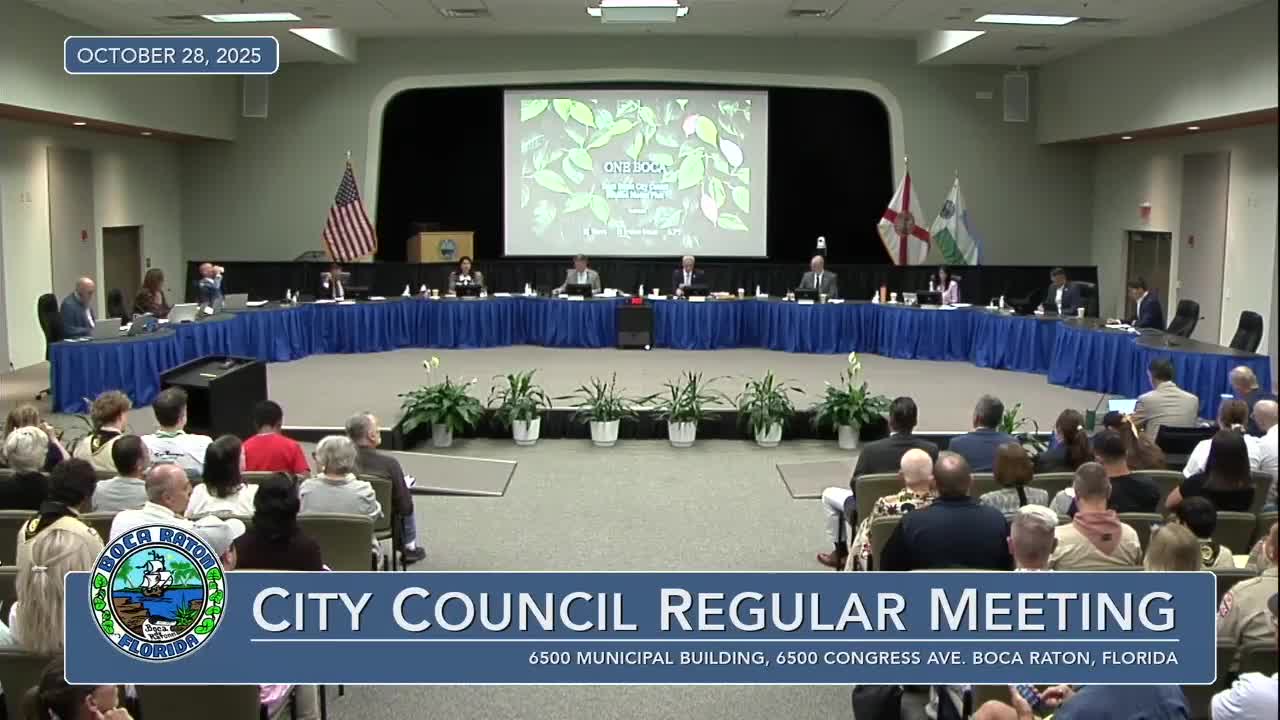
Why it matters: The campus sits at the heart of downtown and includes Memorial Park, the library and a number of long‑standing recreational facilities. The revised plan was presented to the council during a meeting that included an extended public comment period, with many residents raising concerns about parkland protection, recreational fields, traffic and transparency while other speakers supported job creation and station‑adjacent redevelopment.
Frisbie said the plan would “protect public land, expand parks and amenities, and connect the civic center to the rest of downtown.” He told council members the leased area now “is less than 8 acres,” and that the team had reduced building square footage about 20 percent compared with an earlier iteration. He also presented finance figures, saying the project would generate a total gross of $3,800,000,000 over a 99‑year term and a net present value of about $370,000,000 (Frisbie said the NPV of rental payments alone would be $217,000,000).
City staff said they are conducting a high‑level review of the master plan’s traffic and infrastructure impacts, working on appraisals of campus properties, re‑running revenue projections for property and ground‑lease revenues, and engaging PFM as an independent financial consultant to review the pro forma, internal rate of return and public benefit criteria under applicable P3 guidance.
City deputy manager Andy Lukasick told the council staff is examining both the public and private infrastructure cost sides and preparing more detailed traffic analysis that would be required at the site‑plan phase.
Public reaction was mixed and at times sharply critical. Dr. Lorraine Blank, who identified herself as the lead petitioner in a lawsuit filed in August, told the council she had sued the city seeking an injunction and argued the project needs a cost‑effectiveness analysis that considers environmental, social and opportunity costs; she said the first hearing is scheduled for Dec. 12. John Perlman, founder of the Save Boca group, told the council the citizen effort “saved Memorial Park,” and said residents collected petitions because they feared the city was “about to hand over public land to private developers.”
Several speakers urged the city to proceed more cautiously, seek independent verification of financial claims, and prioritize flood and stormwater infrastructure before major redevelopment. Others, including business owners and longtime residents, said a transit‑adjacent redevelopment would bring jobs and housing choices and help keep downtown economically competitive.
Where it goes next: Staff said the city will continue technical reviews and that PFM will complete a third‑party financial analysis. Frisbie’s team said it expects to return with additional financial detail and a more formalized presentation in the coming weeks.
Provenance (excerpted): "First, there will be no private development West Of Northwest Second Avenue in Memorial Park." — Rob Frisbie (developer presentation, 00:33:11) "We are...working on an appraisal of the properties...and reviewing our revenue projections..." — Deputy City Manager Andy Lukasick (staff presentation, 00:27:39) "I filed a lawsuit against the city asking for an injunction against this project...the P3 statute requires a cost effectiveness analysis..." — Dr. Lorraine Blank (public comment, 01:02:50)
Ending note: The council did not vote on a redevelopment agreement at the Oct. 28 meeting; staff reviews and public concern over parkland and fiscal claims indicate the matter will require further hearings and detailed third‑party analysis before any agreement is approved.