Get Full Government Meeting Transcripts, Videos, & Alerts Forever!
Get email alerts on the Vape Shops Enforcement topic
No spam. Unsubscribe anytime.
City planners and police outline zoning limits and enforcement challenges for vape shops amid spike in related robberies
Summary
Planning staff and the Richmond Police Department told the Public Safety Standing Committee on Nov. 1 that recent zoning changes aim to limit where vape shops may locate, but enforcement remains difficult and police say the businesses are targets for violent robberies.
City planning staff and police on Nov. 1 briefed the Public Safety Standing Committee on zoning rules and enforcement challenges for retail sales of tobacco and hemp 94 commonly called vape shops 94 and described an uptick in violent, takeover‑style robberies at those locations.
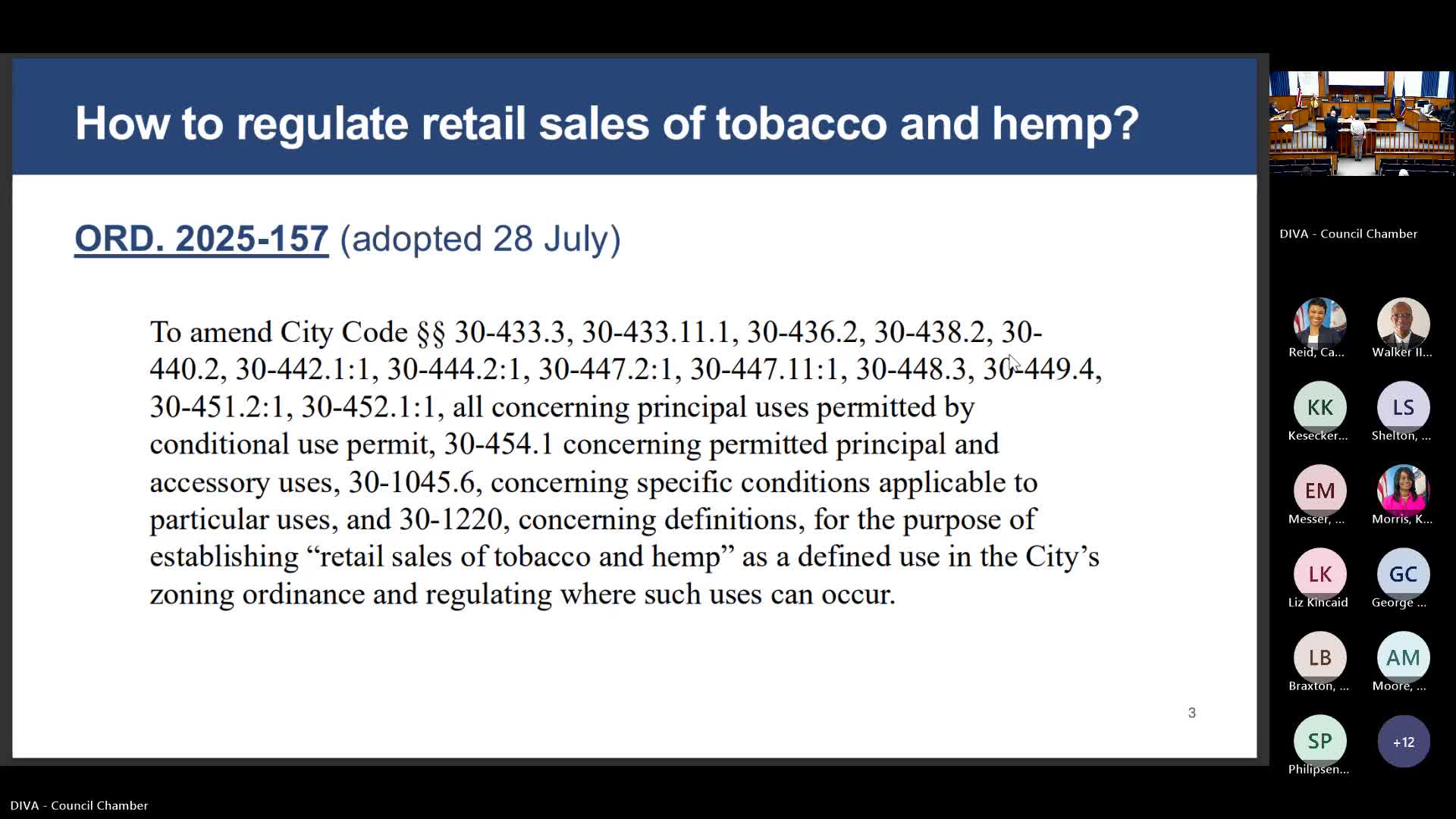
Kevin Javonk, director of Planning and Development Review, said City Council adopted zoning amendments (referenced in committee materials as Ordinance 2025-157) on July 28 that define "retail sales of tobacco and hemp" using a 10% threshold (by floor area, display area, sign area, inventory or gross revenue). The rule makes such uses subject to a conditional‑use process, imposes 1,000‑foot buffers from residential districts and youth‑serving places (day cares, schools, parks, libraries, places of worship), prohibits drive‑through sales and requires sales to occur inside the building. Preexisting businesses are legally nonconforming ("grandfathered") unless the use stops for two years or the business lacks required permits.
Richmond Police Chief Rick Edwards told the committee the department has counted 87 retail locations that meet enforcement suspicion citywide 94 more than many fast‑food chains in the city. Edwards said police have executed 10 search warrants at vape shops this year, seized more than 75 pounds of marijuana/THC products and recovered 10 firearms. He said 34% of the city's commercial robberies this year have occurred at vape shops, describing many incidents as violent "takeover" robberies in which masked suspects order employees and customers to the ground and sometimes zip‑tie victims. Chief Edwards also cautioned that many shops sell packaged products that mimic candy or trusted brands, increasing the risk of accidental ingestion by children and making product origin difficult to trace.
Staff and the chief described enforcement limits. While police can criminally enforce illegal marijuana activity, building, zoning, business-license and health-code violations fall to other city departments; shops that obtained certificates of occupancy and business licenses after the July 28 zoning change may be legally nonconforming and able to continue operating. Staff said coordinated enforcement frequently uncovers building, licensing and health violations that can be used to close unlawful operations, but that businesses holding valid permits often reopen after police action.
Committee members pressed staff on tools to curb problematic operators. Ideas discussed include:
- Using the city's drug‑blight/nuisance code (Chapter 11, Article 5, —11-156) and court remedies to address locations tied to repeated criminal activity; - Leveraging Alcoholic Beverage Control (ABC) authority where alcohol sales are involved; - Revoking certificates of occupancy when applicants misrepresented their use; - Coordinating intelligence regionally with Virginia State Police and neighboring jurisdictions; and - Considering taxation of liquid vape products under state code as a deterrent.
Staff noted that transfers of an existing retail use do not automatically remove legal nonconforming status; a use that continues uninterrupted remains nonconforming. Staff also said that if a shop ceases the use for two years it would lose grandfathered status and be subject to the new rules.
No new ordinance was adopted at the meeting; staff and police were invited to continue work on enforcement strategies and to coordinate with the CAO and other departments on remedies that combine licensing, zoning, code enforcement and criminal enforcement.