Get Full Government Meeting Transcripts, Videos, & Alerts Forever!
Get email alerts on the Affordable Housing Policy topic
No spam. Unsubscribe anytime.
PCDC backs updates to city policy for Low‑Income Housing Tax Credit resolutions to favor deeper affordability, on‑site services and transit proximity
Summary
Staff recommended, and the committee supported, revisions to the city's resolution policy for LIHTC applicants that increase points for deeper affordability (including additional points for project‑based subsidy and units at 30% AMI), add incentives for on‑site high‑quality pre‑K and proximity to VIA green/silver lines, clarify voucher acceptance,
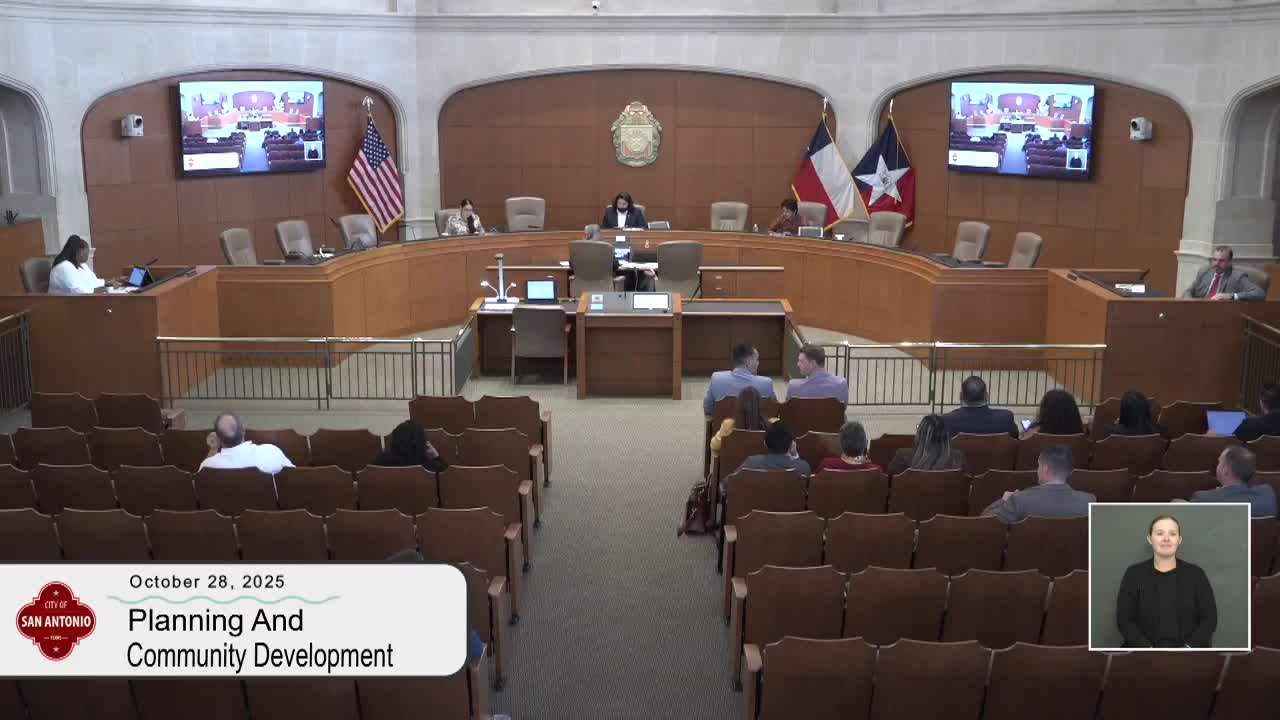
The Planning and Community Development Committee on Oct. 28 recommended city council adopt changes to the city's policy for issuing resolutions of support or no objection for projects seeking Low‑Income Housing Tax Credits (LIHTC) from the Texas Department of Housing and Community Affairs.
Sarah Wamsley Estrada, housing policy administrator for Neighborhood and Housing Services, said the changes reflect council direction and Housing Commission input and are designed to send stronger, locally aligned applications to TDHCA. “The important thing to know is that this is the primary funding source for rental housing production and preservation,” Wamsley Estrada said, describing the two types of credits (competitive 9% and noncompetitive 4%).
Key policy changes include reducing the weight of zoning in the scoring matrix (reflecting Senate Bill 840 provisions), increasing points for deep affordability (developers can earn up to 25 points for substantially exceeding baseline deep‑affordability thresholds and for project‑based subsidy), adding points for proximity to VIA’s green and silver lines (quarter‑mile with partial credit to a half‑mile), scoring for on‑site high‑quality pre‑K developed with Pre‑K for SA, adding points for rent‑assistance funds or housing navigation services, and making local contractor partnerships a threshold requirement. Voucher acceptance must be affirmed by applicants.
Wamsley Estrada outlined the timeline: the city’s request for resolution applications will open Dec. 1; TDHCA pre‑applications are due Jan. 9; the city typically brings resolutions to PCDC in January and to Council in mid‑February (staff cited Feb. 12 for this cycle); full tax‑credit applications go to TDHCA later in the cycle (staff cited a late‑January/February submission window).
Council members pressed staff on accessibility and family‑sized units. Councilwoman Castillo urged stronger measures to increase universally accessible units and family‑sized housing; staff said the next round of gap‑funding and an upcoming UDC cycle will provide additional opportunities to prioritize universal design and family units in complementary funding tools.
The committee moved, seconded and voted to recommend Council include the Housing Commission’s proposed changes to the LIHTC resolution policy.
Details and clarifications from the meeting: staff said projects must still meet TDHCA rules; the city’s region (Region 9) shares competition with neighboring counties; recent subcommittee work produced scoring changes to increase points for deeper affordability and resident services and to incentivize transit proximity and voucher acceptance.