Get Full Government Meeting Transcripts, Videos, & Alerts Forever!
Get email alerts on the Housing Development topic
No spam. Unsubscribe anytime.
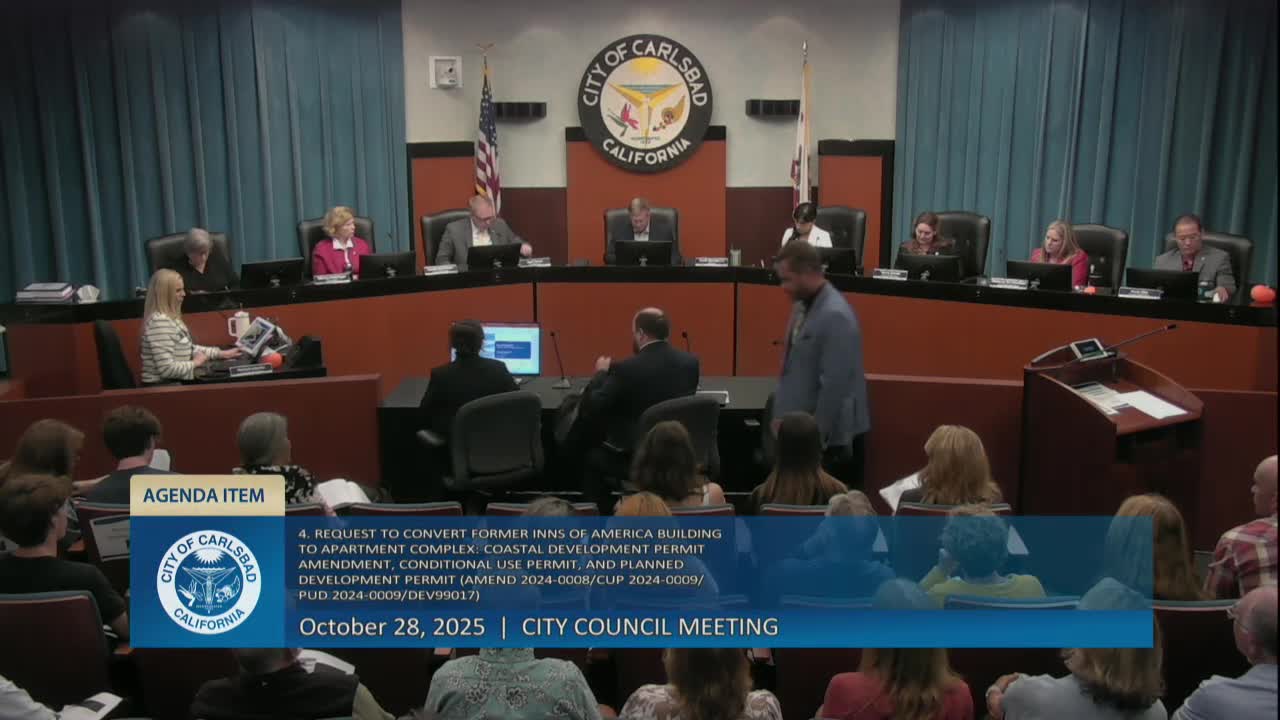
Carlsbad council approves conversion of Ends of America hotel into 98 apartments with 15 affordable units
Summary
The council approved converting the former Ends of America hotel into 98 residential units, including 15 deed‑restricted affordable units, granting four waivers and adding conditions to protect potential long‑term occupants and to mitigate pickleball noise. The vote was unanimous.
Carlsbad — The City Council on Oct. 28 voted unanimously to approve the conversion of the former Ends of America hotel into a 98‑unit apartment development, including 15 deed‑restricted affordable units and site amenities, following staff recommendations and two added conditions addressing potential long‑term occupants.
The project, located on a 3.12‑acre site at the southeast corner of Cannon Road and Avenida Encinas, would convert an existing approximately 65,800‑square‑foot hotel into residential units without adding building square footage. Staff said the developer will provide 7 units restricted to very‑low income households, 5 to low income households and 3 to moderate income households to satisfy state density bonus eligibility and the city's inclusionary housing ordinance.
City planning staff told the council the developer requested four waivers tied to converting the existing structure: waiving the three‑bedroom inclusionary mix requirement (the hotel currently consists of studios and one‑bedroom rooms), reducing the required fully landscaped setback from Cannon Road, providing less community recreation space than the zoning standard, and allowing the existing building height to remain. Staff recommended the council adopt a CEQA categorical exemption (Class 32 infill exemption) and approve the coastal development permit amendment, conditional use permit and planned development permit.
The discussion centered on recently raised allegations that some hotel rooms may have been occupied as long‑term residences. Mike Strong, assistant community development director, explained that state law requires steps to protect tenants if long‑term residency is found and that staff had not been able to validate the new allegations before the hearing. To address that uncertainty, staff recommended — and the applicant agreed to — two conditions: a written declaration from the seller/operator about any occupants who had resided more than 30 consecutive days and a requirement that the developer amend the affordable‑housing agreement if a third party determines that tenants existed so the city can require replacement units at required affordability levels.
Applicant representatives told the council they learned about the occupancy claims only days earlier and have agreed to the two conditions. "We have every intention of operating this, following the rules, following the law," said Marcela Escobar, representing the applicant Atlantis Group. The developer and counsel also told council they require the property to be delivered vacant as a condition of purchase.
Council members also pressed the applicant on an outdoor recreation area that includes two pickleball courts adjacent to Cannon Road. Councilmember Shin and others raised liability and noise concerns and asked whether an 8‑foot fence or a system of nets could prevent errant balls from reaching the public right‑of‑way. The applicant said it would construct an 8‑foot wall if the council preferred or install netting and agreed to incorporate mitigation. The council’s final motion directed staff and the applicant to include netting or equivalent measures to reduce the risk of balls leaving the site.
The applicant previously received a unanimous recommendation for approval from the City Planning Commission. Staff concluded the project is compatible with surrounding industrial park uses, is served by existing sidewalks and bike lanes and complies with applicable development standards apart from the requested waivers. Staff also recommended findings for coastal consistency and presented a draft notice of exemption under CEQA Guidelines §15332.
The council approved the CEQA determination, coastal development permit amendment, conditional use permit and planned development permit, adopting the staff resolution with the two tenant‑protection conditions and the pickleball mitigation requirement. The vote was unanimous.
What comes next: Staff will finalize the conditions and proceed with required permit processing and building permit review. If a third party later substantiates long‑term residency claims, the conditions require the developer to work with the city to ensure replacement housing and tenant protections required by state law.