
City Council marks Clergy Appreciation Month, highlights congregations' roles in homelessness and immigrant support
Get AI-powered insights, summaries, and transcripts
Subscribe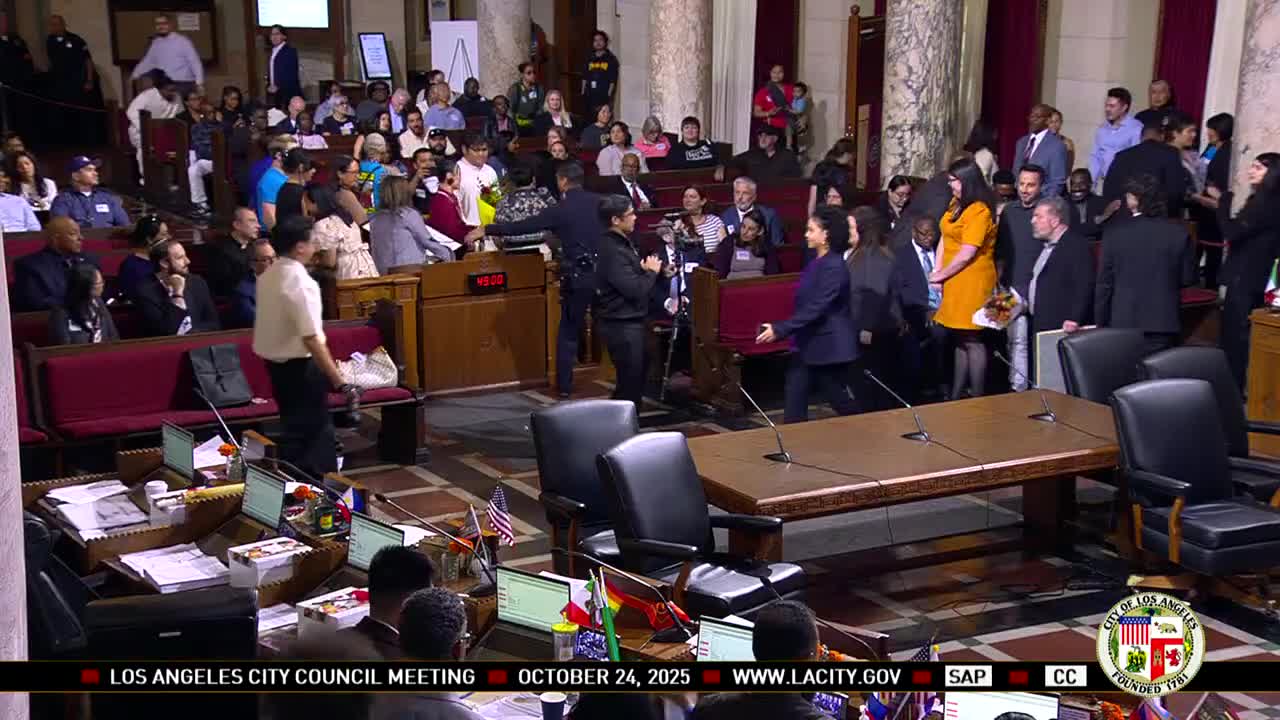
Summary
Council President Marquee Harris-Dawson led the council's annual recognition of clergy across the city. Members of the council presented certificates to faith leaders from each district and emphasized the role of congregations in homelessness response, immigrant support and community services.
The Los Angeles City Council on Friday dedicated part of its meeting to the annual Clergy Appreciation Month, recognizing faith leaders from across the city for community service, disaster response and work on homelessness and immigrant assistance.
Council President Marquise Harris-Dawson led the program and introduced Reverend John Riemer, who offered reflections on service and calling. Twenty or more clergy and faith-based organizations were acknowledged in the chamber; councilmembers from multiple districts presented certificates to honorees including Rabbi Rebecca Schatz (Temple Beth Am), Father Mario Torres (St. Thomas the Apostle), pastors from Purpose LA, Jane Poole of Church of the Chimes, Rabbi Joseph Kanefsky, Pastor Ryan Donnelly (Osborne Neighborhood Church), Reverend Zadar Bridal, Reverend Gentry Atkins, Pastor Julian and Christine Lowe (Oasis Church), Pastor Matthew Harden (Pacific Palisades) and Pastor Robert Taylor (Beulah Baptist), among others.
Speakers praised clergy-led mutual aid, food distributions, access to legal and social services during immigration enforcement actions, neighborhood recovery after fires, and interfaith organizing. The city attorney's remarks highlighted clergy partnership in "tikkun olam" (repairing the world), and several councilmembers noted recent efforts by faith leaders to organize protection and information during immigration enforcement.
The presentations were ceremonial and aimed to highlight the clergy's role in community resilience; no legislative measures were adopted as part of the recognition.