Get Full Government Meeting Transcripts, Videos, & Alerts Forever!
Get email alerts on the Carbon Capture topic
No spam. Unsubscribe anytime.
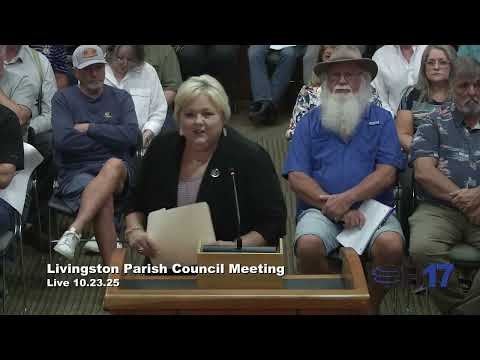
Livingston Parish Council unanimously opposes Class VI CO2 injection wells and pipelines after hours of public comment
Summary
The Livingston Parish Council adopted a resolution Oct. 23 opposing the permitting and establishment of any Class VI carbon-injection wells and associated CO2 pipelines within parish boundaries after a public hearing that drew about 75 speakers.
The Livingston Parish Council adopted a resolution Oct. 23 opposing the permitting and establishment of any Class VI carbon capture injection wells and associated CO2 pipelines within parish boundaries. Councilman Deacon Coats read the final text and Councilman Shavers seconded the motion; the council recorded unanimous support in a roll-call vote and the chair announced the resolution passed.
Why it matters: Residents and local officials said the proposed technology presents health and environmental risks, and they warned long-term liability and property devaluation. Dozens of speakers said federal tax credits and unclear permitting details are driving proposals for local projects and urged stronger local control, independent safety studies, and public access to technical data.
The resolution text affirms the council’s opposition and asks the Louisiana Legislature and the U.S. Congress to give local communities meaningful authority over injection-well projects and to enact stricter federal safety and financial-liability standards. The resolution also directed that copies be sent to the governor, the Louisiana Department of Conservation and Energy and the EPA administrator.
Public hearing and testimony: The council allowed up to three minutes per speaker after announcing that about 75 people had signed to speak. Commenters included residents, local association leaders and state Sen. Valerie Hodges. Common themes included long-term storage uncertainty, seismic and geological instability in Louisiana, the existence of thousands of abandoned wells that could offer leakage pathways, threats to surface and groundwater, and the risk of a heavy CO2 plume causing asphyxiation in low-lying areas.
Representative excerpts from testimony (abridged):
• Rebecca Roberts (Watson): “How much is our health worth? It’s not worth risking.”
• Wade Gilbo: “The CO2 plume can suffocate all living beings and prevent internal combustion engines from starting, making escape and rescue difficult or impossible.”
• Jackie Thibodeaux (resident since 1983): “Louisiana’s geology, environment, and communities make CO2 capture especially risky … we sit on porous, fractured sediment, clay soft clays, sand, and salt domes.”
• Senator Valerie Hodges (District 13): “I’m not against carbon capture sequestration. I’m just against it in Livingston Parish.”
Council and administration remarks: Council members noted a prior local ordinance and subsequent federal litigation challenging that approach; several members said the most effective way to halt projects would be to remove the federal tax incentives that drive them. Parish President Randy De Latt thanked the council and reiterated opposition while urging coordination with the governor and state officials. He also addressed concerns about donations tied to industry outreach and said he declined a six-figure contribution that he believed would create a perception problem.
Formal action and next steps: The council’s resolution is an expression of local policy; it does not, by itself, change parish land-use rules or state permitting procedures. The resolution calls for communication of the council’s position to state and federal agencies and lawmakers and asks for legislative or regulatory changes to increase local authority, financial liability standards and safety rules. The council’s adoption was followed by discussion of legal strategy and a reminder that prior local ordinances had been the subject of federal court litigation.
Clarifying details recorded at the hearing: about 75 residents sought time to speak; the council reduced the speaker limit to three minutes because of turnout; several speakers cited Section 45Q federal tax incentives (transcript references $80–$180 per ton, later reference to $185 per metric ton) as the primary economic driver of projects; speakers asked for independent seismic and groundwater studies, public access to pressure logs and plume models and trained hazmat resources for CO2-specific incidents.
What the council did not do: The parish did not enact a ban or ordinance during the meeting; the action was a resolution expressing opposition and requesting state/federal action or local tools. Speakers and some council members said an ordinance or moratorium had been attempted previously and had been subject to litigation.
Local context: The record of public comment was unusually large for a single topic in Livingston Parish, and senators and other elected officials were present. The council’s resolution will be transmitted to the governor, the Louisiana Department of Conservation and Energy, the EPA administrator and state/federal legislative delegations representing Livingston Parish.