Get Full Government Meeting Transcripts, Videos, & Alerts Forever!
Get email alerts on the School Safety topic
No spam. Unsubscribe anytime.
Sheriff, police describe expanded SRO training, new equipment and school partnerships
Summary
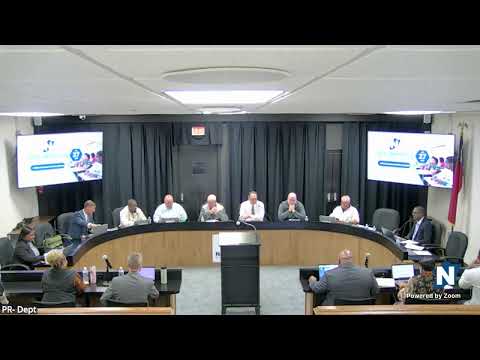
Kevin Bissett, SRO supervisor for the Nash County Sheriff's Office, told the Student Support Services committee that the sheriff's office has reworked its school resource officer program and increased training and tactical preparation.
Kevin Bissett, SRO supervisor for the Nash County Sheriff's Office, told the Student Support Services committee that the sheriff's office has reworked its school resource officer program and increased training and tactical preparation.
The changes follow an internal review and national site visits, Bissett said, and include additional scenario-based simulations, specialized training with the North Carolina State Bureau of Investigation's behavioral threat assessment unit and coordination with Trillium Health for mental-health support. "We were the first agency inside the country to actually go to Uvalde, Texas and speak with those individuals," Bissett said. "The knowledge and wealth was huge."
Why it matters: presenters framed the work as both safety preparedness and relationship-building. Officials said SROs also serve as mentors, coaches and de facto counselors who regularly interact with students outside formal disciplinary contexts, so broadening SRO capabilities can affect everyday school climate as well as emergency response.
What presenters described
- Nash County Sheriff's Office: Bissett said the office currently has 10 full-time SROs assigned to 13 schools and that he serves as the full-time supervisor for the program. He described new and expanded training including annual simmunition exercises (stress inoculation), recurrent firearms and tactics practice, crisis-intervention training (CIT), autism-specific training and partnership training with the FBI on "swatting" incidents. He said SROs were also trained on behavioral threat-assessment techniques delivered by the NC SBI and that all SROs completed an SBI-provided SRO training module.
- Tactical equipment and tactics: Bissett said deputies have been issued Level 3 rifle-rated ballistic shields and have access to long rifles and extended magazines for active-threat responses. He said the office has introduced breaching shotguns for controlled entry and conducts multi-step failure-preparedness drills. "We prepare for the worst and hope for the best," Bissett said.
- Rocky Mount Police Department: a Rocky Mount police representative described a long-standing SRO program adopted locally in 1995, said SROs are state-certified per North Carolina law and highlighted daily collaboration between school administrators and SROs, joint lockdown and scenario-based drills, and school-focused programs such as DARE, reading events, "lunch with a cop" and fundraisers that supply backpacks and school supplies.
- Student supports and certifications: presenters noted crisis-intervention certification (40 hours), youth mental-health training, police law institute training and first-aid certifications as part of the SRO skill set. Both departments emphasized that many SROs are local graduates and that having administrators interview candidates helps ensure "fit" with school culture.
Discussion and context
Board members asked about how SRO responsibilities intersect with mentoring and with other district staff. Bissett and the Rocky Mount representative said SROs commonly act as mentors, coaches and after-school supports; Bissett noted that roughly 4 in 10 SROs serve as coaches. Presenters said the expanded training and equipment were adopted in the last six months as part of a broader effort to update a program that has changed little in prior decades.
No formal board policy or ordinance was proposed by the presenters during this discussion; staff described training and partnership changes and sought input and support. The committee thanked the SROs and presenters before moving on to the next agenda item.
Ending
Presenters closed by reiterating a focus on both day-to-day mentorship and upgraded emergency response capabilities. Committee members thanked the SRO teams for their work.