Get Full Government Meeting Transcripts, Videos, & Alerts Forever!
Get email alerts on the Parks Fields topic
No spam. Unsubscribe anytime.
Lafayette council affirms PTR direction to alter Cheney infield amid Fair Play Act compliance concerns
Summary
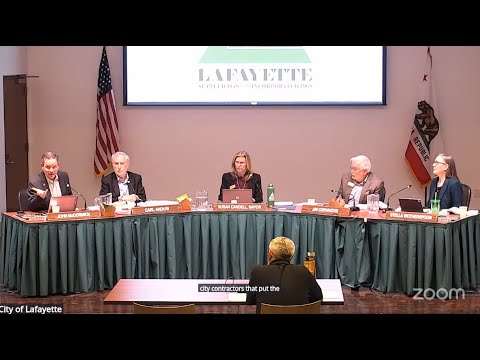
Lafayette — The City Council voted Oct. 21 to affirm the Parks, Trails & Recreation commission’s direction to staff to pursue Option 1 changes at Cheney/Buckeye Fields after the city attorney warned the current allocation likely fails to meet AB 2404 (the Fair Play Act).
Lafayette — The City Council voted Oct. 21 to affirm the Parks, Trails & Recreation commission’s direction to staff on Cheney/Buckeye Fields, moving to implement the option staff identified as necessary to address compliance concerns under AB 2404, the state Fair Play Act.
The action follows an extended public hearing that drew 39 speaker slips and more than two hours of testimony from youth softball players, parents, volunteer coaches and college athletes. Speakers on many sides urged a long-term plan for additional fields and turf, but the council said it must respond now to legal and equity risks identified by staff and the city attorney.
Why it matters: AB 2404 requires substantially equal playing opportunities at publicly owned facilities. City staff and the city attorney advised the council that the current allocation of playable infields raised compliance risks. The council’s vote directs staff to proceed with the PTR-endorsed steps (staff called it Option 1) to alter the Cheney infield surface so it can be used for regulation softball and thereby help correct disparities in on‑site access.
What staff said: Parks, Trails & Recreation Director Jonathan Katnaghi laid out the facility history, user data and three options the PTR considered: (1) remove the grass infield to create a skinned/infield surface (a “70/30 infield mix” described in staff materials); (2) convert to full synthetic turf (higher cost); or (3) remove only the permanent pitcher’s mound while leaving grass. Katnaghi told council the city has budgeted $20,000 this year toward the work staff expects will be required if the infield change is approved, but that synthetic turf or a new field site would require much larger funding and more time.
Legal risk: The city attorney told the council that staff’s review raised “significant concerns” about the city’s compliance with AB 2404 and recommended the council move forward with staff’s recommended option to reduce statutory exposure.
Public comment and stakeholder efforts: The council heard strong, emotional testimony from dozens of speakers. Youth softball players described long travel and limited local opportunities, while Lafayette Little League volunteers emphasized the years of volunteer investment in Buckeye and Cheney and urged a collaborative, fundraised long-term solution. Katnaghi also reported a series of facilitated meetings between Lafayette Little League, Lafayette-Moraga Youth Association (LMYA), and city staff that yielded agreement on many items — portable mound use, a joint task force, and fundraising commitments — but not the single remaining point: whether the Cheney infield’s grass would be removed now.
Council action and next steps: After deliberation the council voted to affirm PTR’s direction to the director and to ask staff to return with a timeline and budget options for both the near-term changes and a longer-term facility plan (including grant options and potential turf/complex development). The resolution recorded in the meeting minutes directs staff to proceed with implementation steps consistent with the PTR recommendation. Councilmembers urged continued partnership among the user groups and directed staff to prioritize seeking funding and identifying a timeline to restore or enhance facilities in the longer term.
What the decision does not do: The action does not immediately preclude the city or user groups from pursuing synthetic turf or a new softball complex; council members repeatedly said those remain policy goals but will require funding and time. The decision also does not automatically remove access for baseball — staff and the council said portable mounds and scheduling will be used during transitions.
Reaction: Residents and many youth players expressed relief that the city moved toward what they described as equitable playing opportunities; some residents and longtime volunteers said they were disappointed to see a long‑standing volunteer-maintained configuration altered and urged a clear, funded plan to restore equivalent facilities for all players.
Documents and evidence: The staff report, PTR minutes and a city attorney memorandum on AB 2404 were presented during the meeting and are part of the public record.
Ending: Council members said they expect to return the issue to the council with budget options, grant-seeking strategies and an implementation schedule so the community can move toward a durable, funded solution that balances equity, volunteer stewardship and field quality.