Get Full Government Meeting Transcripts, Videos, & Alerts Forever!
Get email alerts on the Water And Sewer Rates topic
No spam. Unsubscribe anytime.
Cerritos council adopts water and sewer rate study, directs $40 bi‑monthly low‑income discount and schedules Prop 218 hearing
Summary
After a presentation on a five‑year plan to eliminate ongoing General Fund subsidies for utilities, the City Council voted 5–0 to adopt the 2025 Water and Sewer Rate Study, set a Proposition 218 public hearing for Jan. 26, 2026, and direct staff to implement a $40 bi‑monthly low‑income assistance discount pending program design.
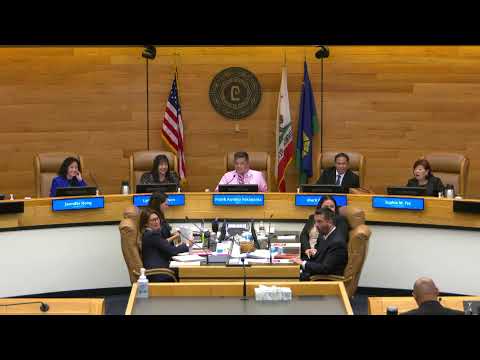
The Cerritos City Council on Oct. 27 received a staff presentation of the 2025 Water and Sewer Rate Study and voted 5–0 to adopt the study, set a Proposition 218 public hearing for Jan. 26, 2026, and direct staff to implement a low‑income assistance program with a fixed bi‑monthly discount of $40.
Alvin Papa, the city’s director of public works, told the council the study models a five‑year schedule of rate adjustments designed to eliminate reliance on General Fund transfers and fund approximately $3.9 million in critical sewer capital improvements and a major treatment project for Well C‑4 on the water side. “To maintain service levels, we have relied heavily on General Fund support,” Papa said, noting that a $24.3 million General Fund loan had been written off in October 2023 and the General Fund has continued to subsidize operations.
Staff presented two scenarios previously chosen by council direction: a gradual five‑year adjustment for water (scenario 2b) and a sewer schedule that includes a larger first‑year increase followed by smaller adjustments in subsequent years (scenario 1). The report showed that, under the status‑quo, the Water Fund could need about $68.9 million and the Sewer Fund $12.1 million in General Fund support over five years; under the proposed schedule those totals drop to about $9.5 million (water) and $3.6 million (sewer), with enterprise self‑sufficiency projected by July 2029.
Council members pressed staff on assumptions and household impacts. Peter Kemp, who assisted with the financial analysis, explained that the model assumes cash funding of capital projects and no new debt issuance and that fixed meter charges were recalibrated to meter capacity standards recommended by the American Water Works Association. “If we fail to deliver these projects in the next few years, we’re going to be spending more money to pay for water that is not coming from our ground underneath,” Papa said, referring to the higher cost of imported water.
On affordability, staff proposed using the income thresholds that Southern California Edison applies to its CARE program as eligibility proxies and offering a flat bi‑monthly discount rather than a percentage rebate. Staff estimated roughly 2,300 eligible households for budgeting; council members urged caution, noting that actual participation could be higher and that outreach and administrative costs would be additional and draw from the General Fund. “This would be a General Fund expenditure, not a water‑fund expenditure,” Kemp said.
Councilmember Mark Polito moved to implement a low‑income assistance program with a fixed bimonthly discount of $40, to waive full reading and adopt a resolution approving the 2025 Water and Sewer Rate Study, and to set the Proposition 218 public hearing for Jan. 26, 2026. Mayor Pro Tem Linda Johnson seconded. The motion passed on a roll‑call vote of 5 to 0.
Staff said next steps include finalizing the proposed rate schedule, preparing Prop. 218 notices to affected property owners, public outreach and education meetings scheduled for Nov. 17, Dec. 8 and Jan. 15, and returning with a refined program framework for the low‑income assistance option. If adopted after the Prop. 218 hearing, staff told the council, new rates would take effect in February 2026 with annual adjustments through 2030.
The council and staff repeatedly framed the recommended approach as consistent with industry best practice: enterprise utilities should cover operating and capital costs to avoid ongoing diversion of General Fund reserves from other city priorities. Council members who supported the action stressed both fiscal sustainability and the need to mitigate impacts on vulnerable residents.
The council’s action at the Oct. 27 meeting was to adopt the study and set the Prop. 218 hearing and to provide the specific direction described above; final rate adoption requires completion of the Prop. 218 process and an additional council decision.