
Planning Commission recommends Beavercreek Road concept plan with green-standards review and parks coordination
Get AI-powered insights, summaries, and transcripts
Subscribe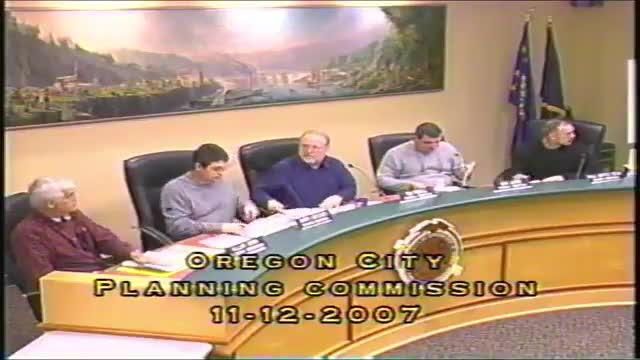
Summary
The Oregon City Planning Commission on Nov. 12 unanimously recommended that the City Commission adopt the Beavercreek Road concept plan, asked staff to form a Green Standards Task Force and to coordinate with Parks on an appropriate parks-acreage-per-1,000-population metric, and set City Commission hearing dates in January and February 2008.
The Oregon City Planning Commission on Nov. 12 voted unanimously to recommend that the City Commission adopt the Beavercreek Road concept plan, the supporting narrative and appendices, and related updates to Oregon City’s comprehensive plan and ancillary master plans. The motion includes creation of a Green Standards Task Force to develop green-building recommendations for residential, commercial and industrial uses and asks staff to explore an ecoenterprise zone. Commissioners also directed staff to work with Scott Archer in Parks & Community Services to clarify the appropriate parks-acreage-per-1,000-population metric to apply in the concept plan before City Commission hearings.
Staff (Tony Conkel) said the hearing was continued from Oct. 22 to allow staff to respond to four issues raised by the Herberger family and others. Staff and consultant Joe Dils recommended several changes in a November 6 memo. Key staff recommendations included: reserving approximately half of the 1,400-foot ridgeline for unobscured public access and views with flexibility to locate the other half inland to accommodate development constraints; aligning open-space and riparian protections with Goal 5 resource mapping and allowing limited non-residential, eco-friendly development below the 490-foot elevation on a maximum of 50% of non-resource lands; tying the Central Park requirement to an acres-per-population target (staff cited working with Parks on a target drawn from the parks master plan rather than a fixed 'no less than 18 acres'); and establishing a Beavercreek zoning framework with subdistricts to allow limited density transfers across tax lots while preserving neighborhood- and transit-supportive densities.
Staff presented estimates showing the plan’s North Employment Campus would yield roughly 127 net acres of employment land, exceeding Metro’s cited minimum of 120 net acres for Title IV employment needs; staff also estimated approximately 33 jobs per net developable acre and about 10.3 dwelling units per net developable acre for the plan area. Staff noted the plan anticipates significant infrastructure and transportation upgrades; improvements will be incorporated into updated system development charges (SDCs) and the city’s transportation master plan and will rely on developer-built local infrastructure and regional improvements funded through SDC updates and other mechanisms.
Public comment reflected a range of concerns and suggestions. Chris Cocker, representing the Herberger family (owner of the Oregon City Golf Course), generally supported staff changes but urged the city to adopt a parks target closer to 14.5 acres per 1,000 (a median derived from the parks study) rather than 16. He suggested eco-friendly ridge uses such as a small eco hotel, cafes, bike rentals and other visitor-oriented services and noted a deep irrigation well on the golf course that could have sustainable uses. Wayne Hall and Ken Allen voiced concerns about annexation irregularities and split ownership, questioned whether small retail in a 10-acre main street would be viable (they proposed 20 acres or allowing retail in adjacent mixed-employment areas), and urged clearer mechanisms for parcel-level implementation. Elizabeth Graser Lindsey (Hamlet of Beaver Creek) asked for clearer protections for industrial land, groundwater and soil safeguards, stronger LEED-like requirements, school planning for the anticipated residents, and better documentation of advisory-committee inputs.
In response, staff and consultant Joe Dils said the plan intentionally balances regional and local needs: the proposal meets Metro’s employment acreage threshold, allows vertical and ground-floor mixed uses in adjacent districts (with draft code limits on retail size), and provides flexibility for master planning through subdistricts while requiring a minimum master-plan parcel of 40 contiguous acres per master-plan application. Dils explained that the committee considered but did not support a requirement that industrial lands be developed before residential and commercial uses, because split ownership and sequencing could unjustly constrain individual property owners. He said committee draft code includes protections limiting reshaping of subdistrict acreage to about +/-10% and that ground-floor retail integrated with vertical mixed use is allowed in several districts.
The commission’s motion recommends that the City Commission adopt the concept plan and ancillary comprehensive-plan and master-plan updates; it directs creation of a Green Standards Task Force to make recommendations on green building standards and to study the feasibility of an ecoenterprise zone; and it directs staff to coordinate with Parks & Community Services (Scott Archer) on the parks-acreage metric. The commission set a public hearing date of Jan. 16, 2008, before the City Commission on the concept plan and ancillary documents and set Feb. 11, 2008, for review of proposed zoning and code amendments to implement the plan. The motion passed by roll-call vote (Commissioners Stein, Groener, Dunne, Lejuez and Chairperson Paul voted aye).