Get Full Government Meeting Transcripts, Videos, & Alerts Forever!
Get email alerts on the Park Lighting topic
No spam. Unsubscribe anytime.
Oxnard holds workshop on park lighting and hours; residents ask for restrooms, neighbors raise noise and maintenance concerns
Summary
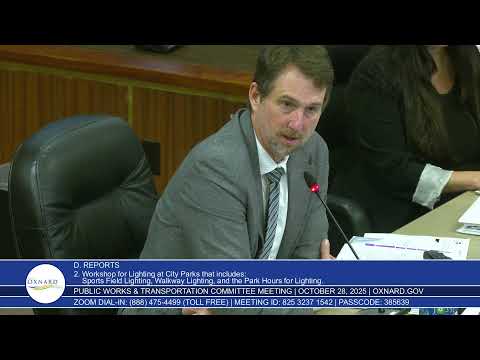
The Oxnard City Public Works and Transportation Committee held a public workshop Oct. 28, 2025, to consider sports‑field and walkway lighting and potential changes to park hours; no formal policy change was adopted and staff was directed to pursue neighborhood outreach and return with a pilot proposal.
The Oxnard City Public Works and Transportation Committee held a public workshop on Oct. 28, 2025, to review lighting at city parks, possible pilot projects for sports‑field and walkway lighting, and potential changes to park hours. The committee did not make a formal decision; staff was directed to pursue neighborhood‑council outreach, discuss joint‑use with school districts and return with a proposal and funding options.
Residents, coaches and neighborhood representatives made more than two dozen oral comments and several written submissions. Key themes: parents and coaches asked for extended hours and permanent lighting to accommodate practices after work; neighbors asked for case‑by‑case decisions and protections for adjacent homes; and multiple speakers urged that restroom and maintenance needs be addressed before or alongside lighting. Michelle Kimble urged the city to “provide restroom facilities for the Southwest Community Park” and said restrooms are necessary for the “comfort, safety, and health of all visitors.”
Staff identified a short list of candidate parks for pilot work that includes Southwest Community Park, Pleasant Valley, Southwinds, Beck and Connolly parks. Staff said permanent sports‑field lighting installations can cost roughly $1 million or more depending on standards and noted that a pilot could use hard‑wired rental lights (not generator‑powered) to produce a more realistic test. Some locations near the airport may require Federal Aviation Administration (FAA) approval.
Park operations staff warned that many neighborhood parks were not designed for heavy sports use: they lack drainage, need rest cycles (staff said some premium fields are rested three times a year for six to eight weeks) and would require additional maintenance if they saw heavier evening programming. The city’s experience with artificial turf shows high installation and replacement costs (staff cited roughly $700,000 to replace an existing artificial turf field versus under $300,000 to replace with grass) and emerging concerns about PFAS chemistry in synthetic surfaces.
Public safety was raised repeatedly. A police commander noted the city ordinance currently prohibits park access after dark (enforcement is complaint‑driven); police and staff identified cameras and other security measures as tradeoffs when adding lighting. Roger Poirier, a former Parks & Recreation commissioner, cited Southwinds Park’s lighting project and said police told him crime dropped about 11% after the park was rehabilitated.
Parks & Recreation Commission Chair Angela Wycombe summarized her panel’s recommendation for community parks: lighting could be allowed up to 10 p.m., and the commission urged attention to lower‑level walkway lighting for safety as well as sports lighting. Committee members asked staff to approach neighborhood councils for sites with existing neighborhood organization capacity (for example, Orchard Park, Pleasant Valley, Rio Lindo, Johnson Creek, Lemonwood and Beck were suggested) and to continue discussions with school districts about joint‑use options for lit fields and gymnasiums.
Next steps: staff will return with results of neighborhood outreach, refined pilot design (including hard‑wired rental options, estimated costs, permitting/FAA considerations and security/camera recommendations) and proposed funding sources (CIP/Quimby funds or other). No ordinance or park‑hours change was adopted at the workshop.
Background: speakers noted that sunset times through winter (about 5 p.m. for several months) are driving demand for later practice times. Several speakers asked that staff prioritize basic maintenance (playgrounds, courts, potholes) and permanent restrooms at parks such as Southwest Community Park before or concurrent with any lighting installation.