Get Full Government Meeting Transcripts, Videos, & Alerts Forever!
Get email alerts on the Municipal Audit topic
No spam. Unsubscribe anytime.
Louisburg auditors issue clean opinion, cite $5.93M water/sewer correction and 12 findings
Summary
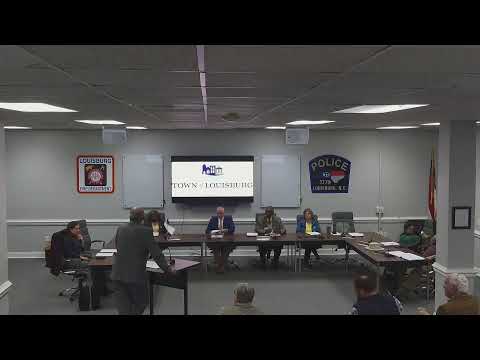
James, the presenting auditor, told the Louisburg Town Council at a special meeting that the firm—s audit of the town—s fiscal year 2022-23 financial statements resulted in a clean (unmodified) opinion and that the firm "found no fraud, no illegal acts, no abuse," while also detailing multiple material corrections and control weaknesses.
James, the presenting auditor, told the Louisburg Town Council at a special meeting that the firm—s audit of the town—s fiscal year 2022-23 financial statements resulted in a clean (unmodified) opinion and that the firm "found no fraud, no illegal acts, no abuse," while also detailing multiple material corrections and control weaknesses.
The auditor said the most significant adjustment was a $5,929,000 prior-period correction to the water and sewer fund, driven by two items: removal of an out-of-service sewer plan with an approximate book value of $2.3 million and a $3.5 million duplication error in fixed-asset listings. As a result of audit adjustments and restatements, the auditor reported the town—s total net position at roughly $8.93 million, with about $8.33 million tied up in fixed assets. On a full-accrual basis the town—s net position increased by about $798,000 for the year, split roughly $307,000 for governmental activities and $491,000 for business-type activities.
The presentation identified a package of 12 formal findings. The auditor said recurring turnover in the finance office and limited staffing contributed to segregation-of-duties issues and reporting errors. Other findings included: incomplete or inaccurate capital-asset records and a required full physical inventory; timing and reconciliation problems for receivables and grant reimbursements; payroll-control weaknesses (including pay-cycle complexity and a need for supervisor approval of timesheets); insufficient general-ledger documentation and review of journal entries; incomplete recording of unbilled utility receivables; and a reporting discrepancy on federal ARPA spending that the auditor said can still be corrected on the federal report.
The auditor praised several positive items, including the town—s property-tax collection performance (reported at 99.8 percent for 2023) and said the town had obtained a clean opinion on both the financial statement audit and the single-audit/ARPA work. He recommended that the town consider hiring at least one position to focus on grants and reimbursements, adopt stronger internal controls and cross-training to address segregation-of-duties problems, maintain a current fixed-asset register, adopt a work-order system tied to inventory usage for the electric system, and review payroll cycle timing to simplify overtime calculations.
On specific grant and reserve matters, the auditor noted the existence of USDA-required reserves (reported in the audit at roughly $160,000—$180,000 across funds), a state capital infrastructure grant of about $700,000 with $504,000 in reported expenditures during the grant period, and a cluster of sidewalk-related grants the auditor estimated at about $916,000 across several agreements he reviewed; he recommended active grant administration to ensure timely reimbursements and to avoid deferred revenue recognition where reimbursements lag.
The auditor described next steps: the audit reports and communication items would be submitted to the North Carolina Local Government Commission for its review, corrective action plans and recommendations appear in the report, and the town retains the ability to amend federal ARPA reporting to align expenditures with the original budget categories. Council members did not move to take formal action on the audit report itself during the meeting.
Votes at a glance: Adoption of meeting agenda: motion moved and seconded; vote: unanimous (Aye); outcome: approved. Motion to adjourn: motion moved and seconded; vote: unanimous (Aye); outcome: approved.
Context and immediate implications: The audit—s clean opinion means the auditors are able to attest that the financial statements are materially correct for fiscal year 2022-23 after the adjustments. The council now has a formal list of findings and the town has provided corrective action plans for each finding; several recommendations (grant administration, fixed-asset maintenance, strengthened payroll controls) would require either new hires or reallocation of staff time. The Local Government Commission—s review is a standard next administrative step for an issued audit.