Get Full Government Meeting Transcripts, Videos, & Alerts Forever!
Get email alerts on the Healthcare topic
No spam. Unsubscribe anytime.
Ohio sponsors seek employer tax credit for paid leave after living organ donation
Summary
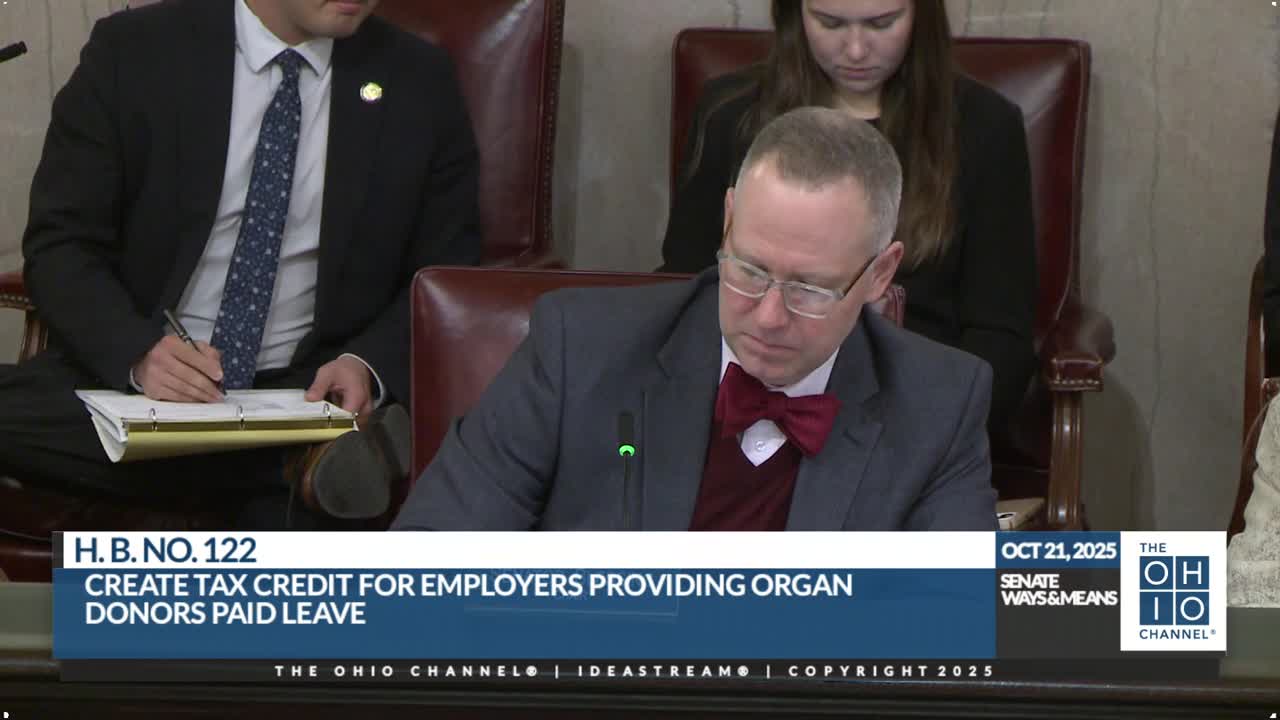
Representative Hall provided sponsor testimony in support of House Bill 122, saying the measure would create an Ohio employer income‑tax credit to encourage paid leave for employees who make living organ donations.
Representative Hall provided sponsor testimony in support of House Bill 122, saying the measure would create an Ohio employer income‑tax credit to encourage paid leave for employees who make living organ donations.
The bill, as described by Representative Hall, would allow qualifying employers to claim a credit equal to the amount of paid‑leave benefits provided or $300 per day, whichever is less, for up to 30 days per donation (a maximum of $9,000 per employee per donation). The credit an individual employer may claim in a taxable year would be capped at $54,000. HB122 would cover living donations consistent with the National Organ Transplant Act, including whole or partial liver, pancreas, kidney, intestine, lung or bone marrow donations; it would also require the Ohio tax commissioner to issue an annual report on use of the paid‑donor relief credit to the chairs of the Ohio Senate and House taxation committees.
Representative Hall told the committee that, citing national transplant‑system data, more than 100,000 individuals are on waiting lists nationwide and nearly 3,000 Ohioans are awaiting life‑saving organ transplants, with about 1,900 of those waiting specifically for kidney transplants. He and his joint sponsor, Representative Lampton, described living donation as a way to increase the pool of transplantable kidneys and to improve health and workforce outcomes for recipients.
Representative Lampton cited analysis by the Legislative Service Commission (LSC) that used demographic and employment assumptions to estimate the number of qualifying employees. LSC’s maximum estimate for 2022 was about 81 qualifying employees; under a scenario in which each received the maximum credit, the revenue reduction to the state was estimated at roughly $700,000. Lampton and Hall noted that the LSC estimate assumes the maximum credit and that actual revenue impact could be lower if donors returned to work sooner or received less than $300 per day in pay while on leave.
Committee members asked no substantive questions during the sponsor testimony and no committee action was taken on HB122 at the first hearing.
Ending: The committee concluded the first hearing on House Bill 122 with no vote; sponsors said they would be available for follow‑up questions and the bill record includes the LSC estimate and the tax‑commissioner reporting requirement.