Get Full Government Meeting Transcripts, Videos, & Alerts Forever!
Get email alerts on the Education topic
No spam. Unsubscribe anytime.
Senate committee hears bill to let Ohio students use U.S. naturalization civics test as alternate exam
Summary
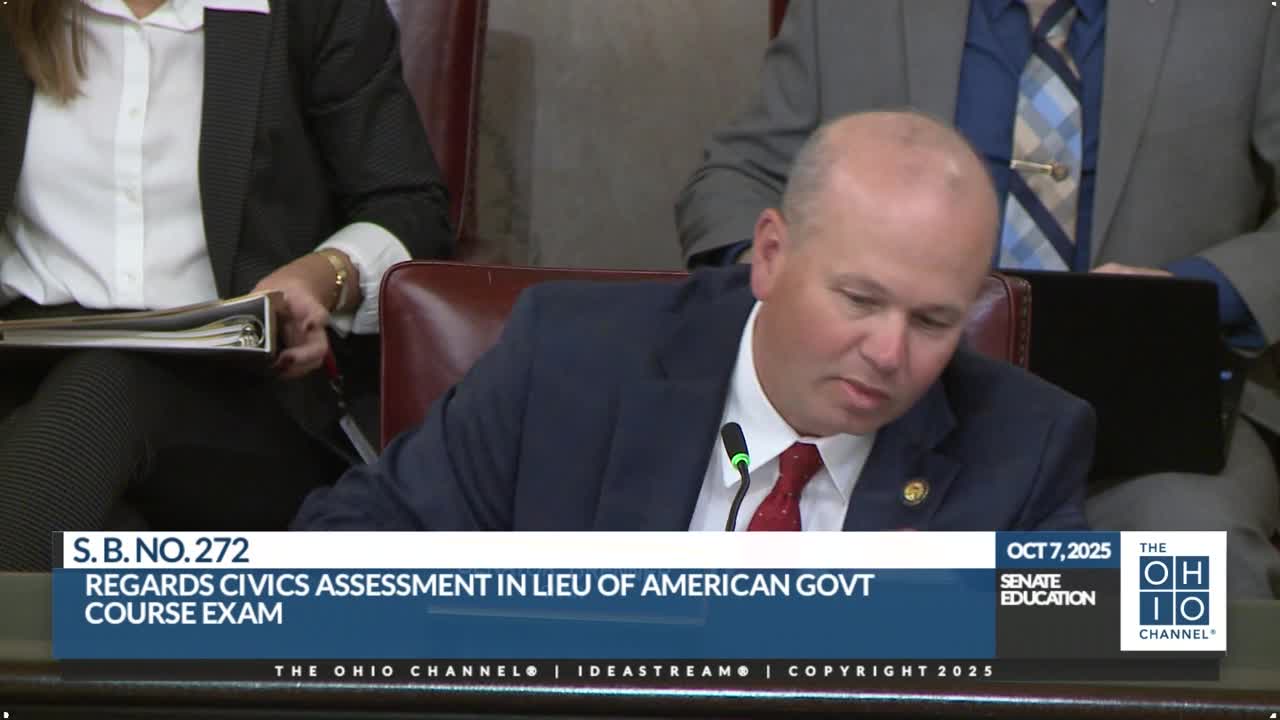
Senator Kahler presented Senate Bill 272 to the Senate Education Committee as a voluntary alternative assessment that would allow eleventh‑grade students to take the civics portion of the U.S. naturalization test instead of the existing American government end‑of‑course exam beginning in the 2026–27 school year.
Senator Kahler presented Senate Bill 272 to the Senate Education Committee as a voluntary alternative assessment that would allow eleventh‑grade students to take the civics portion of the U.S. naturalization test instead of the existing American government end‑of‑course exam beginning in the 2026–27 school year. "It's imperative that students are expected to know the same basic content about our country as the hundreds of thousands of immigrants who become US citizens each year," Senator Kahler said.
The bill would require students to answer at least 60% of the questions correctly to demonstrate successful completion. School district boards of education would determine the method and manner of administration, and students who do not obtain a passing score could retake the assessment until they pass. Senator Kahler said the measure is not intended to change high‑school government curriculum but to provide an alternate testing option.
Sponsor testimony cited a 2024 U.S. Chamber of Commerce Foundation study that the sponsor described as showing broad deficits in civic literacy among Americans. The sponsor argued the civics assessment is "basic knowledge" that all students should master and said offering the alternative could incentivize students to review civics content more thoroughly than they might for the longer American government exam.
Committee members sought clarifications. Ranking Member Ingram asked whether the bill would change what is taught in American government classes; Senator Kahler replied, "this does not change the curriculum for American government in high schools. I'm not suggesting that we teach anything different." Senator Smith asked how the civics portion relates to other components of the naturalization process; the sponsor described the civics questions as covering American government, history, rights and responsibilities, symbols and holidays, and said the naturalization process may ask questions until an applicant reaches a specified number of correct responses.
Vice Chair Blessing and other members discussed implementation logistics, including whether the assessment could be taken at flexible times and whether it would reduce testing burdens on districts. Senator Kahler said the bill is a voluntary option and that additional implementation ideas could be considered.
The committee received the testimony and questions at a first hearing; no final committee action on SB 272 was recorded in the transcript.
Ending: The committee closed the first hearing on Senate Bill 272 and proceeded to the next agenda item.