
Indian River parents, teachers and board push for changes to 'Schools of Hope' co‑location rules
Get AI-powered insights, summaries, and transcripts
Subscribe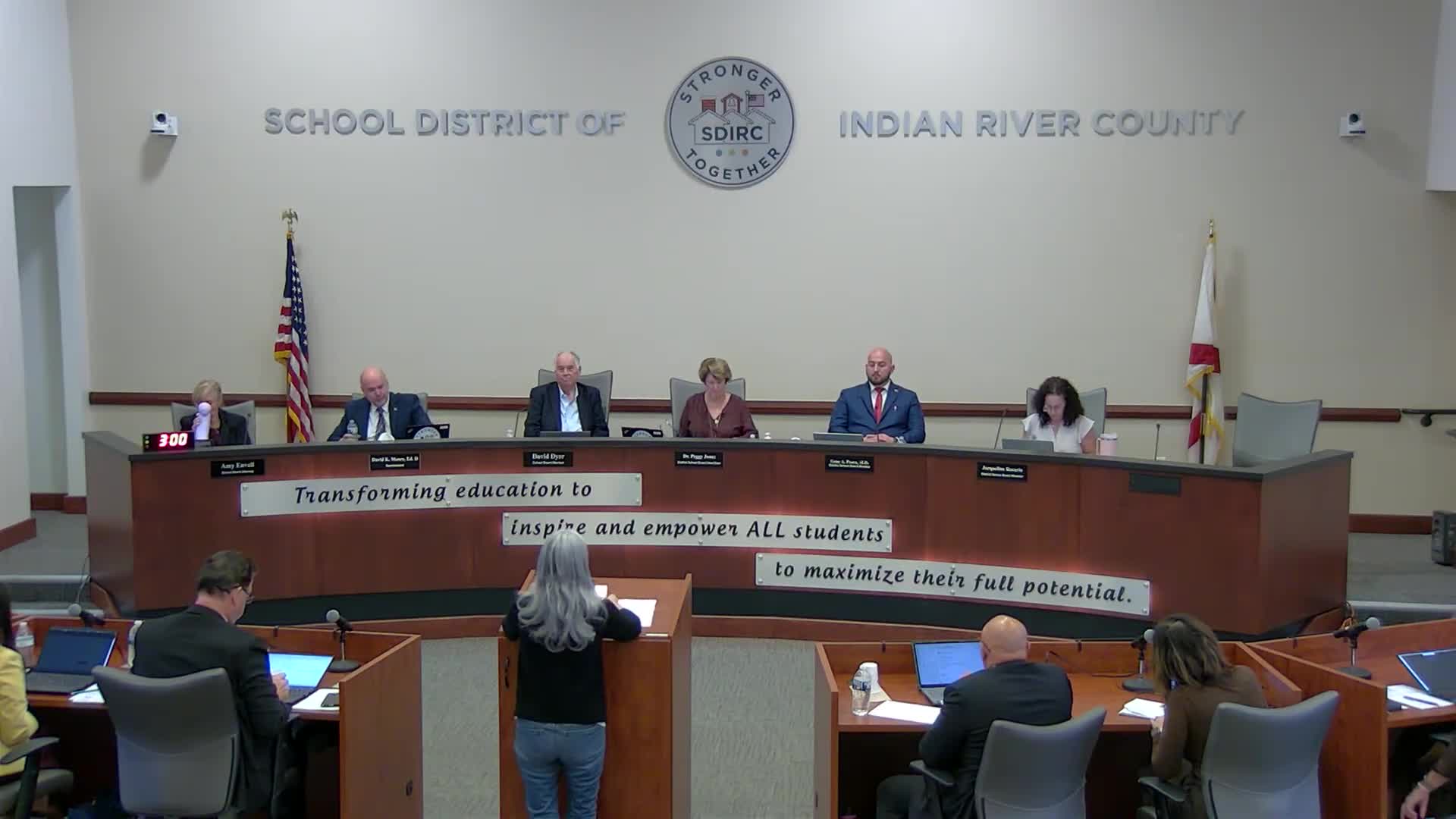
Summary
Public commenters urged the school board to press state lawmakers to undo recent statutory changes that allow private 'Schools of Hope' to co‑locate in district facilities with limited district control or charge, and the board pledged coordinated advocacy and legal/administrative follow‑up.
Public speakers at the Indian River County School Board meeting on Oct. 30 urged the board and local legislators to roll back recent changes to Florida law that allow private "Schools of Hope" to seek co‑location inside public school buildings. The board discussed the statutory timeline and said it would coordinate advocacy to seek fixes at the state level.
May Asencio, a parent, told the board the recent changes "allow schools of hope to be able to request co location within a school that has decreased enrollment or are failing," and warned the law could permit operators to use district facilities at no charge while the district continues to provide services such as cafeteria, nursing and transportation. "They will be getting charter funds, school of hope funds, and our tax dollars while having minimal operational expenses," Asencio said.
Dr. Margie Flanagan, chair of Education Champions, said the expansion was added late in the legislative process and described limited grounds and a short response window for districts that receive a building notice. "Districts have a mere 20 days to object and very limited grounds to do so," she said, noting the rule and statutory changes were finalized in recent weeks.
Members of the volunteer group Education Champions and other community speakers emphasized fiscal impacts, describing the voucher program and the potential for private operators to receive additional state funding while using public facilities. Margaret Murray, vice chair of Education Champions, told the board the statewide voucher program is projected to reach roughly $5 billion in 2024–26 budget planning and said the combined effect is a drain on public schools.
Several commenters called for a narrow set of legislative changes: require private operators to pay for facility use, narrow co‑location authority, and remove or limit the application of "opportunity zone" criteria that expand operator access. Zachary Wiggers, treasurer of the Indian River County Education Association and a teacher, quoted section 1002.333 of state law and warned that some Schools of Hope language would exempt operators from chapters 1000–1013 and school board policy.
Board members and the superintendent said the district has already received a building notice that staff deemed premature. Superintendent Michael Moore explained Department of Education rule 6A‑1.0998271 sets the administrative timeline and said the earliest meaningful date for building notices under the revised rule is Nov. 11. He said staff had informed the charter operator that its notice was untimely and that the board would prepare a coordinated, factual packet for legislators and the Department of Education.
Board members stressed two clarifications in their public messaging: that the statewide voucher program and the Schools of Hope statute are separate mechanisms, and that not all charter schools will receive multiple funding streams; Schools of Hope charters (as defined in statute) are the entities that carry the specific additional stream cited by commenters. Ms. Rosario and other board members asked staff to provide an itemized list of rule and statute provisions and suggested model language for legislators that would address "no‑cost" co‑location and narrow the opportunity‑zone trigger.
Several public comments raised other concerns that the board said it would follow up on, including a request to review the role of school resource officers deputized under 287(g) (raised by Dana King) and a complaint about NEA materials (raised by Dr. Mark Gerber) that the board said it would investigate further.
Why it matters: Speakers and board members framed the issue as both a procedural and fiscal threat to locally managed public schools. The district is not designated as a low‑performing system, and local leaders argued the law's co‑location and cost provisions could allow outside operators to occupy public space without bearing facility costs, shifting expenses to districts.
What happens next: Superintendent Moore said staff will prepare clear, itemized talking points about what in the rule and statute the board wants changed, will coordinate with statewide associations (FSBA) and legal counsel on messaging, and will watch for additional building notices expected after Nov. 11. Community members urged residents to contact state legislators before the 2026 legislative session.