Get Full Government Meeting Transcripts, Videos, & Alerts Forever!
Get email alerts on the Materials Standards topic
No spam. Unsubscribe anytime.
Preservation Board Allows Vinyl Fence Replacement at 5122 Waterman With Street-Facing Condition
Summary
After testimony from the homeowner and discussion of visibility and materials, the board overturned a director—s denial for a repair/replacement fence at 5122 Waterman Blvd., but required that the portion visible from the street be walnut or wood and that final plans be approved by the Cultural Resources Office.
The St. Louis Preservation Board on Oct. 27 overturned the director—s denial of a permit for fence replacement at 5122 Waterman Boulevard in the Central West End but imposed conditions on the street-visible portion. The board's approval requires final Cultural Resources Office review of plans, details and colors and specifies that the street-visible faces must be walnut or wood.
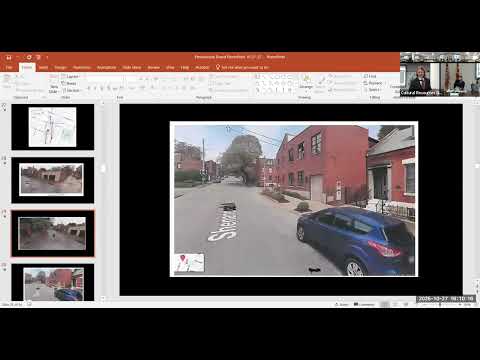
Andrea Gagan of the Cultural Resources Office presented the appeal and told the board that vinyl is not a permitted material for street-visible fences in the Central West End historic district. Staff recommended upholding the director—s denial. The applicant, identified as Parker Veil, said his existing wooden fence was repeatedly damaged in wind events (including most recently), that insurance covered only replacement with wood, and that he seeks a low-maintenance, reinforced vinyl product. He provided a signed neighbor statement and said the visible section sits about 100 feet from the street.
Commissioners discussed precedent, visibility, setbacks and neighborhood input. Several commissioners said they were reluctant to broadly relax materials standards but were persuaded in this instance by the combination of setback and the applicant's offer to limit the street-visible panel to a darker, less conspicuous finish. The board first considered a motion to overturn the director's denial on the basis of setback and limited visibility; after further discussion, the applicant agreed to a condition that the street-facing section be walnut or wood. The board then approved the amended motion.
Roll-call voting recorded votes in favor from Kevin Hamaker, David Richardson, Stanley Fowler, Anthony Robinson, Mike Killeen and others; Ruth Kenoy recorded a dissenting vote. The board's approval is recorded as an overturning of the director's denial with the stated conditions. Staff will require final, stamped drawings and color samples from the applicant before issuing the permit.
The board noted the potential policy implication of allowing vinyl in any visible context and emphasized that this approval was tied to the specific setback, the limited visible length of fence, and the requirement that the visible panel be walnut or represented by wood.