Get Full Government Meeting Transcripts, Videos, & Alerts Forever!
Get email alerts on the Ai Personhood topic
No spam. Unsubscribe anytime.
Ohio sponsors bill to bar AI personhood, place legal liability on humans and organizations
Summary
Representative Claggett presented sponsor testimony on House Bill 469 arguing AI systems should be legally defined as non‑sentient and not eligible for personhood; the bill would assign legal responsibility for harms to owners, developers or operators and seeks to prevent corporations or actors from using AI to evade accountability.
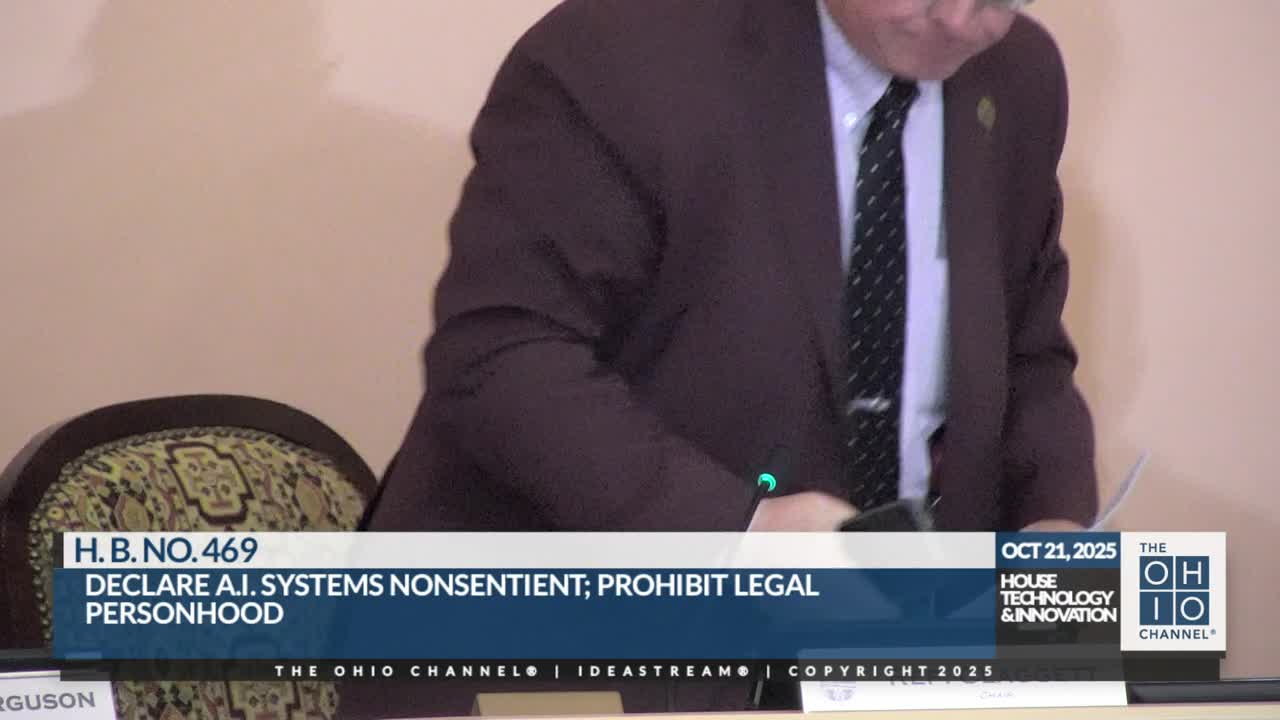
Representative Claggett offered sponsor testimony for House Bill 469 on Oct. 14, telling the Technology Innovation Committee that the bill would establish a clear legal framework declaring artificial intelligence systems non‑sentient and therefore ineligible for legal personhood under Ohio law.
“AI may simulate human reason to a degree, but it cannot and must not be permitted to supplant it,” Claggett said, arguing the bill affirms that liability for injury or damage caused by an AI system falls on the human owner, developer or operator rather than on an algorithm itself. He framed the legislation as consistent with common‑law principles that treat non‑person instruments as the responsibility of the human actors behind them.
Claggett said the bill is intended to prevent “legal loopholes” that could allow corporations or other actors to deflect responsibility by attributing actions to an AI agent. He also said the bill would guard against speculative future claims of AI rights or personhood and would help provide clarity for courts and judges as new cases arise.
Members questioned scenarios such as corporate personhood, marriage or other legal relationships involving an AI, and Claggett cited foreign examples — including an Albanian government deployment where an AI agent participates in contract processes — to illustrate rapid developments elsewhere. He stressed the bill’s purpose is to keep humans accountable, citing the need for courts and precedent to sort finer liability questions as disputes arise.
Committee members and the sponsor discussed practical legal questions, such as attribution of fault among multiple users and manufacturer responsibilities; Claggett used the phrase “keep a leash on your beast” to describe a proposed obligation on manufacturers to prevent autonomous systems from acting outside intended limits. No committee vote occurred; the hearing was informational.